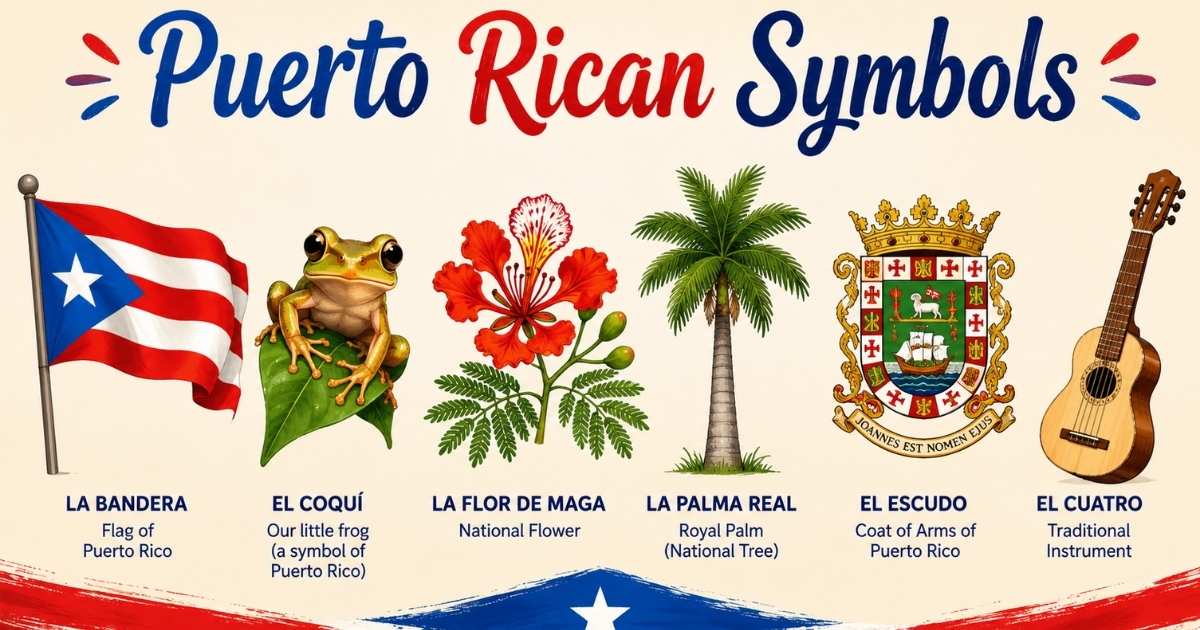

Puerto Rican symbols are powerful cultural markers that carry centuries of history, spirituality, and identity in a single image. Whether you’ve seen a coquí frog tattoo on someone’s arm in New York City or spotted a Puerto Rican flag hanging proudly from a Bronx apartment window, you already know these symbols carry serious emotional weight. They aren’t just decorations. They’re declarations.
Puerto Rico’s symbolic language was built from three civilizations that collided, merged, and created something truly unique. The Taíno indigenous people carved their beliefs into stone. Spanish colonizers layered in crosses and royal crests. African traditions brought rhythm, resilience, and spiritual depth. The result is a rich visual culture that still speaks loudly today, from the streets of San Juan to the neighborhoods of Chicago.
What Are Puerto Rican Symbols?
Puerto Rican symbols are visual, cultural, and spiritual representations that reflect the island’s identity, history, and values. They come from a blend of Taíno indigenous traditions, Spanish colonial influence, and African heritage, each layer adding a new dimension of meaning. These symbols aren’t frozen in history either. They’re living, breathing expressions you’ll find in tattoos, murals, jewelry, festivals, and everyday conversation.
What makes them especially powerful is how they travel. Puerto Ricans make up over 5.8 million people living on the U.S. mainland, according to the Pew Research Center. For many of them, these symbols serve as a cultural anchor, a way to stay connected to Puerto Rican ancestry when the island is thousands of miles away. A coquí frog pendant or a Taíno sun tattoo isn’t nostalgia. It’s identity in action.
Puerto Rican Symbols And Their Cultural Meanings
Cultural meaning is what separates a symbol from a simple image. Every Puerto Rican symbol carries layers of emotion, memory, and history that words often struggle to capture. When you understand what these symbols mean, you stop seeing them as pretty designs and start seeing them as stories.
The meanings behind symbols of Puerto Rico have shifted over centuries, shaped by colonization, resistance, migration, and revival. Some symbols carry joy and pride. Others carry grief and defiance. Most carry both at the same time, which is exactly what makes them so powerful.
Puerto Rican Symbols And Meanings
The core symbols of Puerto Rican culture each carry a distinct message. The coquí frog represents home and belonging. The Taíno sun stands for life and divine energy. The Puerto Rican flag signals freedom and unity. The hibiscus flower reflects natural beauty, and the royal palm tree represents dignity and strength rooted in Caribbean soil.
Read More: 93+ Popular Sanskrit Symbols That Can Transform Your Life in 2026
Puerto Rican Symbols Tattoos
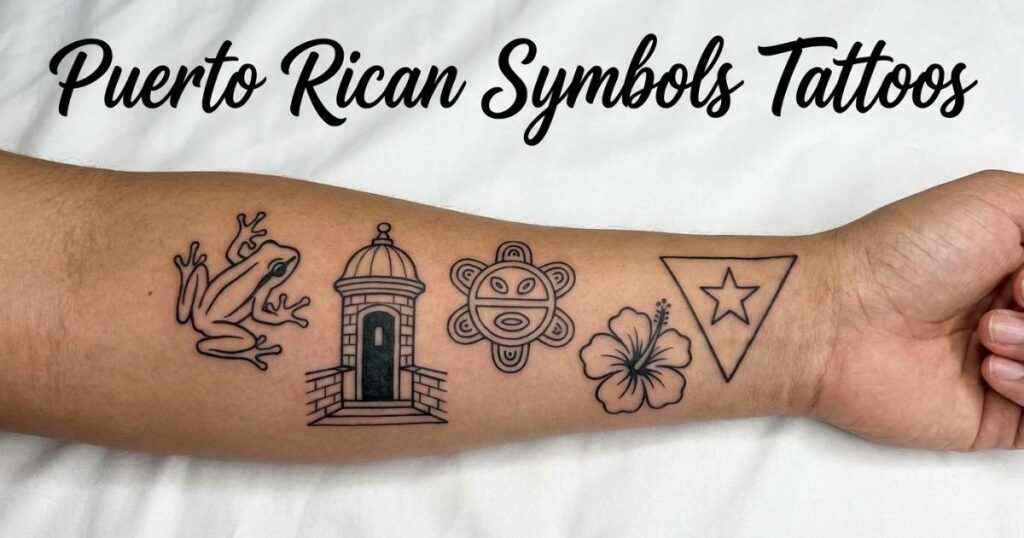
Puerto Rican symbol tattoos are hugely popular across U.S. cities like New York, Orlando, and Chicago, where large Puerto Rican communities live. People choose designs like the coquí, the Taíno sun face, the flag, and the Vejigante mask to express Puerto Rican pride and ancestral connection. A tattoo isn’t just art here. It’s a permanent statement of who you are and where you come from.
Taino Symbols And Meanings
The Taíno people were Puerto Rico’s original indigenous inhabitants, and their symbols were sacred. Key Taíno symbols and meanings include the sun face (divine power), the spiral (life cycles), the turtle (protection and wisdom), the coquí (connection to nature), and the zemí figures (spiritual guardians). These ancient Taíno carvings weren’t decorative. They were deeply spiritual, used in ceremonies, healing rituals, and communication with gods.
Puerto Rican Symbols Copy And Paste
In the digital age, Puerto Rican cultural symbols have found a new home online. These are the most commonly used icons for social media bios, captions, and text messages:
- 🇵🇷 Puerto Rican flag
- 🐸 Coquí frog
- 🌺 Hibiscus flower
- ☀️ Taíno sun
- 🌴 Royal palm tree
For the Puerto Rican diaspora especially, these small digital symbols carry big emotional meaning.
Puerto Rico Taino Symbols
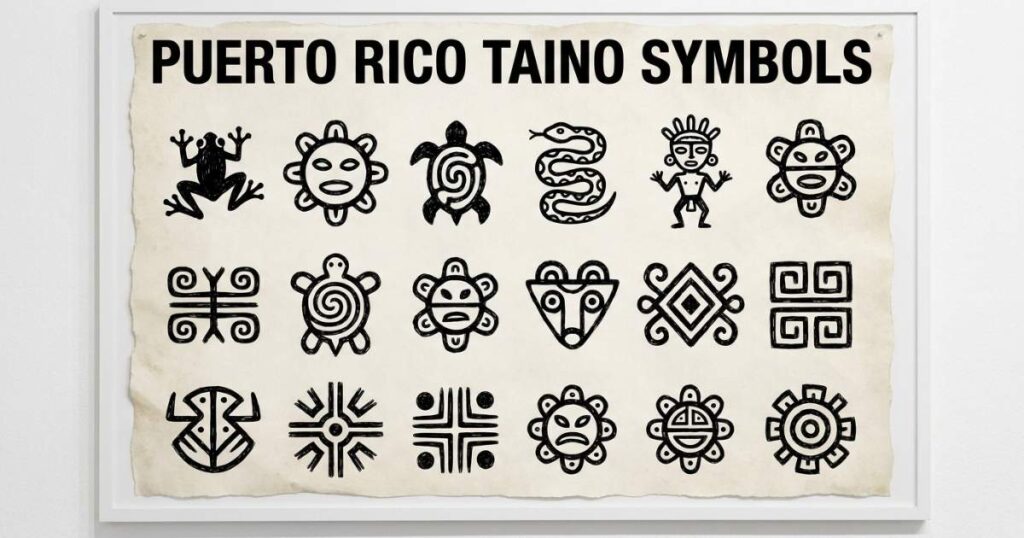
Puerto Rico Taíno symbols were physically carved into rocks, caves, and ceremonial objects centuries before European arrival. One of the best places to see them today is the Caguana Indigenous Ceremonial Center in Utuado, Puerto Rico, where ancient petroglyphs are still visible on standing stones. These indigenous Caribbean symbols represent gods, nature, fertility, and the spiritual world the Taíno people believed in deeply.
Puerto Rico Taino Symbols Tattoos
The Taíno tattoo revival is real and growing. Many Puerto Ricans and Puerto Rican Americans are choosing Taíno-inspired tattoos as a way to reclaim indigenous identity and honor ancestors erased by colonization. Popular designs include the sun face, the bat (a cave deity), the turtle, and spiral patterns. It’s worth understanding the cultural meaning behind each one before choosing a design, out of both respect and personal depth.
Famous Symbols That Represent Puerto Rico
Not every symbol comes from ancient stone carvings. Some of the most famous symbols that represent Puerto Rico are rooted in modern history, political struggle, and national pride. Together, the old and new tell a complete story of who Puerto Ricans are and what they’ve survived.
Read More: 63+ Mysterious Filipino Symbols and Their Hidden Meanings You’ve Never Noticed
Taino Sun Symbol Meaning
The Taíno sun symbol is one of the most recognized images in Puerto Rican art. It features a circular face with radiating beams, representing life, divine energy, and the solar deity connected to Yúcahu, the Taíno god of cassava and the sea. You’ll find this symbol carved at ancient ceremonial sites, painted in murals across Puerto Rico, and tattooed on people from San Juan to the South Bronx.
Puerto Rico Symbol Frog
The coquí frog is Puerto Rico’s most beloved symbol, and for good reason. This tiny tree frog produces a distinctive “ko-KEE” sound that fills the island’s nights. What makes the coquí especially symbolic is a biological fact: it cannot survive outside Puerto Rico. When taken elsewhere, it goes silent and dies. For Puerto Ricans, this perfectly mirrors their own emotional truth. Home is irreplaceable.
Puerto Rican Symbols Toa
Toa refers to regions in Puerto Rico, including Toa Alta and Toa Baja, with deep Taíno historical roots. The name itself comes from the Taíno language. Symbols connected to the Toa region reflect the indigenous symbolism of communities that once thrived there, including nature-based carvings, tribal patterns, and spiritual designs tied to the land and rivers of northern Puerto Rico.
Taino Puerto Rican Symbols
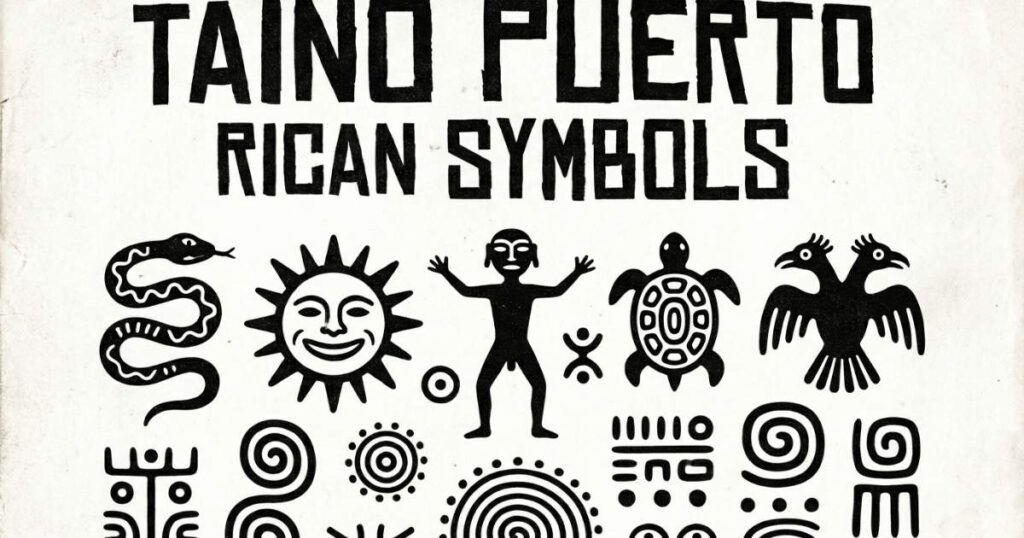
Three Taíno Puerto Rican symbols that often go underexplained are the bat, the turtle, and the sun. The bat represented cave deities and the underworld. The turtle symbolized protection and long life. The sun connected daily life to divine order. These weren’t random images. Each one was intentional, spiritually charged, and deeply meaningful to Taíno communities.
Puerto Rican Tattoos
Puerto Rican tattoos go beyond Taíno art. Many people choose the map of Puerto Rico, the flag, phrases in Spanish tied to Puerto Rican folklore, or Old San Juan’s colorful architecture as tattoo inspiration. For Puerto Ricans living stateside, these tattoos serve as a bridge between two worlds, a permanent piece of the island they carry with them. Cultural pride symbols inked into skin don’t fade with distance.
Puerto Rican Taino Symbols
One of the most spiritually significant concepts in Puerto Rican Taíno symbols is the zemí. Zemís were small carved figures made from stone, wood, or bone, believed to hold spiritual power. They were used in healing ceremonies, agricultural rituals, and communication with ancestors. These objects weren’t just symbols. They were considered living spiritual presences that protected families and communities.
Puerto Rico Symbols
Here’s a quick look at the core Puerto Rico symbols and where you’ll encounter them:
| Symbol | Meaning | Where It Appears |
| Coquí Frog | Home, identity, pride | Tattoos, souvenirs, folklore |
| Puerto Rican Flag | Freedom, unity | Everywhere |
| Taíno Sun | Divine energy, life | Jewelry, murals, tattoos |
| Maga Flower | Natural beauty | Gardens, art, festivals |
| Vejigante Mask | Celebration, duality | Carnivals, paintings |
| Royal Palm | Dignity, strength | Architecture, emblems |
| Coat of Arms | Colonial and national history | Official documents |
Symbols Of Puerto Rico
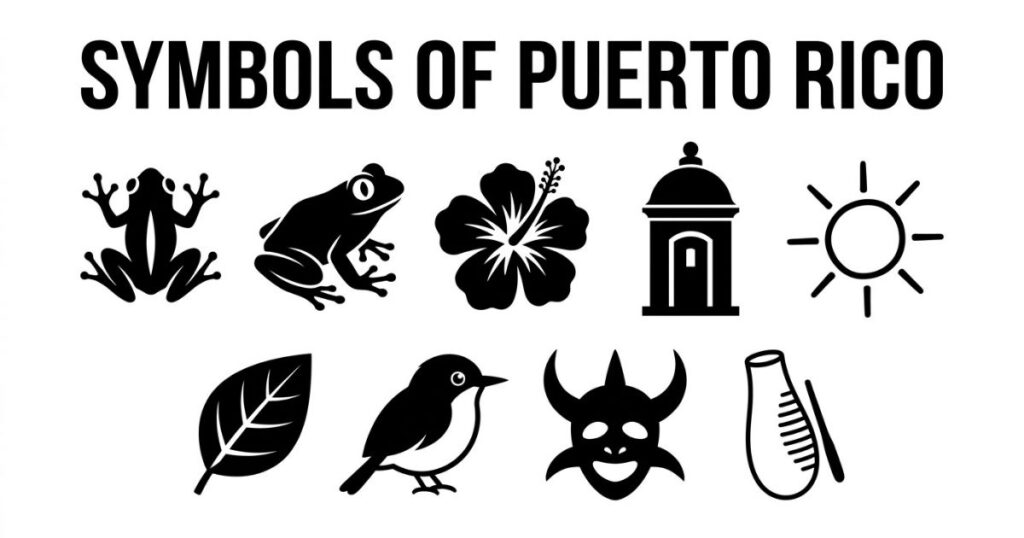
Puerto Rico has both official national symbols and widely recognized folk symbols. The official ones were designated by law and include the Puerto Rican Spindalis as the national bird, the coquí as the national animal, and the maga as the national flower. Folk symbols, like the Vejigante mask or the cuatro guitar, hold equal cultural weight even without official status.
Puerto Rican Protection Symbols
Puerto Rican protection symbols draw from both Taíno and African spiritual traditions. Zemí carvings were placed in homes to guard families. African-influenced Santería practices brought additional protective imagery, including specific colors, patterns, and ritual objects. Today, many Puerto Rican families still keep protective symbols in their homes, not always for religious reasons, but as a cultural connection to Caribbean spirituality and ancestral wisdom.
Traditional Puerto Rico Symbols And National Identity
Symbols and national identity are inseparable in Puerto Rico. For a place with a complex political status, these symbols fill a gap that official designations sometimes can’t. They give people something to belong to, something that’s entirely and unmistakably theirs.
This is especially true in the United States, where Puerto Rican heritage symbols help second and third-generation Puerto Ricans maintain a connection to roots they may never have lived firsthand. Symbols become the language of identity when geography separates you from home.
Things That Represent Puerto Rico
Puerto Rico’s identity goes beyond official symbols. Things that represent Puerto Rico include the sound of salsa music drifting from an open window, the smell of café con leche on a Sunday morning, the sight of brightly painted buildings in Old San Juan, and the taste of tostones at a family gathering. Bomba dance, plena rhythms, and the handmade Vejigante masks of Ponce’s carnival all carry island heritage that no government document can fully define.
Puerto Rico Symbols And Meanings
| Symbol | Cultural Meaning |
| Coquí Frog | Belonging, home, Puerto Rican soul |
| Taíno Sun | Life force, divine connection |
| Puerto Rican Flag | Freedom, sacrifice, unity |
| Maga Flower | Natural pride, femininity |
| Ceiba Tree | Sacred life, Taíno cosmology |
| Coat of Arms | Layered colonial and national history |
| Cuatro Guitar | Musical soul of the island |
Puerto Rico National Symbols
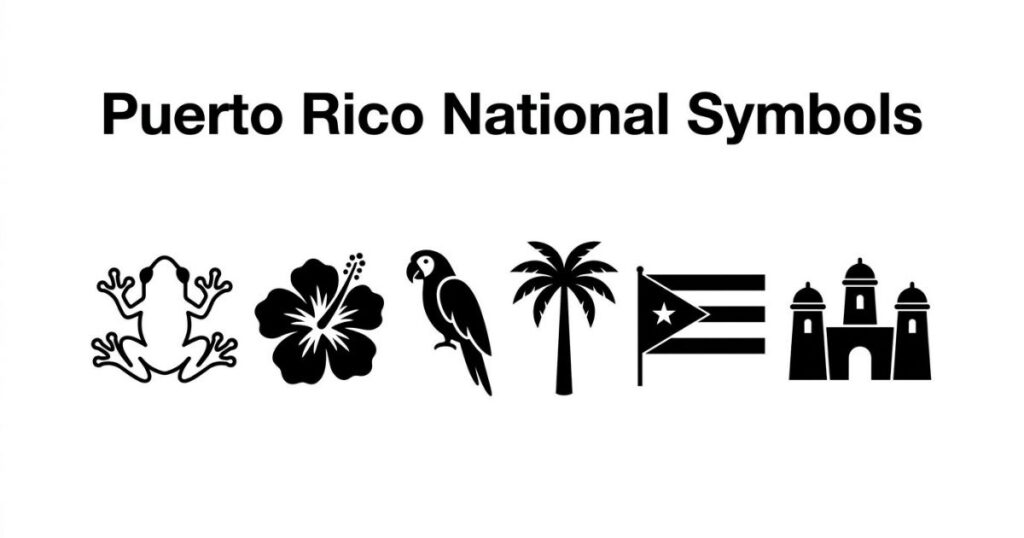
Puerto Rico’s official national symbols were chosen to reflect the island’s natural environment and cultural character:
- National Bird: Puerto Rican Spindalis (also called the “reinita mora”)
- National Animal: Coquí frog
- National Flower: Maga (a deep red tropical bloom)
- National Tree: Ceiba (sacred in Taíno belief)
- National Instrument: Cuatro (a 10-string guitar unique to Puerto Rico)
Each of these was chosen because it couldn’t belong to anywhere else. They are distinctly, irreplaceably Puerto Rican.
Puerto Rico Symbol
The Puerto Rican flag is the single most recognized Puerto Rico symbol worldwide. Designed in 1895 by the Puerto Rican Revolutionary Committee in New York, it features three red stripes, two white stripes, a blue triangle, and a lone white star. Red represents the blood of brave warriors. White stands for peace and victory. Blue reflects the island’s sky and coastal waters. The star represents Puerto Rico itself. In 1952, the shade of blue shifted from light to dark, a change that still carries political meaning for many today.
Deep Symbolic Meaning
Puerto Rican symbols operate on multiple levels simultaneously. On a spiritual level, many connect to Taíno gods and ancestral protection. On a psychological level, they give people a sense of rootedness and belonging. On a cultural level, they tell the story of a people who survived colonization, displacement, and natural disaster without losing their identity.
Think about a second-generation Puerto Rican woman living in Chicago who has never set foot on the island. When she gets a coquí tattoo on her wrist, she’s not commemorating a vacation. She’s claiming ancestry. She’s connecting to Puerto Rican cultural identity in a way that is deeply personal and politically aware at the same time. That’s the power of a well-chosen symbol.
Types and Variations of Puerto Rican Symbols
Puerto Rican symbols fall into several categories: natural, indigenous, national, and spiritual. Understanding the differences helps you appreciate the full landscape of Puerto Rican artwork and cultural expression.
The Coquí Frog
There are actually 17 species of coquí in Puerto Rico, but only two make the famous two-note call that gives the frog its name. The coquí appears in lullabies, folk stories, and children’s books. Its sound is so tied to Puerto Rican identity that hearing it recorded can bring a Puerto Rican to tears when they’re far from home. It’s not just an animal. It’s an emotional experience.
The Sun Symbol (Taíno Sun)
The Taíno sun features a human-like face at its center surrounded by radiating rays, a design found carved into ceremonial stones across Puerto Rico and the broader Caribbean. It represents the life-giving power of the sun and its connection to Taíno spiritual beliefs. Modern artists and tattoo designers continue using this image because it bridges ancient Caribbean art with contemporary identity expression.
The Puerto Rican Flag
The Puerto Rican flag was created in 1895 as a symbol of independence and later adapted as the official flag in 1952. The shift from a light blue to a darker blue triangle marked Puerto Rico’s transition to commonwealth status, a change that remains politically debated. For many Puerto Rican Americans, the flag is the ultimate symbol of pride, carried at parades, draped over balconies, and worn during cultural events across the U.S.
The Coquí Taíno Symbol
In Taíno art, the coquí appears not as a realistic frog but as a stylized, geometric figure carved into stone and pottery. This abstract version of the frog was used in ceremonial contexts and carried spiritual meaning tied to the natural world. It’s different from the cute cartoon coquí you’ll see on souvenirs, but both versions trace back to the same deep cultural root.
The Hibiscus Flower
The maga, Puerto Rico’s national flower, is a large hibiscus-like bloom with deep red petals found only on the island. It represents tropical beauty, natural pride, and femininity. You’ll see it painted in murals, embroidered on traditional clothing, and used in cultural festival decorations. The hibiscus flower symbolism in Puerto Rico is tied to the island’s lush natural environment and its people’s deep love of the land.
The Taíno Spiral
The Taíno spiral is one of the oldest and most universal symbols found in Taíno petroglyphs. It represents continuity, life cycles, and the connection between past, present, and future. You’ll find spiral carvings at ceremonial sites like Caguana, and you’ll find them adapted into modern jewelry and tattoo designs. The spiral reminds us that culture doesn’t end. It circles back, evolves, and continues.
Puerto Rican Symbols Across Cultures
Puerto Rican symbols didn’t stay on the island. They traveled north with the Puerto Rican diaspora, particularly during the Great Migration of the 1940s and 1950s when hundreds of thousands moved to New York City. In neighborhoods like East Harlem (El Barrio) and the South Bronx, these symbols found new walls, new skin, and new meanings.
The Nuyorican movement of the 1960s and 70s transformed Puerto Rican symbols into political tools. Artists, poets, and activists used the flag, Taíno imagery, and folk symbols to assert identity and resist cultural erasure. Today, Puerto Rican cultural symbols appear in communities across Florida, Connecticut, Illinois, and beyond, wherever Puerto Rican communities have put down roots.
Puerto Rican Symbols in Art, Movies and Pop Culture
The Vejigante mask might be the most visually striking symbol in Puerto Rican culture. These colorful, multi-horned masks are worn during the Ponce Carnival and the Loíza Festival, each town using different materials (papier-mâché in Ponce, coconut shells in Loíza). They represent a blend of Spanish, African, and indigenous traditions and have become iconic in Puerto Rican artwork and international art exhibitions.
In pop culture, artists like Lin-Manuel Miranda have brought Puerto Rican symbols to global audiences. Murals in New York’s El Barrio feature coquís, flags, and Taíno imagery. Films set in Puerto Rico increasingly incorporate these visual markers to establish authenticity. Even in music videos and fashion, Puerto Rican heritage symbols show up as proud, intentional statements of cultural identity.
Spiritual and Dream Meaning of Puerto Rican Symbols
Many people report seeing Puerto Rican symbols in dreams, and within Caribbean spirituality traditions, these visions carry meaning. Dreaming of a coquí often signals a longing for home or a need to reconnect with your roots. Seeing the Taíno sun in a dream may represent a new beginning or a moment of personal clarity. The spiral, appearing in dreams, often signals that you’re in a period of deep personal transformation.
Taíno spiritual practices used symbols in healing ceremonies, where zemí figures were believed to channel energy from the spiritual world into the physical. This tradition of spiritual symbols carrying healing power lives on in many Puerto Rican families, sometimes consciously, sometimes simply as inherited instinct.
Positive vs Negative Meaning
Like all powerful cultural symbols, Puerto Rican symbols carry both light and shadow. On the positive side, they represent resilience, beauty, unity, and an unbreakable sense of cultural pride. They help people feel grounded, seen, and connected to something larger than themselves.
But the same symbols can also carry pain. The flag, for some, represents political tension around Puerto Rico’s unresolved status as a U.S. territory. Taíno symbols remind people of a civilization that was decimated by colonization. The Vejigante mask, though joyful, carries echoes of a colonial past where African and indigenous traditions were suppressed. Understanding both sides doesn’t diminish these symbols. It makes them more honest and more human.
Why Humans Are Attracted to Puerto Rican Symbols
Humans are wired for symbols. We use them to make sense of complex emotions, to communicate identity without words, and to feel connected to something beyond ourselves. Puerto Rican symbols tap into all of these needs, which is why they resonate even with people who have no direct connection to the island.
Psychologically, symbols provide a sense of cultural belonging in a world where identity is often fragmented. For Puerto Ricans living in the U.S., symbols fill the gap between two worlds. They’re visual proof that identity doesn’t have to be either/or. You can be fully American and fully Puerto Rican, and your symbols carry both truths at once.
FAQ’s
What is the most recognized Puerto Rican symbol?
The Puerto Rican flag is the most widely recognized symbol, followed closely by the coquí frog. Both are instantly associated with Puerto Rican identity around the world.
What does the coquí frog symbolize in Puerto Rico?
The coquí frog symbolizes home, pride, and the irreplaceable spirit of Puerto Rico. Its inability to survive outside the island makes it a powerful metaphor for cultural belonging.
What are the official national symbols of Puerto Rico?
Puerto Rico’s official national symbols include the Puerto Rican Spindalis (bird), the coquí (animal), the maga flower (flower), the ceiba tree (tree), and the cuatro guitar (instrument).
What do Taíno symbols represent?
Taíno symbols represent nature, spirituality, divine power, and the relationship between humans and the natural world. They were used in ceremonies, carved into stones, and passed down through generations.
Why are Puerto Rican symbols used in tattoos so often?
Tattoos offer a permanent, visible way to express Puerto Rican ancestry and cultural pride. For many Puerto Ricans living far from the island, a tattoo is the closest thing to carrying home on your body.
What is the meaning behind the colors of the Puerto Rican flag?
Red represents the blood of brave warriors. White stands for peace and victory. Blue reflects the island’s sky and coastal waters. The lone white star represents Puerto Rico itself.
Conclusion
Puerto Rican symbols are far more than cultural decorations. They are living, breathing expressions of a people who have held onto their identity through colonization, migration, natural disaster, and political uncertainty. Each symbol, whether it’s a tiny frog, an ancient sun carving, or a striped flag, carries a story that refuses to be silenced.
Whether you’re Puerto Rican yourself or simply someone who wants to understand the island’s true soul, these symbols invite you in. They speak a language older than borders and louder than politics. And once you understand what they mean, you’ll never look at a coquí the same way again.

Hi, I’m Ethan Brooks, the admin of SymbolHubz.com. Passionate about symbols, emojis, kaomojis, and text art, helping users discover creative ways to express themselves online.