
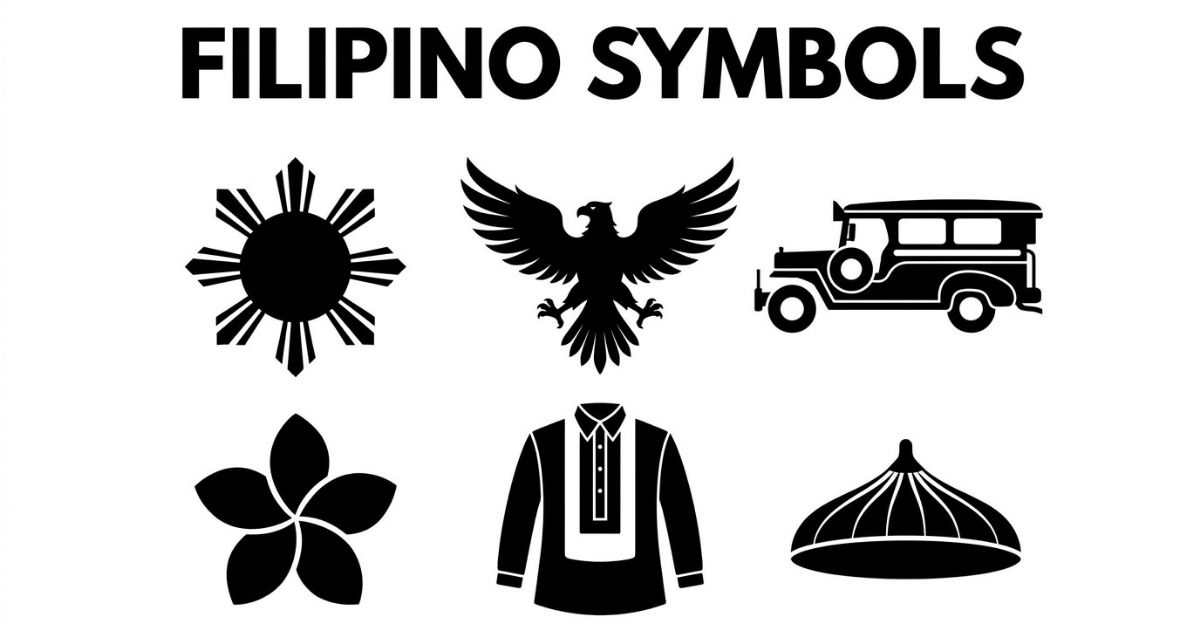

Filipino symbols are one of the most layered, emotionally rich, and historically significant visual languages in all of Southeast Asia. Long before the Philippines had a written constitution or a national anthem, its people were already communicating through symbols carved into wood, tattooed onto skin, woven into cloth, and painted on ritual objects. These symbols told stories about who people were, what they believed, and what they were willing to fight for.
Most people encounter Filipino symbols without realizing the depth behind them. You might see a tribal tattoo on someone’s arm, a golden sun on a flag, or a brightly colored mythical bird in a museum and think it looks beautiful without knowing it carries centuries of meaning. That’s exactly what this article is here to change.
From ancient warrior markings to the sacred Baybayin script, from protective amulets to the national emblems taught in schools, this guide walks you through the full world of Filipino symbols and what they truly mean.
What Are Filipino Symbols?
Filipino symbols are visual, spiritual, and cultural expressions that capture the identity, beliefs, and history of the Filipino people. They aren’t just decorative. Each one carries a story rooted in lived experience, community values, and an unbroken connection to the land and the ancestors who shaped it.
Before Spanish colonizers arrived in 1565, the Philippines was home to hundreds of thriving indigenous communities. Each had its own symbolic language expressed through tattoos, carvings, weaving patterns, and ritual objects. These symbols weren’t created for art galleries. They served real purposes: marking warriors, blessing homes, honoring the dead, and communicating with the spirit world.
Over centuries, Spanish, American, and Asian influences layered onto these indigenous foundations. Christian crosses merged with sun imagery. Colonial flags replaced tribal banners. But the original symbolic traditions never completely disappeared. Today, they’re experiencing a powerful revival, especially among Filipino Americans who use symbols to stay connected to their roots.
Read This: 59+ Legendary Leadership Symbols From History That Still Guide Leaders Today
Filipino Cultural Symbols And Their Meanings
Filipino culture is rich with symbols that show up in daily life, celebrations, and personal expression. Understanding them helps you see the deeper values that shape Filipino society: respect for elders, devotion to family, love of community, and fierce pride in heritage.
Filipino Symbols and Meanings
Every Filipino symbol carries at least two layers of meaning: what it literally depicts and what it emotionally represents. A sun isn’t just a sun. It’s freedom, awakening, and the courage to resist. A bamboo stalk isn’t just a plant. It’s resilience, flexibility, and survival.
These meanings vary by region and tribal origin. A symbol used by the Ilocano people of northern Luzon may carry different significance than the same shape used by the Maranao of Mindanao. Context always matters in Filipino symbolism.
What stays consistent across all regions is the emotional weight. These symbols were created by people who felt deeply and believed their world was alive with spiritual meaning. That emotional intensity is why these symbols still resonate today.
Filipino Flag
The Philippine flag is arguably the most recognized Filipino symbol in the world. It features three horizontal bands: blue on top representing peace and justice, red on the bottom representing courage and patriotism, and a white triangle on the left representing equality and brotherhood.
At the center of the white triangle sits a golden sun with eight rays. Each ray represents one of the eight provinces that first rose up against Spanish colonial rule in 1896: Manila, Bulacan, Cavite, Pampanga, Nueva Ecija, Batangas, Laguna, and Tarlac. Three five-pointed stars sit at each corner of the triangle, symbolizing the country’s three major island groups: Luzon, Visayas, and Mindanao.
One unique detail most people don’t know: the flag is intentionally reversible. During times of war, it’s flown with the red stripe on top. During peacetime, the blue stripe is on top. No other national flag in the world works quite this way, making it one of the most symbolically thoughtful flags in existence.
Filipino Symbols Tattoos
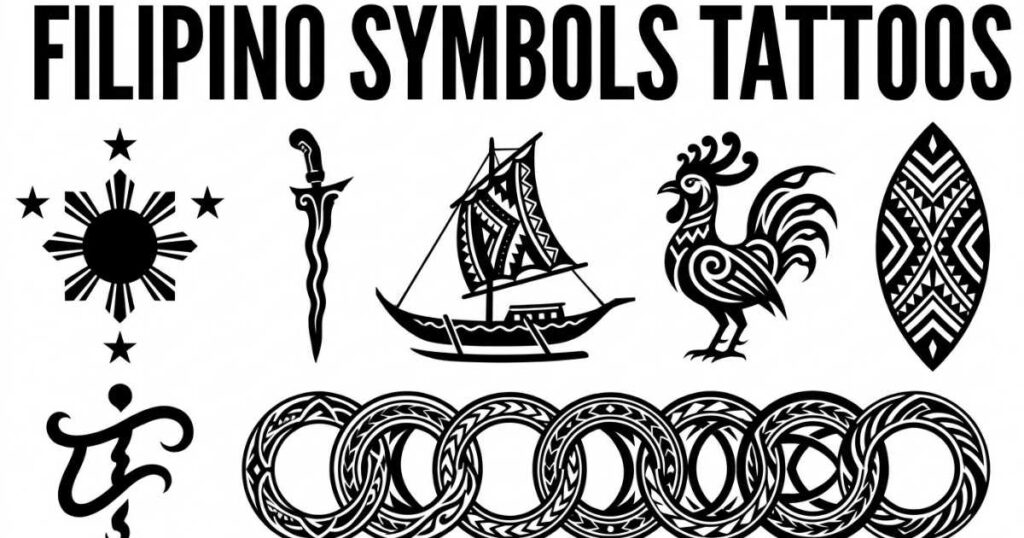
Tattoos have been a form of symbolic expression in the Philippines for over a thousand years. The ancient Visayan warriors known as the Pintados (meaning “painted ones”) covered their entire bodies in tattoos that marked their victories in battle, their social rank, and their spiritual protections.
In Cordillera, the Kalinga people practiced a sacred tattoo tradition called batok. These tattoos were earned, not chosen. Warriors received them after headhunting victories. Women received them as markers of beauty, skill, and community status. The tradition is still alive today through Whang-Od Oggay, a 104-year-old woman from Buscalan village who is widely recognized as the last traditional Kalinga tattoo artist. Her story went viral across American social media and sparked renewed global interest in indigenous Filipino tattooing.
Read This: 20+ Hidden Symbols of Rebirth You See Every Day but Never Notice
Filipino Symbols Tattoos (Diaspora Perspective)
For Filipino Americans, tribal tattoos carry a deeply personal meaning that goes beyond aesthetics. Getting a Kalinga-inspired tattoo or a Baybayin script piece is often an act of cultural reconnection. It’s a way of honoring ancestry when you’re thousands of miles from the homeland.
Common tattoo symbols include sun rays representing freedom, wave patterns representing the ocean and resilience, serpent or naga motifs representing protection and power, and geometric tribal lines representing warrior lineage. Modern Filipino tattoo artists like Rodel Tapaya and others in the diaspora are reshaping how these ancient designs reach new audiences while keeping their spiritual integrity intact.
Filipino Symbols Letters
The ancient Baybayin script is one of the most stunning examples of pre-colonial Filipino cultural identity. It’s a syllabic writing system, meaning each character represents a syllable rather than a single letter. It was widely used across the Philippine archipelago before the Spanish colonial period and was eventually suppressed as Latin script took over.
One important correction worth knowing: many people call this script alibata, but that term was actually invented in 1914 by a Filipino scholar named Paul Versoza and has no historical basis. The correct name, supported by academic research and linguistic historians, is Baybayin.
Today, Baybayin is experiencing a major cultural revival. It appears on the Philippine passport, in government branding, and in countless tattoos and artworks. For many Filipinos and Filipino Americans, learning Baybayin is an act of cultural reclamation.
Philippines Symbols and Meanings
The Philippines’ collection of national symbols creates a picture of a country defined by natural beauty, quiet strength, and deep cultural pride. Together, the eagle, the narra tree, the sampaguita flower, and the flag tell a cohesive story about what the Filipino people value and who they strive to be.
National Symbols Of The Philippines
The Philippines has a set of officially recognized national symbols established through law and presidential proclamation. These symbols appear in schools, government buildings, and cultural institutions across the country.
What Are the 10 National Symbols of the Philippines
Here are ten of the most recognized national symbols:
| Symbol | Name | What It Represents |
| National Flag | Pambansang Watawat | Freedom, unity, courage |
| National Bird | Philippine Eagle | Strength, independence |
| National Tree | Narra | Resilience, durability |
| National Flower | Sampaguita | Purity, simplicity, humility |
| National Animal | Carabao | Hard work, perseverance |
| National Fish | Bangus (Milkfish) | Abundance, coastal culture |
| National Gem | South Sea Pearl | Natural wealth |
| National Martial Art | Arnis | Warrior heritage |
| National Anthem | Lupang Hinirang | Patriotism, love of country |
| National Dish (Cultural) | Adobo | Filipino culinary identity |
Philippine National Symbols PDF
Educational institutions, especially in the United States with large Filipino American student populations, often use official Philippine national symbols PDFs as teaching tools. These documents, many of which are available through the Philippine Department of Education (DepEd) and the National Historical Commission of the Philippines, include images, descriptions, and the legal proclamation numbers behind each symbol. They’re an excellent starting point for anyone teaching or learning about Philippine heritage.
Read This: 73+ Best Sleep Token Symbols | Hidden Meanings, Sacred Geometry and the Dark Poetry Behind the Mask
Philippines National Bird
The Philippine Eagle (Pithecophaga jefferyi) is one of the largest, most powerful, and most endangered eagles in the world. With a wingspan reaching up to seven feet, this bird is a breathtaking creature found primarily in the forests of Mindanao. It was officially declared the national bird in 1995, replacing the maya sparrow.
The eagle symbolizes freedom, sharp vision, and strength. It hunts alone, rules its territory, and mates for life, all qualities that Filipinos see reflected in their own national character. Because fewer than 800 individuals remain in the wild, it also represents the urgent need for environmental protection and cultural preservation.
Philippine National Symbols with Pictures and Description
Visual learning is particularly powerful when it comes to these symbols. The Philippine eagle’s brown and white plumage, the narra tree’s bright yellow flowers, and the sampaguita’s tiny white blossoms all carry visual meaning that complements their symbolic one. Educational materials that pair images with descriptions help students and curious readers form stronger connections between the symbols and the values they represent.
National Tree of the Philippines
The Narra tree (Pterocarpus indicus) is a towering hardwood tree native to the Philippines. Its wood is famous for its reddish-brown color and extraordinary durability, making it prized for furniture and architecture. But its symbolic value goes even deeper than its physical properties.
The Narra represents the enduring spirit of the Filipino people: strong under pressure, beautiful in form, and rooted firmly in the earth. It was proclaimed the national tree in 1934. Many Filipinos see the Narra as a metaphor for how their culture has survived centuries of colonization, natural disasters, and displacement while remaining fundamentally itself.
Ancient And Traditional Filipino Symbols
Before written history, ancient Filipinos created a rich symbolic world that was deeply tied to nature, spirituality, and community life.
Ancient Filipino Symbols
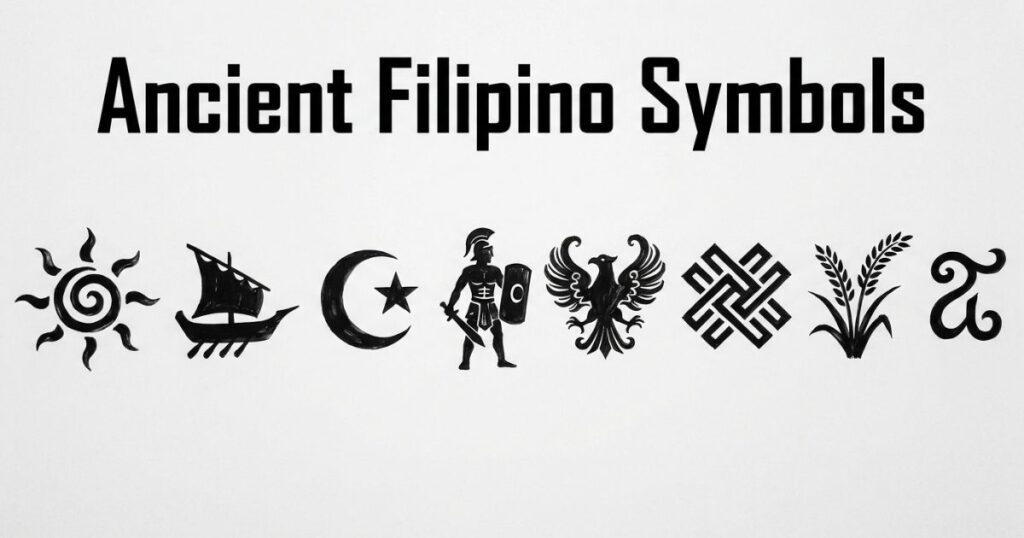
Ancient Filipino symbols appeared in tools, burial jars, house carvings, and body art. Among the most significant early artifacts is the Manunggul Jar, a 710 BCE burial jar found in Palawan that features two figures paddling a boat, widely interpreted as a symbol of the soul’s journey to the afterlife. The Laguna Copperplate Inscription from 900 CE is the oldest known written document found in the Philippines, covered in characters that bridge ancient Southeast Asian script traditions.
Common motifs in ancient Filipino art include the naga (a serpent deity representing water and protection), the crocodile (a guardian of rivers and sacred spaces), and the sun wheel (representing life, cyclical time, and the divine).
Filipino Symbolism
Filipino symbolism doesn’t operate in isolation. It’s woven into language, gesture, and social behavior. The act of pagmamano, where a younger person takes an elder’s hand and presses it to their forehead, is itself a living symbol of respect and generational connection. The way rice appears in almost every Filipino celebration is symbolic of abundance and gratitude.
Filipino symbolism also operates through the concept of kapwa, a core value in Filipino psychology that roughly translates as “shared identity” or “fellow being.” It’s the understanding that the self is never separate from the community. Many traditional symbols visually express this idea through interconnected patterns and circular designs.
Traditional Filipino Symbols
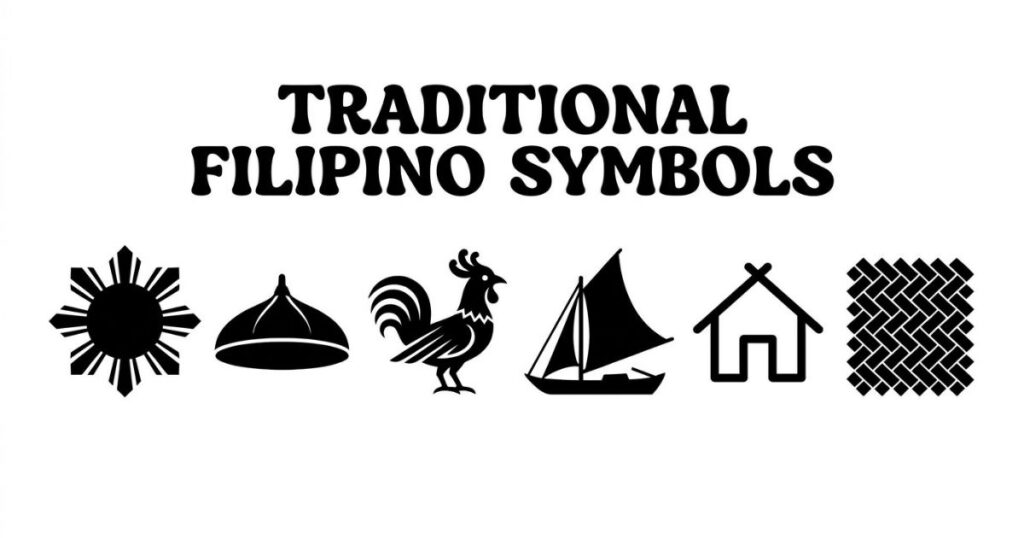
Traditional Filipino weaving is one of the most underappreciated symbol systems in Southeast Asian culture. The T’nalak cloth of the T’boli people of Mindanao features geometric patterns that are said to come to the weaver in dreams from a spirit called Fu Dalu. No two T’nalak pieces are identical. Each pattern tells a unique story.
Similarly, the hablon textiles of the Hiligaynon people and the piña cloth made from pineapple fiber carry encoded symbols of harvest cycles, social status, and spiritual protection. These aren’t just beautiful fabrics. They’re living libraries of cultural knowledge.
Filipino Good Luck Symbols
The most uniquely Filipino good luck symbol is the anting-anting, a personal amulet believed to grant protection, strength, or supernatural power to its owner. Anting-anting come in many forms: inscribed metal discs, carved bone, knotted cloth, or small bottles containing blessed materials. Their origins blend pre-colonial animist beliefs with Spanish Catholic imagery, often featuring crosses alongside ancient scripts or symbols.
Other good luck symbols include the parol (a star-shaped Christmas lantern made from bamboo and paper) which represents hope and the Star of Bethlehem, and sampaguita garlands which are offered as blessings and symbols of pure intention.
Filipino Ancient Symbols
Among the most powerful ancient Filipino symbols are those connected to the spirit world. Early Filipino communities believed the world was inhabited by spirits called anito, who lived in natural objects like trees, rocks, and rivers. Symbols carved into ritual objects were meant to attract benevolent spirits and ward off harmful ones.
These beliefs were practiced by babaylan, the spiritual leaders of pre-colonial Filipino communities. The babaylan, who were often women or gender-fluid individuals, used symbolic objects, chants, and rituals to heal, protect, and communicate with the unseen world. Their tradition is being reclaimed today by scholars and Filipino cultural practitioners worldwide.
Filipino Indigenous Symbols
The indigenous tribes of the Philippines each carry their own rich symbolic tradition. The Lumad peoples of Mindanao use distinct geometric symbols in their weavings and rituals. The Igorot people of the Cordillera mountains are known for their intricate rice terraces, which are themselves a symbol of harmony between human society and the natural world. The Mangyan of Mindoro preserve an ancient script called Hanunuo Mangyan that is still actively written, making it one of the few living indigenous scripts in Asia.
Filipino Protection Symbols
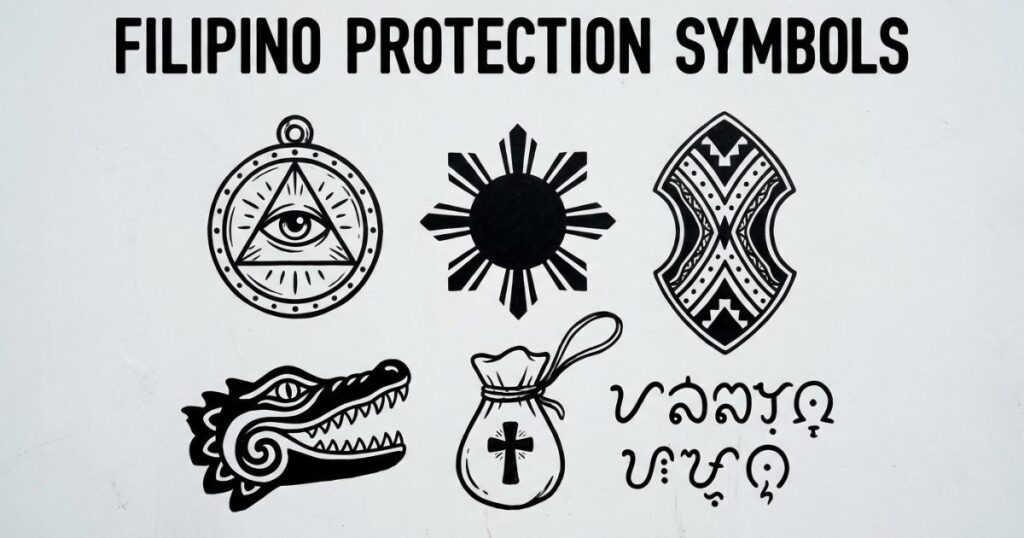
Filipino protection symbols are among the most emotionally powerful in the entire symbolic tradition. The anting-anting leads this category, but warriors also wore tattoos specifically designed to make them spiritually invulnerable in battle. The kris, a wavy-bladed sword used by Muslim Filipino warriors, was not just a weapon but a spiritual object. Intricate okir carvings on the kris handle were believed to channel divine energy into the blade.
Filipino Symbols Of Identity, Culture And Strength
Family Filipino Symbols and Meanings
Family is the single most important social institution in Filipino culture. The concept of pamilya (family) extends beyond the nuclear unit to include extended relatives, godparents, and close community members. Filipino family symbols often use circular or interlocking designs to represent this web of connection.
The principle of utang na loob (debt of gratitude) is a symbolic social bond that ties family members to each other across generations. It’s the idea that the love and sacrifice of parents and elders must be honored and returned. Many Filipinos honor this bond through tattoos that incorporate Baybayin characters spelling ancestors’ names.
Filipino Symbols for Strength
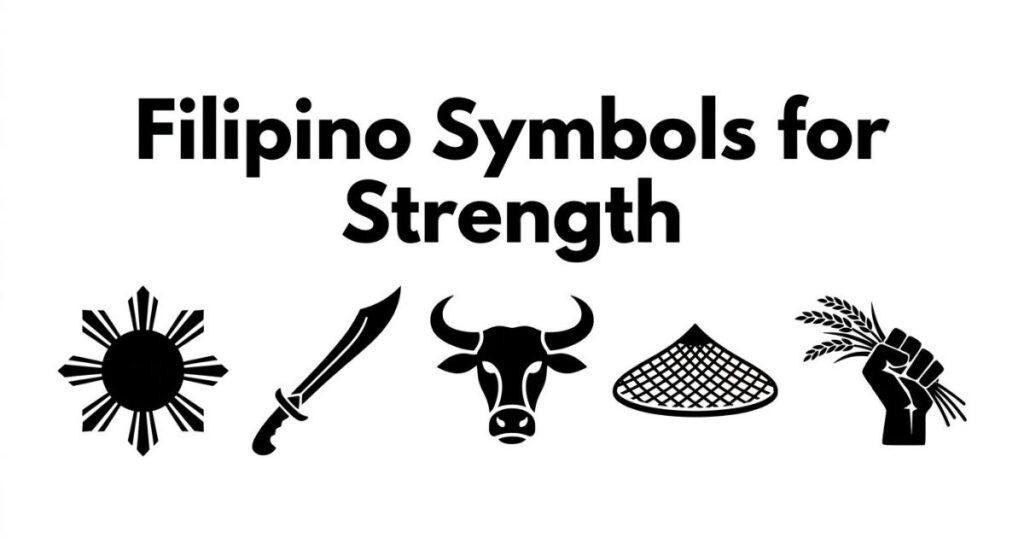
Warrior Filipino symbols are the most visually bold in the Philippine tradition. The Katipunan, the revolutionary brotherhood that fought for Philippine independence in 1896, used a red flag with a white sun as their battle standard. That sun, with rays radiating outward, became one of the most powerful strength symbols in modern Philippine history.
Ancient symbols for strength include the sibat (spear) pattern, the lawin (hawk) motif, and bold geometric arrangements that warriors wore as tattoos. These weren’t decorative choices. They were declarations of identity and intention.
Symbols That Represent Filipino Culture
The carabao (water buffalo) is one of the most beloved symbols of Filipino culture. It represents the hardworking spirit of the Filipino farmer and the deep bond between people and land. Bamboo represents flexibility and resilience, the ability to bend without breaking. The paraw, a traditional outrigger sailboat, symbolizes the Filipino spirit of adventure and the courage to navigate uncertain waters.
Filipino Culture Symbols and Practices
Filipino festivals are living symbol systems. The Sinulog festival of Cebu combines Catholic devotion to the Santo Niño with indigenous rhythmic dancing, creating a hybrid symbol of faith and resilience. The Pahiyas festival of Quezon province sees farmers decorating their homes with rice-based art called kiping, turning an entire village into a colorful celebration of harvest and gratitude.
The pagmamano gesture remains one of the most practiced living symbols of Filipino culture: a daily, physical expression of the values of respect, family, and intergenerational connection.
More Ancient And Cultural Filipino Symbols
Common Filipino Symbols at a Glance
| Symbol | Meaning |
| Sun | Freedom, enlightenment, revolution |
| Eagle | Strength, independence |
| Bamboo | Resilience, flexibility |
| Sampaguita | Purity, humility, devotion |
| Carabao | Hard work, agricultural heritage |
| Parol | Hope, community, Christmas spirit |
| Kris | Spiritual power, warrior identity |
| Baybayin | Cultural identity, pre-colonial heritage |
Warrior Filipino Symbols
The Pintados warriors of Visayas are perhaps the most striking example of warrior symbolism in Philippine history. Spanish chronicles from the 16th century describe these warriors as covered head to toe in tattoos that told their entire life story. The more tattoos a warrior had, the greater his status and reputation.
In Mindanao, the kampilan, a long single-edged sword with a forked tip, was both a weapon and a ceremonial object. Its design carried deep spiritual symbolism connected to Moro warrior identity and the protection of the community.
Ilocano Ancient Filipino Symbols and Meanings
The Ilocano people of northern Luzon have a rich tradition of symbolic expression through abel cloth weaving. Their geometric patterns represent agricultural cycles, community values, and spiritual protection. Specific designs were traditionally used to mark life milestones: birth, marriage, and death. Carvings on wooden furniture and household objects also carried symbolic meaning, often representing connections to ancestry and the natural world.
Deep Symbolic Meaning of Filipino Symbols
Spiritual Level
At the spiritual level, Filipino symbols served as interfaces between the human world and the world of spirits. The babaylan used sacred objects covered in symbols to heal the sick, bless harvests, and mediate conflicts. The anito figures, carved from wood or stone in human-like form, were believed to house the spirits of ancestors.
This wasn’t superstition. It was a sophisticated spiritual technology developed over thousands of years by people who understood that the visible world was only part of reality.
Psychological Level
Psychologically, Filipino symbols create belonging. For the Filipino diaspora in the United States, seeing a Baybayin tattoo on a stranger or a sarimanok design in a restaurant can trigger an immediate emotional response: recognition, pride, and a deep sense of being seen. Research in cultural psychology shows that symbolic identification with one’s heritage significantly improves mental wellness in immigrant communities.
The concept of kapwa operates as a psychological foundation here. When you recognize a Filipino symbol, you’re not just recognizing an image. You’re recognizing yourself as part of a shared story.
Cultural Level
Culturally, Filipino symbols function as oral history made visible. In communities where written records were lost or destroyed during colonization, symbols in weavings, carvings, and body art preserved knowledge that would otherwise have been erased. They pass wisdom from elders to younger generations without a single word being spoken.
Today, Filipino Gen Z communities, both in the Philippines and the United States, are leading a cultural revival that centers these symbols in art, fashion, music, and activism.
Types and Variations of Filipino Symbols
Sarimanok
The Sarimanok is a mythical bird from the tradition of the Maranao people of Mindanao and one of the most iconic images in all of Filipino art. It’s typically depicted as a brightly colored rooster or bird holding a fish in its beak or talons, adorned with flowing okir patterns and elaborate plumage.
The Sarimanok symbolizes prosperity, divine blessing, and the connection between earthly life and the spiritual realm. It appears on royal textiles, boat prows, banners, and architectural carvings. For Filipino Americans, the Sarimanok has become a powerful diaspora symbol: a reminder of a rich indigenous culture that predates colonial disruption.
Sun and Stars of the Philippine Flag
The eight-ray sun of the Philippine flag carries extraordinary emotional weight. Each ray is named for a specific province that took up arms against Spain in 1896: Manila, Bulacan, Cavite, Pampanga, Nueva Ecija, Batangas, Laguna, and Tarlac. The three stars represent the geographic unity of Luzon, Visayas, and Mindanao.
This sun isn’t just a national symbol. It’s a monument to sacrifice. Every Filipino who sees it is reminded of the men and women who gave their lives so that future generations could live free.
Anito Figures
Anito figures are carved human-like statues that served as vessels for ancestral spirits in pre-colonial Filipino spirituality. Made from wood, stone, or ivory, they were placed in homes, fields, and sacred spaces to invite protection and guidance from those who had passed on.
When Spanish colonizers arrived, they systematically destroyed thousands of anito figures as part of their conversion campaign. The loss was enormous. Today, Filipino artists and cultural practitioners are recreating and honoring these figures as acts of spiritual and cultural restoration.
Okir Patterns
Okir is the visual language of the Maranao and Maguindanao peoples of Mindanao. It features flowing, plant-inspired curvilinear forms combined with geometric precision. You can find okir on boat prows, the handles of kris swords, textiles, and traditional architecture.
A closely related tradition is ukkil, the Tausug version of this decorative style, which tends to be slightly more angular. Both traditions express the belief that life flows continuously and that all things are connected. Okir is sometimes described as the Islamic-influenced cousin of Celtic knotwork: intricate, endless, and deeply meaningful.
Baybayin Script
Baybayin is the pre-colonial Filipino script that deserves far more global recognition than it currently receives. It’s an abugida, meaning that each character represents a consonant-vowel syllable. It reads from left to right and was written on perishable materials like bamboo and leaves, which is why so few original examples survive.
The script is now appearing on the Philippine passport, national government seals, and in mainstream Filipino culture. For the Filipino American community, learning to write one’s name in Baybayin has become a meaningful rite of cultural reconnection. The confusion with the word “alibata” still persists in many communities, but scholars are clear: Baybayin is the correct term, historically and linguistically.
Filipino Symbols Across Cultures
Filipino symbols don’t exist in isolation. They’re part of a broader Southeast Asian visual tradition that stretches across Indonesia, Malaysia, Thailand, and beyond. The naga serpent motif appears across all these cultures, demonstrating ancient trade routes and shared mythological frameworks that predate modern national borders.
During the Spanish colonial period, a fascinating symbolic fusion occurred. Indigenous sun imagery merged with Catholic crosses. Local nature spirits were quietly absorbed into the stories of Catholic saints. The Sto. Niño (Holy Child) became a sacred symbol that blends Catholic devotion with older traditions of honoring sacred figures.
In the modern Filipino diaspora across the United States, symbols function as cultural anchors. A Filipino American in Los Angeles might hang a sarimanok print in their home, wear a Baybayin tattoo on their wrist, and display the Philippine flag on their car, each symbol reinforcing their identity in a culture that often overlooks Filipino heritage.
Filipino Symbols in Art, Movies and Pop Culture
Filipino painter Juan Luna used classical imagery combined with symbolic Filipino themes in works like “Spoliarium,” which became a symbol of colonial suffering and Filipino awakening. Contemporary Filipino artists continue this tradition, using indigenous symbols to explore migration, identity, and resistance.
In cinema, films like Heneral Luna use symbolic imagery to reinforce themes of patriotism and betrayal, making historical symbols feel urgent and personal for modern audiences. Filipino American filmmakers and content creators on platforms like YouTube and TikTok are using Baybayin overlays, tribal patterns, and cultural symbols to build audiences who are hungry for authentic Filipino storytelling.
In fashion, brands like Filipiniana-inspired designers are using T’nalak patterns, okir-inspired prints, and indigenous motifs on international runways, reclaiming cultural identity in a global marketplace.
Spiritual and Dream Meaning of Filipino Symbols
In traditional Filipino belief, dreams were never dismissed as random brain activity. They were considered messages from ancestors, spirits, or the divine. Seeing specific Filipino symbols in dreams was taken seriously as guidance or warning.
A sun symbol in a dream is generally interpreted as inner awakening, breakthrough, or a call to leadership. Seeing an eagle suggests a need for freedom or a reminder of inner strength. Encountering anito figures in a dream often signals unresolved emotional ties to ancestors or a need for spiritual grounding. Baybayin characters appearing in dreams may represent a search for identity or truth.
Even today, many Filipinos consult spiritual advisors or reflect deeply on dreams featuring these symbols. The tradition of taking symbolic dreams seriously is itself a form of cultural preservation.
Positive vs Negative Meaning
Every powerful symbol carries both light and shadow, and Filipino symbols are no different.
On the positive side, they represent unity, resilience, hope, spiritual protection, and the unbreakable bonds of family and community. The sun represents freedom. The eagle represents strength. Baybayin represents cultural pride.
On the shadow side, these same symbols carry the memory of colonization, forced conversion, cultural erasure, and generational trauma. The cross that appears in so many Filipino symbols was also the symbol of the colonizers who destroyed anito figures and banned indigenous practices. The sun of the Philippine flag was adopted after centuries of bloodshed.
This duality is actually what makes Filipino symbols so emotionally powerful. They hold both grief and celebration. They remind people that resilience isn’t the absence of suffering; it’s what happens after.
Why Humans Are Attracted to Filipino Symbols
People are drawn to Filipino symbols for the same reason they’re drawn to any great story: they feel true. These symbols speak of survival against overwhelming odds, of love for family that crosses generations, and of a spiritual relationship with the natural world that modern life often forgets.
For Filipino Americans specifically, these symbols offer something precious: a sense of belonging and continuity in a culture that often renders them invisible. Seeing a Baybayin character or a sarimanok design is a reminder that they come from a civilization with depth, beauty, and wisdom.
For non-Filipinos, the attraction is often the visual richness combined with the emotional depth. Okir patterns are aesthetically stunning. Tribal tattoo designs are bold and beautiful. But once you understand what they mean, the beauty becomes something more. It becomes reverence.
FAQ’s
What is the most powerful Filipino symbol?
The anting-anting is widely considered the most powerful protective symbol in Filipino tradition, blending animist and Catholic beliefs into a uniquely Filipino spiritual object.
What does the sun symbolize in Filipino culture?
The sun represents freedom, enlightenment, and revolutionary spirit. Its eight rays honor the provinces that first fought for Philippine independence in 1896.
What is Baybayin and is it still used today?
Baybayin is the pre-colonial syllabic script of the Philippines. Yes, it’s actively being revived in tattoos, art, education, and even on the official Philippine passport.
What are Filipino protection symbols called?
The most well-known are anting-anting (amulets). Warrior tattoos and kris sword carvings also served as protection symbols in ancient Filipino culture.
Can non-Filipinos get Filipino symbol tattoos?
Respectful appreciation with genuine understanding is generally welcomed. Learning the meaning behind a symbol before using it is the most important step.
What is the difference between okir and ukkil?
Okir is the flowing, plant-inspired decorative art of the Maranao and Maguindanao peoples. Ukkil is the closely related tradition of the Tausug people, typically slightly more angular in style.
Conclusion
Filipino symbols are not museum artifacts frozen in the past. They are living, breathing expressions of a culture that has survived colonization, displacement, and erasure while refusing to disappear. Each symbol, whether it’s the golden sun on the flag, the intricate curves of a Baybayin character, or the bold lines of a Kalinga tattoo, carries the voices of people who came before and the hopes of those who come after.
When you truly see these symbols, you don’t just learn history. You feel it. You understand what it means to belong to a people who bent under centuries of pressure and still rose, rooted and radiant, like the Narra tree in full bloom.
The story of Filipino symbols is the story of humanity at its most resilient: finding beauty in struggle, meaning in hardship, and identity in the marks we choose to carry.

Hi, I’m Ethan Brooks, the admin of SymbolHubz.com. Passionate about symbols, emojis, kaomojis, and text art, helping users discover creative ways to express themselves online.