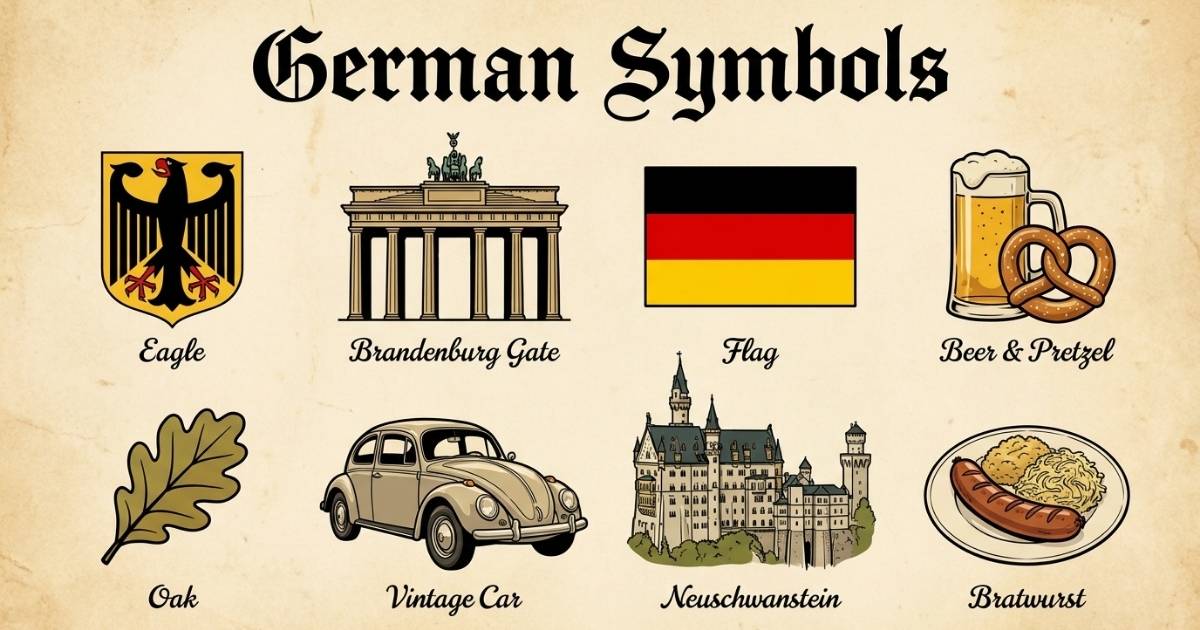

German symbols are living pieces of history that continue to shape culture, identity, art, and even law in ways most people never realize. From ancient runic carvings to the modern Federal Eagle printed on every German passport, these symbols tell a story that spans over two thousand years. Whether you’re exploring your German heritage, planning a tattoo, or just curious about what these icons really mean, this guide covers everything you need to know.
Germany’s symbolic identity didn’t appear overnight. It was built layer by layer through tribal migrations, empire, war, collapse, and democratic rebirth. Understanding these symbols means understanding one of the most complex and fascinating national stories in human history.
What are German Symbols?
German symbols are visual emblems, marks, and icons tied to Germany’s history, culture, politics, and national identity. They range from ancient runic letters carved by Germanic tribes to the modern black-red-gold flag flying at the Olympics. What makes them unique is the sheer depth of meaning packed into each one.
Before Germany unified in 1871, it was a patchwork of kingdoms, duchies, and free cities, each carrying its own coat of arms, regional symbols, and local traditions. That fragmented history is exactly why German cultural heritage is so symbolically rich. Every emblem reflects a different chapter of a nation that kept reinventing itself without ever forgetting where it came from.
Ancient German Symbols And Their Hidden Stories
Ancient German symbols predate written history. These were carved into stone, painted on shields, and etched into jewelry long before any formal German state existed. They weren’t decorative. They were functional, spiritual, and deeply personal to the people who used them.
Most of what we know about these symbols comes from archaeological discoveries across northern and central Europe. Weapons, burial sites, and runestones have revealed a symbolic language that connected warriors, communities, and spiritual beliefs in ways that modern people are still trying to fully understand.
You can also explore: Symbols of Rebirth
Ancient German Symbols
Ancient Germanic symbols include the sun wheel, protective runes, and animal totems that tribes used for spiritual protection and identity. The Elder Futhark, the oldest known runic alphabet with 24 characters, dates back to around 150 CE and served as both a writing system and a spiritual tool. These symbols appeared on swords, brooches, and sacred stones across modern-day Germany, Scandinavia, and the British Isles.
Germanic Tribe Symbols
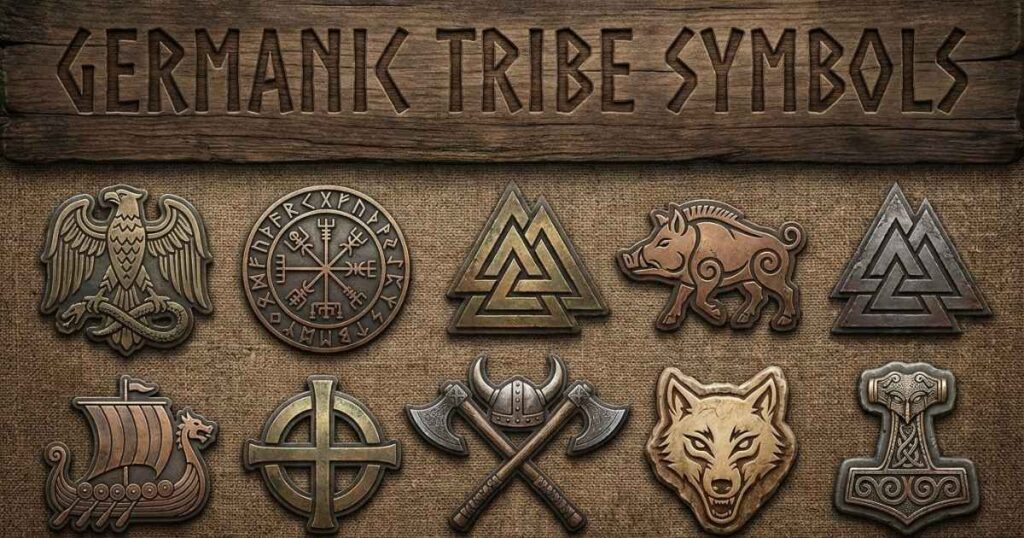
Different Germanic tribes used distinct symbols to mark their identity during battle and ceremony. The Saxons used the Irminsul, a sacred tree pillar representing the axis of the world, while Frankish warriors carried symbols of wolves and boars on their battle standards. The Wolfsangel, shaped like a stylized anchor, was a common protective mark believed to ward off wolves and evil spirits.
Germanic Symbols
Germanic symbols as a broader category connect German, Norse, and Anglo-Saxon cultures through shared mythology and artistic tradition. Animal symbols like the boar (courage), wolf (loyalty), and raven (wisdom) crossed tribal boundaries. Many of these German mythology symbols survived into medieval Christian art, quietly carrying pagan meanings into a new religious era.
German Symbols And Meanings In Modern Culture
Today, German symbols and meanings are studied by historians, worn by tattoo enthusiasts, used in logo design, and debated in legal courts. The ancient has collided with the modern in fascinating ways. Some symbols have kept their original meaning. Others have been completely reinterpreted across centuries.
What’s remarkable is how many of these symbols still appear in everyday American life. German-Americans make up the largest ancestry group in the United States, with over 40 million people claiming German heritage according to U.S. Census data. That cultural connection keeps these symbols alive on this side of the Atlantic too.
German Symbols And Meanings
| Symbol | Core Meaning | Era of Origin |
| Federal Eagle | Sovereignty and unity | Holy Roman Empire |
| Iron Cross | Military honor | Prussian Wars (1813) |
| Black-Red-Gold Flag | Freedom and democracy | 1848 Revolution |
| Oak Leaves | Endurance and strength | Ancient Germanic |
| Cornflower | Loyalty and remembrance | Medieval Germany |
| Linden Tree | Love and community | Pre-Christian era |
German Symbolism
German symbolism as an artistic tradition peaked during the Romantic era of the early 19th century. Painters like Caspar David Friedrich used misty forests, ruined abbeys, and lone figures against vast landscapes to express something deeply German: the tension between nature, history, and the human soul. That symbolic tradition lives on in modern German design, architecture, and visual identity.
Symbols Of Germany
Germany’s official national symbols include the Federal Eagle, the black-red-gold flag, the national anthem “Das Lied der Deutschen,” the cornflower as the national flower, and the oak as the national tree. Each of these was deliberately chosen to represent specific values. The cornflower, for example, was associated with Queen Louise of Prussia and later became a symbol of remembrance and national identity.
What Is The Symbol Of Germany?
The Bundesadler, or Federal Eagle, is Germany’s primary national symbol. It appears on the coat of arms, official government seals, euro coins, and passports. The eagle’s design has evolved significantly over centuries, from the double-headed eagle of the Holy Roman Empire to the single black eagle of modern democratic Germany. Its current minimalist form was redesigned after World War II specifically to represent a new, democratic German identity separate from the Nazi era.
German Symbols Text
German symbols in text often refer to Gothic Fraktur typography and Unicode runic characters used in digital design and social media. Fraktur was the dominant German typeface for centuries and carries an unmistakably medieval aesthetic. Today it appears in logos, band merchandise, and tattoo scripts. Runic Unicode characters are also widely copied for social media bios and creative projects.
German Symbols Letters
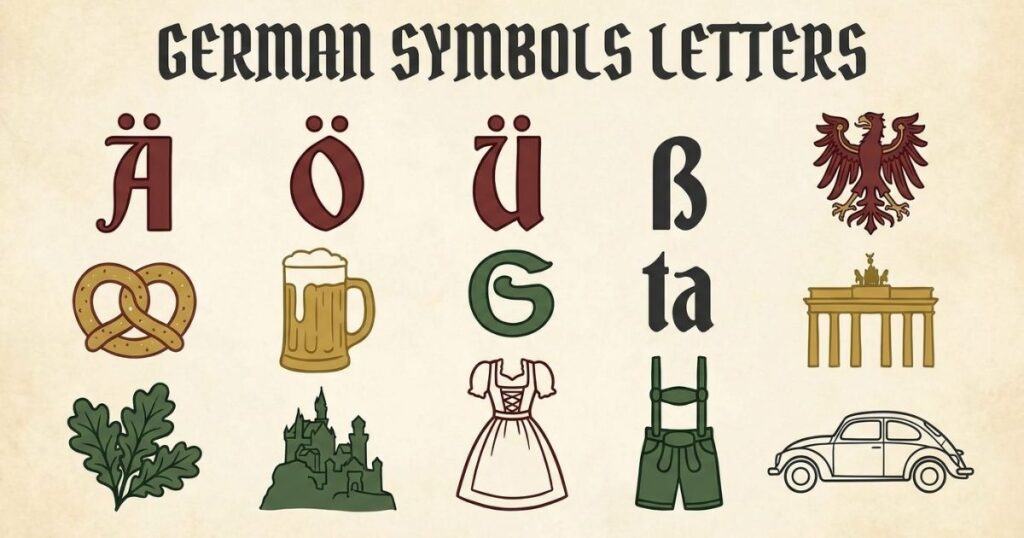
Germanic runic letters were never just decorative. The Elder Futhark alphabet was used for inscriptions, communication, and ritual purposes from roughly 150 CE to 800 CE. Each rune had both a phonetic value and a symbolic meaning. For example, Algiz meant protection, Tiwaz represented justice and the war god Tyr, and Othala symbolized ancestral heritage and homeland.
You can also explore: Life Symbols
German Symbols To Copy
Many people search for German symbols to copy for use in usernames, creative writing, or design projects. If you use runic or Germanic symbols, it’s worth knowing what they actually mean first. Some runes were misappropriated by the Nazi SS in the 20th century and still carry that association in certain contexts. Using a symbol without knowing its background can send an unintended message.
German Symbols Tattoos
German symbol tattoos are enormously popular in the USA, especially designs featuring the eagle, Iron Cross, oak leaves, and Elder Futhark runes. Before getting inked, research the full history of any Germanic symbol. The Algiz rune makes a beautiful protection tattoo with a clean ancient origin. The Othala rune, however, was used by the SS and remains controversial despite its pre-Nazi roots. Context always matters.
Iconic, Ancient And Historical German Symbols
The most iconic German symbols didn’t become famous by accident. They earned their status through centuries of use, political weight, and cultural repetition. Some of these emblems are recognized worldwide even by people who don’t know their names.
Many of these symbols also crossed over into American consciousness through immigration, World War history, pop culture, and the global spread of German design. You’ve seen them in films, video games, history books, and on motorcycles. Now let’s understand what they actually represent.
Iconic German Symbols
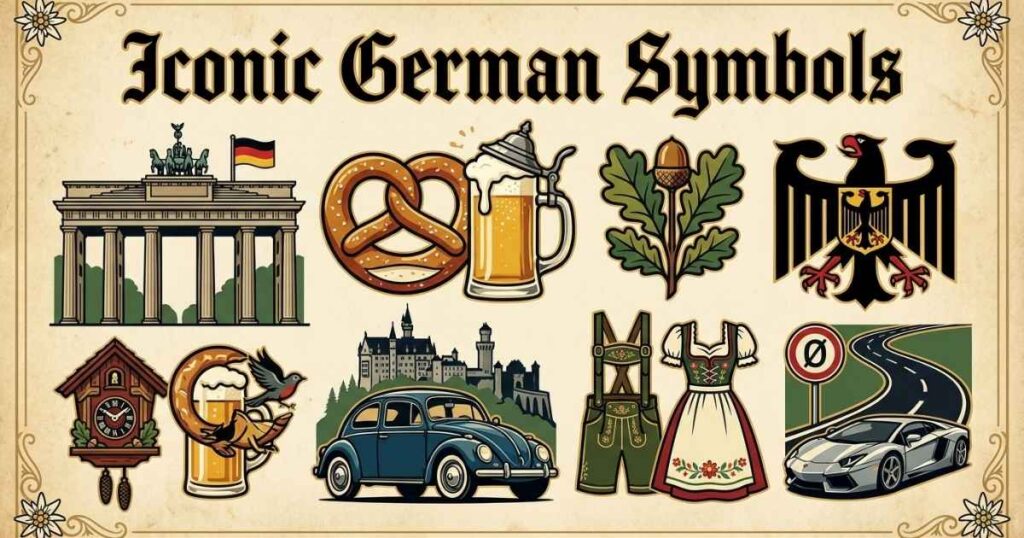
The Federal Eagle, the Iron Cross, and the Brandenburg Gate are Germany’s three most globally recognized symbols. The Brandenburg Gate in Berlin went from being a symbol of Prussian power to a symbol of Cold War division to a symbol of reunification after 1989. Its meaning literally changed within a single lifetime, which tells you a lot about how German national identity works.
Traditional German Symbols
Traditional German symbols are rooted in regional folk culture rather than national politics. Bavaria’s blue-and-white diamond pattern, the Hanseatic League’s trading city seals, and the oak and linden trees of German folklore all represent a grassroots layer of identity. These German folklore symbols appear at festivals, on regional flags, and in traditional crafts still practiced today.
Famous German Symbols
Some famous German emblems became internationally known through tourism and pop culture rather than politics. The Berlin Bear, the city’s symbol since the 13th century, appears on everything from street signs to souvenir mugs. Cologne Cathedral, a UNESCO World Heritage Site, functions as a symbol of German Gothic architecture and spiritual endurance. These symbols represent Germany’s cultural confidence.
Ancient German Symbols Tattoos
For tattoo enthusiasts drawn to ancient Germanic warrior symbols, specific runes carry clear and historically grounded meanings:
- Algiz (ᛉ): Protection and defense
- Tiwaz (ᛏ): Justice, sacrifice, and the warrior spirit
- Fehu (ᚠ): Wealth, abundance, and new beginnings
- Uruz (ᚢ): Raw strength and vitality
Always work with a tattoo artist who understands the historical context of these symbols.
You can also explore: Sleep Token Symbols
Old German Symbols
Old German symbols from the Holy Roman Empire era include the double-headed eagle, royal seals, and the elaborate coats of arms of German noble houses. Prussia’s black eagle, adopted as the state symbol in the 18th century, became the direct ancestor of the modern Bundesadler. That visual lineage connects today’s democratic Germany to a chain of power stretching back to Charlemagne.
Meaningful German Symbols
The most meaningful Germanic symbols often come from nature. The oak tree represents endurance because it outlives everything around it. The cornflower, small and blue, became a symbol of loyalty when Queen Louise of Prussia supposedly hid her children in a cornfield during Napoleon’s invasion. The linden tree was where village communities gathered to resolve disputes, making it a symbol of justice and community.
German Symbols In War, Politics and Family
War and politics have shaped German historical symbols more than almost anything else. Germany experienced the Holy Roman Empire, the Prussian Kingdom, the Weimar Republic, Nazi dictatorship, Cold War division, and democratic reunification, each phase producing its own visual identity.
Understanding the German military symbols from different eras isn’t just history trivia. It explains why certain symbols are celebrated today while others are legally banned, and why Germany takes its symbolic identity more seriously than almost any other country.
WW1 German Symbols
WW1 German symbols centered on the Imperial Eagle, the Iron Cross, and the distinctive Pickelhaube spiked helmet. The Iron Cross was actually introduced by Prussia in 1813 during the wars against Napoleon, not in World War I. It was revived in 1914 as a military decoration for bravery. These German military symbols represented a monarchy fighting for its survival in a changing world.
WW2 German Symbols
WW2 German symbols are among the most studied and legally regulated in the world. Many Nazi symbols, including the swastika, were appropriated from much older cultures. The swastika appears in Hindu, Buddhist, and ancient European traditions as a symbol of good fortune, thousands of years before the Nazi party adopted it. Germany’s §86a StGB law now bans the public display of Nazi symbols, with exceptions for educational and artistic purposes.
WWII German Symbols
After 1945, Germany’s denazification process extended to its visual identity. The Bundesadler was completely redesigned. The new eagle was made simpler, less aggressive in posture, and deliberately distinct from the Nazi-era Reichsadler. This was a conscious effort to reclaim the eagle’s ancient positive meaning while rejecting what it had represented between 1933 and 1945. Germany calls this process of confronting its past Erinnerungskultur, or “memory culture.”
East German Symbols
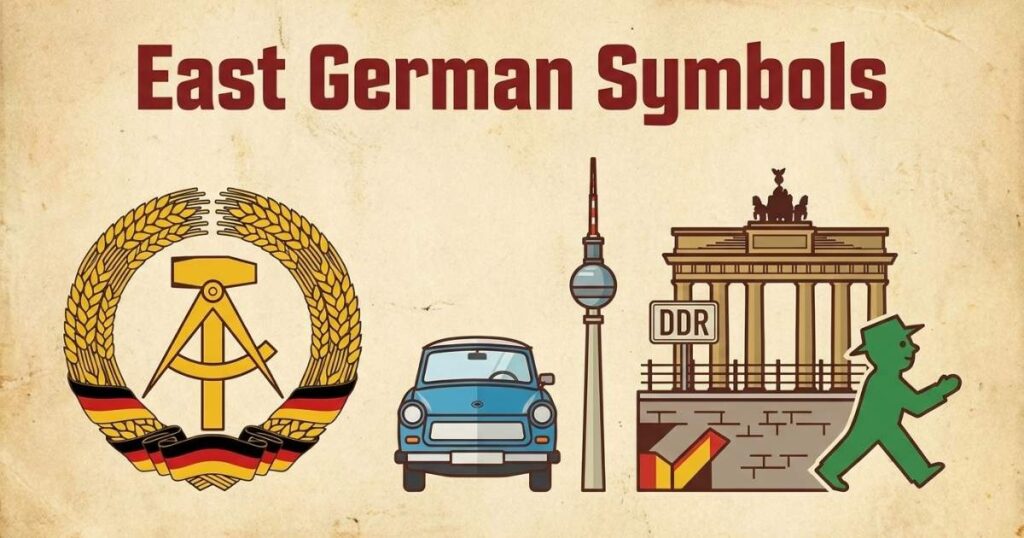
East German symbols reflected Cold War communist ideology. The DDR’s emblem featured a hammer (for workers), a compass (for intellectuals), and a wreath of grain (for farmers), all wrapped in the black-red-gold colors. It was designed to project a workers’ state identity distinct from West Germany. After reunification in 1990, these symbols were retired, though they’ve experienced a cultural nostalgia revival known as “Ostalgie.”
German Symbols For Family
German family crests and heraldic traditions run deep. Many German surnames connect directly to regional symbols. Animals like lions, bears, and eagles commonly appear on German coats of arms, each carrying specific meanings about the family’s history and values. The oak tree and acorn appear frequently as symbols of a family’s roots and endurance across generations.
Popular German Symbols
Beyond official emblems, some popular German cultural symbols are recognized globally through tourism and food culture. The beer stein, the pretzel, Oktoberfest imagery, and even the logos of German car brands like Mercedes-Benz and BMW function as cultural symbols that carry associations of quality, engineering precision, and German identity around the world.
Deep Symbolic Meaning of German Symbols
Spiritual Meaning
Before Christianity reached Germanic tribes, German spiritual symbols represented connections to nature, fate, and divine forces. Sacred trees, protective runes, and animal spirits were believed to carry real power. Modern Heathen and neo-pagan communities still work with these pre-Christian Germanic symbols as living spiritual tools, not historical curiosities.
Psychological Meaning
Carl Jung, one of history’s most influential psychologists, was himself German-Swiss and deeply influenced by Germanic symbolic tradition. His concept of archetypes, universal symbolic patterns in the human unconscious, maps closely onto Germanic symbol systems. The eagle as authority, the rune as hidden knowledge, and the cross as moral crossroads all reflect psychological patterns Jung identified as universal to human experience.
Cultural Meaning
German cultural symbols reflect three core national values that historians consistently identify: discipline, resilience, and reinvention. After every major collapse, whether the fall of the Holy Roman Empire, defeat in two World Wars, or the Cold War division, Germany rebuilt itself and redesigned its symbolic identity to match. That pattern of transformation makes German symbols uniquely powerful as cultural statements.
Types / Variations of German Symbols
1. Federal Eagle (Bundesadler)
The Bundesadler is a black eagle with spread wings on a gold shield, appearing in a clean, modernist style. It traces its lineage through the Holy Roman Empire’s eagle back to Roman imperial standards. Today it appears on German passports, euro coins, and official government buildings. It represents sovereignty, unity, and democratic governance.
2. Black-Red-Gold Flag
The German flag’s three colors each carry historical meaning. Black and gold come from the Austrian Habsburgs and the Holy Roman Empire. Red appears in the Hanseatic League’s colors. Together, black-red-gold first appeared as the colors of the 1848 democratic revolution, making the flag a direct symbol of Germany’s democratic aspirations long before the modern republic existed.
3. Iron Cross (Eisernes Kreuz)
The Iron Cross has one of the most complex histories of any German symbol. Created in 1813, used in both World Wars, banned in modified forms after 1945, and then reintroduced as a Bundeswehr military decoration in 1956 with a redesigned appearance. Today it also appears in motorcycle culture, extreme sports branding, and fashion, particularly in the USA, often stripped of its military context entirely.
4. Germanic Runes
The Elder Futhark runic system contains 24 runes, each with a name, sound, and symbolic meaning. Key runes include:
- Fehu: Wealth and prosperity
- Uruz: Physical strength
- Algiz: Protection and sanctuary
- Sowilo: Success and solar power
- Tiwaz: Justice and sacrifice
Two runes, the Sig rune (used as the SS insignia) and the Othala rune, were appropriated by the Nazi SS. Understanding this history is essential before using these symbols.
5. Holy Roman Empire Eagle
The double-headed eagle of the Holy Roman Empire represented dual authority over both spiritual and political power. Used from the reign of Charlemagne through the Habsburg dynasty until 1806, this symbol influenced German, Austrian, Russian, and Byzantine heraldry. It remains one of the most visually complex and historically layered of all German visual symbols.
German Symbols Across Cultures
Germany’s symbols didn’t develop in isolation. They absorbed influences from Rome, adopted them during medieval Europe’s heraldic boom, and then exported their design philosophy to the rest of the world.
The result is a symbolic tradition that belongs to Germany but resonates far beyond its borders, showing up in American folk art, European heraldry, and global design movements.
Ancient Germanic Tribes
Germanic tribal symbols spread across Europe through migration between 300 and 700 CE. As tribes moved into modern-day France, Spain, England, and Italy, they carried their symbolic language with them. This is why you’ll find similar animal symbols and runic-inspired marks in Anglo-Saxon, Frankish, and Lombard art.
Roman Influence
When Roman legions made contact with Germanic tribes, a symbolic exchange happened. Germanic groups adopted the eagle from Roman military standards, eventually making it their own. In return, Roman artists incorporated Germanic animal motifs and interlace patterns into provincial art across the empire.
Medieval Europe
Germany was central to medieval European heraldry. The Holy Roman Emperor set the visual standard for coats of arms across the continent. German noble houses developed some of the most sophisticated heraldic systems in European history, with strict rules about colors, animals, and symbols that influenced every other European heraldic tradition.
Modern Europe
German design philosophy, especially through the Bauhaus movement founded in 1919, transformed modern visual culture globally. Bauhaus championed clean lines, functional beauty, and minimal ornamentation. That aesthetic shaped everything from typography to architecture to product design and lives on in the visual language of brands like Apple and IKEA.
Global Influence
Pennsylvania Dutch (actually Pennsylvania German) communities in the USA preserved Germanic folk symbols for centuries. Their decorative hex signs, colorful patterns painted on barns, incorporate ancient Germanic sun symbols, fertility marks, and protective designs. These are living examples of German cultural heritage thriving on American soil.
German Symbols in Art, Movies & Pop Culture
German symbols in film range from the historically serious to the commercially iconic. Movies like Valkyrie, Das Boot, and Schindler’s List use German military symbols to evoke specific historical periods with visual shorthand. Steven Spielberg’s Indiana Jones films turned Nazi imagery into recognizable pop culture villains, cementing certain German historical symbols in American visual memory.
In video games, titles like the Wolfenstein series and historical strategy games like Victoria 3 use Germanic symbols extensively. Heavy metal music has long embraced runic imagery and the Iron Cross aesthetic. Fashion brands from streetwear to luxury have incorporated Gothic Fraktur lettering and eagle motifs into designs sold worldwide.
Spiritual & Dream Meaning of German Symbols
When German symbols appear in dreams, psychologists suggest interpreting them through their core archetypal meanings rather than their political associations. Dreaming of an eagle typically connects to themes of ambition, leadership, and the desire to rise above current circumstances. Rune symbols in dreams often point to hidden knowledge or a need to understand something more deeply. Cross-shaped symbols frequently appear during periods of moral decision-making or significant life transitions.
Positive vs Negative Meaning
Positive Meanings
German symbols at their best represent values that resonate across cultures:
- Unity and collective strength
- Democratic freedom and civic responsibility
- Resilience through historical hardship
- Deep connection to nature and heritage
- Artistic precision and structural beauty
Negative Interpretations
The darker side of German symbolism is impossible to ignore, and Germany itself doesn’t try to ignore it. Several symbols were corrupted during the Nazi era, and Germany’s legal system actively regulates their public display. What makes Germany’s approach remarkable is its commitment to Erinnerungskultur, confronting negative history openly rather than erasing it. This makes German symbolic history one of the most honestly examined of any nation.
Why Humans Are Attracted to German Symbols
Humans are drawn to German symbols for the same reason we’re drawn to any powerful visual language: they condense complex meaning into simple, memorable forms. The brain processes images faster than words, and symbols that have carried meaning for centuries carry an emotional weight that newly invented logos simply can’t replicate.
For Americans specifically, there’s an additional layer. With over 40 million Americans claiming German ancestry, these symbols connect people to roots that span centuries. And for those without German heritage, the symbols still communicate recognizable values like strength, precision, and historical depth that German culture has become associated with globally.
FAQ’s
What is the most famous German symbol?
The Federal Eagle (Bundesadler) is Germany’s most recognized national symbol, appearing on passports, coins, and government buildings.
What symbols are illegal in Germany?
Nazi symbols including the swastika, SS insignia, and certain runic combinations used by the Nazi party are banned under §86a StGB, with exceptions for educational and artistic contexts.
What is the oldest German symbol?
The Elder Futhark runes, dating to around 150 CE, are among the oldest documented Germanic symbols.
What do the colors of the German flag mean?
Black represents determination, red symbolizes bravery, and gold represents generosity. Together they trace back to the 1848 democratic revolution.
Did the Nazis invent their symbols?
No. Most Nazi symbols were appropriated from older cultures. The swastika, for example, is thousands of years old and appears in Hindu, Buddhist, and ancient European traditions.
Are Iron Cross symbols still used today?
Yes. A redesigned Iron Cross has been used as the symbol of the German Bundeswehr (armed forces) since 1956 and appears on German military aircraft.
What German symbols are popular for tattoos in the USA?
Eagle designs, oak leaf clusters, Elder Futhark runes (especially Algiz and Tiwaz), and Iron Cross variations are among the most popular choices.
Conclusion
German symbols are far more than decorative icons. They are compressed history, carrying within their lines the weight of empires, the memory of wars, the hope of revolutions, and the values of a culture that has rebuilt itself more dramatically than almost any other in the modern world.
From the ancient runic carvings of Germanic tribes to the clean, democratic lines of the modern Bundesadler, each symbol reflects a moment in a continuous human story about identity, power, and reinvention. Understanding these symbols doesn’t just teach you about Germany. It teaches you something about how humans use images to hold onto meaning across time.
Whether you’re exploring your ancestry, researching a tattoo, or simply curious about the icons you’ve seen in films and history books, these symbols reward deeper attention. The more you look, the more you see.

Hi, I’m Ethan Brooks, the admin of SymbolHubz.com. Passionate about symbols, emojis, kaomojis, and text art, helping users discover creative ways to express themselves online.