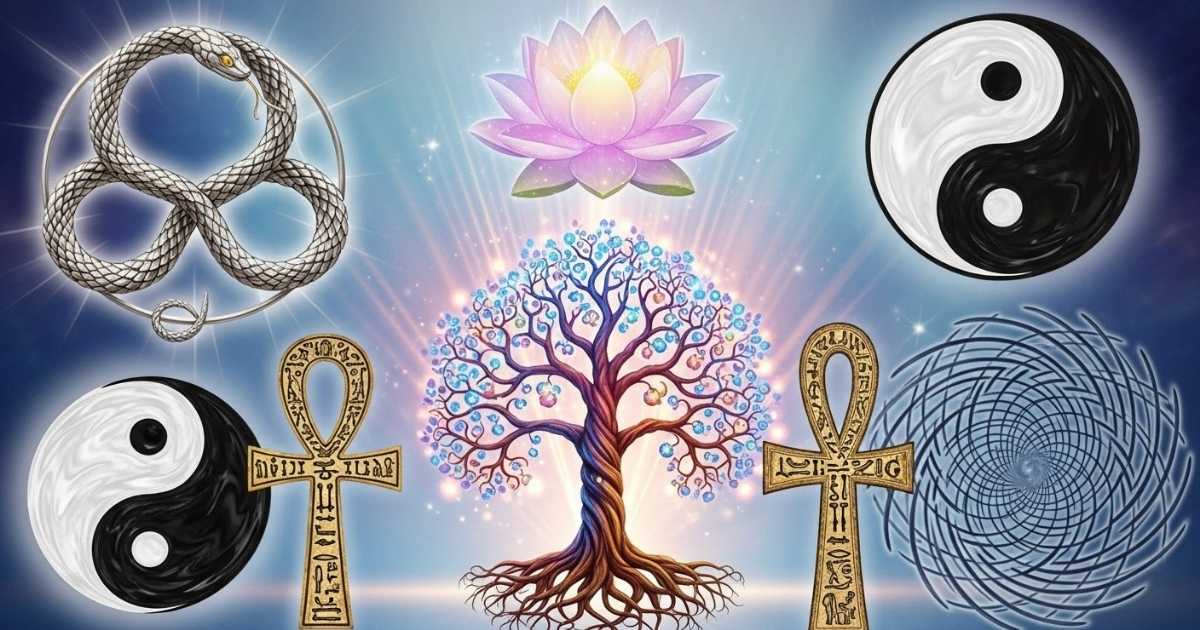

Life symbols are visual representations of humanity’s deepest truths, and they’ve been guiding human beings for thousands of years. Long before written language existed, people carved symbols into stone, painted them on cave walls, and wore them as sacred protection. These symbols helped ancient civilizations explain what words simply couldn’t capture: the mystery of existence, the cycle of birth and death, and the hope of something greater.
Today, life symbols appear in tattoos, jewelry, spiritual practice, art, and even everyday objects. Whether you’ve felt drawn to a particular symbol without knowing why or you’re searching for something meaningful to represent your journey, this guide will walk you through the most powerful life symbols ever created and explain exactly what they mean.
What Are Life Symbols?
Life symbols are shapes, signs, or objects that humans have used across centuries to express the essence, mystery, and continuity of life itself. They aren’t random designs. Every one of them carries intentional meaning, born from human experience, spiritual belief, and cultural tradition.
Before written language developed, symbols were humanity’s primary communication tool. Ancient Egyptians carved the Ankh into temple walls. Celtic tribes etched spirals into sacred stones. Native Americans wove dreamcatchers as physical expressions of life’s protection and flow. These weren’t decorations. They were statements about existence.
Psychologist Carl Jung called these recurring symbols “archetypes,” arguing they’re hardwired into the human collective unconscious. That’s why a person in the USA and a person in ancient Egypt can look at the same spiral and feel something similar. Life symbols bypass language entirely and speak directly to emotion and instinct. They represent ideas like birth and creation, growth and transformation, eternity and immortality, renewal and rebirth, and the delicate balance between life and death.
Life Symbols and Meanings
The world of life symbols and meanings is far richer and more diverse than most people realize. Meanings vary by culture, religion, personal experience, and historical era. A butterfly means transformation in Western culture but represents the soul of the departed in some Japanese traditions. The sun signals hope and warmth in most societies but represented divine authority and royal power in ancient Egypt.
What makes life symbols so powerful is that they operate on multiple levels simultaneously. On the surface, a simple circle is just a round shape. But dig deeper and you’ll find it represents eternity, wholeness, and the endless cycle of life in cultures spanning every continent. That layered quality is what makes symbols so emotionally resonant.
Broadly speaking, life symbols fall into four major categories: nature-based symbols (trees, water, sun, flowers), geometric symbols (circle, spiral, infinity sign), mythological symbols (phoenix, dragon, ouroboros), and spiritual symbols (lotus, ankh, mandala). Each category carries its own emotional weight and cultural history.
Read More: 7+ Symbols of Virgo That Reveal Its True Personality And Hidden Power
Tree of Life Symbols
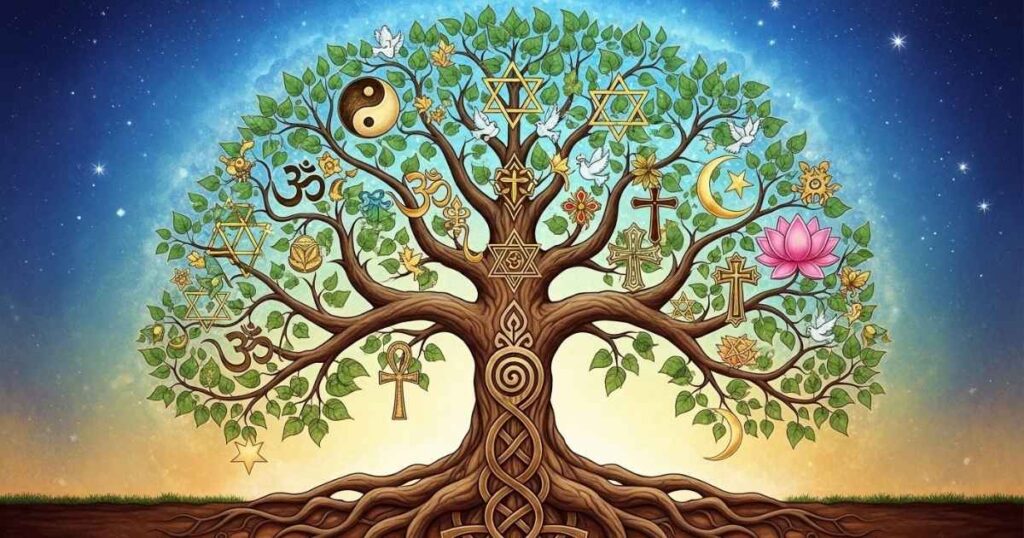
The Tree of Life is arguably the most universally recognized life symbol in human history. It appears in Norse mythology as Yggdrasil, the great ash tree connecting the nine realms of existence. In Celtic culture, it represents the harmony between humans and the natural world. In Jewish mysticism (Kabbalah), the Tree of Life is a diagram of divine energy. In Christianity, it appears in the Garden of Eden as the source of eternal life.
What makes this symbol so enduring is its visual clarity. A tree is something everyone understands. It grows from invisible roots deep in the earth, stands strong against storms, and reaches upward toward light and sky. That journey, from darkness to light, from hidden origins to visible growth, mirrors the human experience perfectly.
Today, the Tree of Life symbol appears in necklaces, wall art, tattoos, and spiritual designs across the USA and beyond. It’s one of the most popular tattoo choices for people representing family bonds, personal growth, and spiritual strength.
Tree of Life Symbols and Meanings
Each part of the Tree of Life carries its own distinct symbolic meaning, and understanding these layers makes the symbol even more powerful.
Roots represent ancestry, heritage, and foundation. They’re the invisible parts of you: your family history, your early experiences, and the cultural ground you grew from. Deep roots symbolize strength that isn’t always visible on the surface.
The trunk represents your present self: stability, endurance, and the core of who you are. It’s the part that holds everything together, connecting past to future.
The branches reach toward goals, dreams, and future generations. They represent growth, wisdom, and the connections you make throughout life. Leaves on those branches represent individual life experiences, each one unique but part of the greater whole.
What’s fascinating is how different cultures assign different details to this same structure. The Norse Yggdrasil has a serpent at its roots and an eagle at its crown, symbolizing the tension between destruction and wisdom. The Kabbalistic Tree of Life maps ten divine attributes called Sefirot across the branches, making it a spiritual roadmap rather than just a nature symbol. The Celtic version emphasizes interconnection between all living things.
Eternal Life Symbols
Eternal life symbols share one core message: life doesn’t end. They represent immortality, infinity, and the continuation of the soul beyond physical existence. These symbols have appeared in every major spiritual tradition throughout human history because the question of what happens after death is universal.
The most recognized eternal life symbols include:
- The Ankh: Ancient Egypt’s key to eternal existence
- The Infinity Symbol (∞): Endless life and limitless possibility
- The Ouroboros: A serpent eating its own tail, representing the eternal cycle of death and rebirth
- The Circle: Eternity expressed through a shape with no beginning and no end
What these symbols share is the concept of continuation. They don’t deny death. Instead, they place death within a larger cycle where ending is simply part of the ongoing story. That’s why eternal life symbols remain so popular in modern spirituality, memorial tattoos, and grief jewelry across the USA.
Symbols of Life
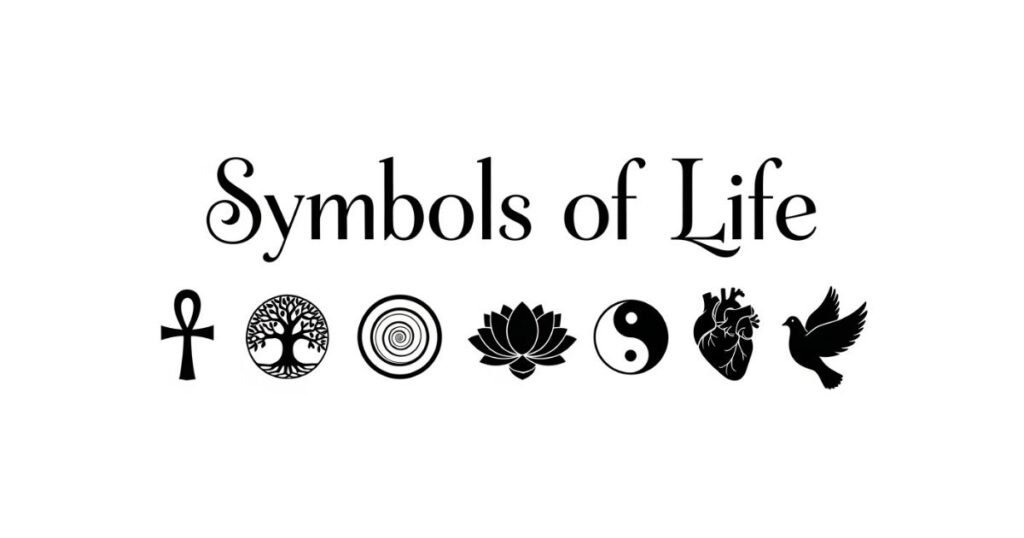
Across civilizations, humans have consistently chosen the same natural elements to represent life: the sun, water, trees, butterflies, and lotus flowers. This consistency isn’t a coincidence. It reflects shared human experience. Everyone needs sunlight to survive. Everyone drinks water. Everyone watches things grow.
The sun is one of the oldest and most powerful symbols of life, representing warmth, energy, and the force that makes all other life possible. Water symbolizes survival, purity, and constant movement. A seed growing into a plant is the most direct visual metaphor for life’s journey: potential becoming reality.
What’s significant is that these symbols don’t just represent being alive. They represent the quality of being alive: growing, moving, transforming, and connecting. They remind you that life isn’t static. It’s always in motion.
What Symbolizes Life
When people ask what symbolizes life, the answer almost always comes from nature. Natural elements were humanity’s first teachers, and the lessons they carry are still relevant today.
The sun rising each morning represents new beginnings and the gift of another day. Flowing water symbolizes change, adaptation, and the fact that life never stays still. A growing plant reflects development, hope, and the patience that real growth requires. Even a heartbeat, the modern EKG line that appears in health apps and medical tattoos, is now one of the most recognizable symbols of being alive.
Different cultures symbolize life differently based on their environment and belief systems. Desert cultures elevated the sun and water as life’s most precious symbols. Forest cultures across Europe and Asia centered their symbolism on trees. Ocean cultures saw waves and fish as life’s defining images. The symbol you resonate with most often reflects where you come from as much as who you are.
Symbol of Life
If you had to choose one single symbol of life, most traditions across history point to the Tree of Life. It combines roots (past and origin), trunk (present strength), and branches (future growth) into one unified image. It’s complete. It tells the whole story of existence in a single symbol.
That said, the Ankh makes a strong case as well. Dating back to approximately 3100 BCE, it’s one of the oldest known symbols of life ever created. And the circle is arguably even more universal since no single culture owns it and every civilization has used it to represent life’s endless cycle.
Ultimately, the “best” symbol of life depends on your personal belief system. A person with spiritual roots in ancient Egyptian history might choose the Ankh. Someone drawn to nature might choose the Tree of Life. Someone focused on infinite possibility might prefer the infinity symbol. All of them are valid. All of them are true.
Life Symbols and Meanings
The same symbol can carry beautifully different meanings depending on who’s looking at it and where they come from. That’s one of the things that makes life symbols and meanings so endlessly interesting to explore.
Consider the butterfly. In Western culture, it represents transformation and new life because of its metamorphosis from caterpillar to winged creature. In ancient Greek culture, the butterfly represented the soul (psyche in Greek means both “soul” and “butterfly”). In some parts of China, two butterflies together symbolize love and partnership. Same symbol, three entirely different meanings.
The sun offers another example. To the ancient Egyptians, the sun was Ra, the supreme god, a symbol of divine authority and royal power. To modern Americans, a sunrise on a tattoo often simply means “a fresh start” or “I made it through the darkness.” The symbol evolves with the people who use it, and that evolution is part of what keeps it alive.
Symbols for Life
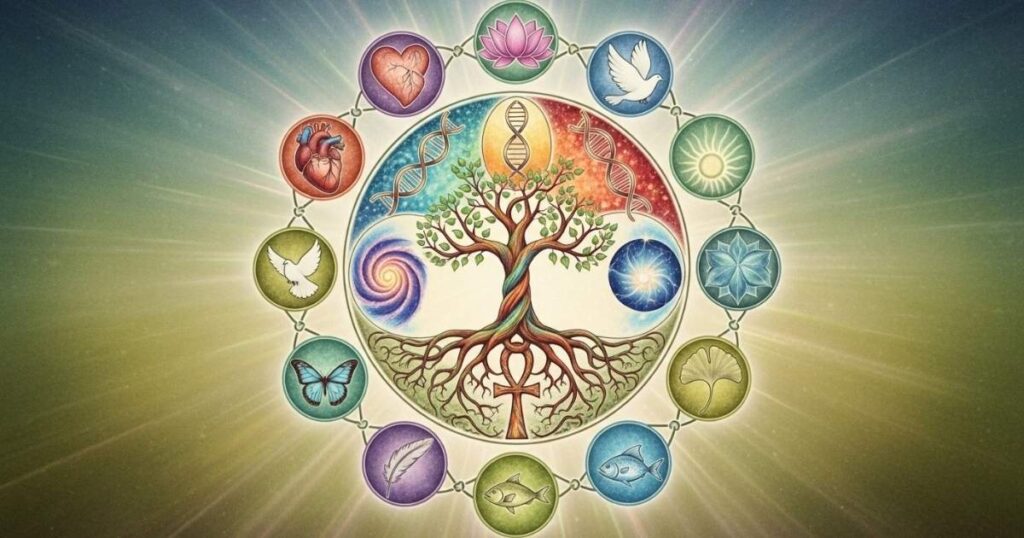
Modern American culture has added its own layer to the world of life symbols. Alongside ancient symbols, you’ll find powerful modern icons that carry just as much emotional weight.
The EKG heartbeat line is perhaps the most distinctly modern symbol of being alive. It appears in health branding, memorial tattoos, and fitness culture because it visually captures the rhythm of a beating heart. The DNA double helix, discovered in 1953, has become a scientific symbol of life itself since it represents the biological code that makes every living thing what it is.
Green leaves and seedlings have become popular life symbols in environmental movements, representing not just individual life but the health of the planet. The heart shape, while primarily a love symbol, also functions as a life symbol because it points to the emotional and relational dimensions of being human. These modern symbols prove that humanity is still creating new visual language to express old truths.
Symbol for Change in Life
The most powerful symbol for change in life is the butterfly, and it earns that title completely. The transformation from caterpillar to butterfly isn’t just a pretty metaphor. It’s a biological process where the caterpillar essentially dissolves inside its chrysalis before reforming into something entirely new. Real change, the kind that truly transforms you, often feels exactly like that.
The phoenix follows closely as a symbol of change through destruction and rebirth. If you’ve survived something that should have broken you and came out stronger, the phoenix reflects your story.
Flowing water and changing seasons also represent life’s natural changes. Water never stays the same shape. It adapts to whatever container holds it, carves through stone given enough time, and finds a way forward no matter what. The shift from winter to spring is nature’s most dramatic change symbol: life returning after a period of darkness and cold. These are among the most meaningful symbols of new beginnings across cultures.
Symbols That Have Deep Meaning
Some symbols carry such layered, multi-dimensional meaning that a single article can barely scratch the surface.
The Mandala is a perfect example. Originating in Hindu and Buddhist traditions, a mandala represents the universe, wholeness, and the structure of the cosmos. Psychologist Carl Jung used mandalas in therapy because he believed drawing them helped people access their unconscious mind and find inner order during periods of chaos.
The Ouroboros (serpent eating its own tail) represents the unity of opposites: life and death, beginning and end, creation and destruction. It first appeared in ancient Egypt around 1600 BCE and later spread to Greek, Norse, and alchemical traditions. The Yin-Yang from Chinese philosophy expresses a similar idea: life requires both light and dark, and each contains a seed of the other.
The Triquetra (Celtic triple knot) represents the eternal cycle of life through three interlocking loops with no beginning and no end. These symbols challenge simple interpretation and reward deeper reflection.
Things That Represent Life
Both natural elements and human-made objects have long served as things that represent life. The natural ones come first because humans observed them before creating anything themselves.
Fire is one of the most primal life symbols. It gives warmth, light, and the ability to cook food, which made human civilization possible. But it’s also fragile and dangerous, mirroring life’s own delicate nature. Seeds represent life in its purest form: invisible potential waiting for the right conditions to emerge. A candle flame captures this same idea in a more intimate, human-made form.
From a modern perspective, a heartbeat monitor line placed flatly on a hospital screen is the most dramatic possible representation of life because its absence marks death. A compass represents life as a journey with direction and purpose. Even a mirror has been used as a life symbol across cultures, representing self-awareness and the examined existence.
What Represents Life
Life is represented through nature, light, water, growth, and movement. These four elements appear as life symbols in virtually every culture throughout human history because they reflect the observable truth of what keeps living things alive.
In spiritual terms, life is represented by symbols of the soul’s journey: the lotus rising from mud, the phoenix rising from ashes, the tree growing toward light. These aren’t random images. They’re carefully observed truths about how life actually works.
In modern contexts, life is often represented by connection: the heart for love, the infinity sign for endless bond, the circle for unity. What represents life ultimately mirrors what we value most about being alive.
Things That Symbolize Life
A wide range of things symbolize life across different categories:
From nature: Trees, rivers, flowers in bloom, birds in flight, ocean waves, and the sun itself
From mythology: The phoenix, the dragon (representing life force in Eastern cultures), the serpent (cyclical renewal)
From sacred geometry: The circle (eternity), the spiral (evolution), the infinity symbol (endless existence)
What ties all of these together is movement and continuation. Nothing that symbolizes life is static. Trees grow. Rivers flow. Phoenixes rise. Spirals expand. Life symbols capture the dynamic, ever-changing quality of existence itself.
Symbol of Life Meaning
The symbolic meaning of life operates on three distinct levels: spiritual, emotional, and cultural. On the spiritual level, life symbols point toward the eternal nature of the soul and the continuation of consciousness beyond physical death. On the emotional level, they provide comfort, hope, and a sense of meaning during difficult times. On the cultural level, they carry generational wisdom and connect individuals to their heritage.
Carl Jung’s concept of the collective unconscious explains why these symbols feel deeply familiar even when you encounter them for the first time. Certain shapes and images are stored in humanity’s shared psychological memory, passed down not through books but through the deep structure of human consciousness itself. That’s why a spiral carved 5,000 years ago in Ireland still feels meaningful to someone in modern-day New York.
Symbol for Life
The Tree of Life holds the strongest claim as the universal symbol for life because it represents the complete arc of existence: origin, growth, connection, and continuity. But context always matters.
The Ankh is the most direct ancient symbol for life, literally depicted as being “handed” to humans by Egyptian gods. The circle is the most geometric and universal. The green leaf is the most immediate and natural.
If someone asks which symbol for life they should choose for a tattoo, piece of jewelry, or personal emblem, the answer depends on what aspect of life matters most to them: their roots, their growth, their eternity, or their renewal.
Symbols That Represent Life
Here’s a curated overview of the most recognized symbols that represent life:
| Symbol | Origin | Core Meaning |
| Tree of Life | Universal | Growth, connection, eternity |
| Ankh | Ancient Egypt | Eternal life, immortality |
| Lotus Flower | Buddhism/Hinduism | Rebirth, purity, spiritual growth |
| Phoenix | Greek/Egyptian | Resurrection, transformation |
| Spiral | Celtic/Universal | Life’s journey, evolution |
| Infinity Symbol | Modern/Spiritual | Endless life, eternity |
| Circle | Universal | Unity, wholeness, eternal cycle |
| Butterfly | Universal | Transformation, new life |
| Sun | Universal | Energy, warmth, new beginnings |
Each of these symbols has been used across thousands of years and dozens of cultures, which is exactly what gives them their lasting power.
What Symbol Represents Life
No single symbol represents life for every person in every culture. But if you had to identify the top three most universally agreed upon, they would be the Tree of Life, the Ankh, and the Circle.
The Tree of Life wins for breadth: it appears in more cultures, more religions, and more historical periods than any other single life symbol. The Ankh wins for specificity: it literally means “life” and was drawn into Egyptian art as the physical key to existence. The Circle wins for universality: it requires no cultural context to feel complete and endless.
What symbol represents life to you is ultimately the most important question.
Powerful Symbols with Deep Meanings
Several powerful symbols with deep meanings were overlooked by most life symbol guides, and they deserve serious attention.
The Hamsa is a hand-shaped amulet used across Middle Eastern, North African, and Jewish cultures to represent protection, life energy, and good fortune. Its five fingers are said to represent the five books of the Torah or the Five Pillars of Islam depending on tradition. It’s one of the most widely worn protective life symbols in the world today.
The Om (Aum) symbol from Hindu and Buddhist tradition represents the primordial sound of creation, the vibration from which all life emerged. It’s considered the most sacred syllable in Eastern spirituality and appears in meditation, yoga, and spiritual art worldwide.
The Vesica Piscis, a shape formed by two overlapping circles, comes from sacred geometry and represents the origin point of creation, the place where two worlds meet to produce something new. It appears in Gothic cathedral architecture and is considered one of the foundational forms of the universe.
The Mandala represents the universe’s structure and the self’s wholeness, used therapeutically by Jung and spiritually by Buddhist monks who spend weeks creating sand mandalas only to sweep them away as a lesson in impermanence.
Symbol That Represents Life
When people choose a symbol to represent their own life, it’s deeply personal. A cancer survivor might choose the phoenix because it mirrors their experience of destruction and rebuilding. A parent might choose the Tree of Life to represent family roots and the growth of their children. Someone who has overcome addiction might choose the lotus because it blooms beautifully from muddy water.
To identify your personal life symbol, consider what aspect of life speaks most to your story. Is it survival and rebirth? Look to the phoenix or lotus. Is it connection and continuity? The Tree of Life fits naturally. Is it infinite possibility and hope? The infinity symbol carries that meaning beautifully.
Your life symbol should reflect where you’ve been and where you’re growing toward.
Symbols Representing Life
A brief cultural survey reveals just how consistently humanity reaches for the same themes when creating symbols representing life:
The Egyptian scarab represented the rising sun and renewal. The Norse Yggdrasil connected worlds and held cosmic order. The Chinese dragon embodied life force, strength, and good fortune. The Aztec sun stone tracked life’s cyclical nature through calendar symbols. The Celtic knot expressed eternal interconnection with no visible beginning or end.
What’s remarkable is the common thread running through all of these diverse traditions: life is cyclical, connected, and continuous. No matter where on earth a civilization developed, humans arrived at the same core insight about the nature of existence.
Objects That Represent Life
Physical objects have long served as objects that represent life in both spiritual and everyday contexts.
A candle represents life’s fragile but luminous nature: it can be extinguished by the smallest breeze but burns brightly while it lasts. A seed is perhaps the most hopeful life object: invisible potential in a tiny package, waiting for the right conditions to become something extraordinary. An hourglass represents life measured in time and the preciousness of each moment.
A compass symbolizes life as a directional journey with purpose and intention. A mirror has been used across cultures to represent self-awareness and conscious existence, the idea that being truly alive means being aware that you’re alive. Even a simple green plant on someone’s windowsill serves as a daily reminder of growth and the responsibility of tending living things.
Symbols Meaning Life
Not every symbol is about life. Some symbols touch on related themes like love, luck, or protection. But certain symbols carry life itself as their primary meaning.
The Ankh is the clearest example: it was literally the hieroglyphic word for “life” in ancient Egypt. The Tree of Life across Celtic and Norse traditions meant life in its fullest sense: connection, growth, and continuity. The Caduceus, often confused with the Rod of Asclepius, actually represents commerce and communication. The Rod of Asclepius (one snake, one staff) is the true medical symbol, representing healing and the preservation of life.
Understanding the difference between symbols that mean life and symbols that represent adjacent concepts helps you choose more meaningfully when selecting a personal emblem.
Symbolism for Life
Human beings have always needed symbolism to make sense of experiences too large or complex for ordinary language. Symbolism for life evolved as humanity’s way of wrestling with the biggest question of all: what does it mean to exist?
From a neuroscience perspective, symbols activate multiple brain regions simultaneously: visual processing, emotional response, and memory retrieval. That’s why seeing a meaningful symbol can trigger a physical emotional response. It’s not mystical. It’s biological.
From cave paintings 40,000 years ago to modern tattoos, the impulse to mark life with meaningful symbols has never faded. It’s evolved. What began as carved spirals on stone now appears as digital infinity symbols in social media bios and heartbeat lines on fitness trackers. The medium changes. The meaning endures.
What Symbolises Life
The top five most universally agreed-upon answers to what symbolises life are:
- The Tree of Life: Growth, connection, ancestry, and eternity across dozens of cultures
- The Sun: Energy, warmth, and the sustaining force behind all living things
- Water: Survival, purification, and the constant flow of existence
- The Circle: Wholeness, eternity, and the endless cycle of living
- The Heartbeat Line: The modern, instantly recognizable signal of being alive
These five symbols appear across cultures, time periods, and belief systems with remarkable consistency. They represent life not as a single moment but as an ongoing, dynamic process.
Symbolism of Life
The broader symbolism of life centers on three universal themes: cycles, balance, and connection.
Cycles appear in the changing seasons, the phases of the moon, the arc from birth to death to rebirth. Life doesn’t move in straight lines. It spirals, expands, contracts, and renews. Balance appears in yin-yang philosophy, in the Tree of Life connecting earth and sky, in the lotus growing through darkness into light. Life requires tension between opposites to function.
Connection is perhaps the most profound theme: the Tree of Life, the Flower of Life, the Celtic knot, and the mandala all express the idea that nothing exists in isolation. Every living thing is part of a greater whole. The symbolism of life ultimately teaches that you are not separate from the world around you. You are an expression of it.
Thing That Represent Life
Five things that represent life across virtually every human tradition:
A green plant growing toward sunlight represents life at its most immediate and visible. A flame represents life’s warmth, passion, and fragility. A flowing river represents the direction and movement of a lived journey. A newborn represents potential, innocence, and the fresh beginning of a life story. A beating heart represents the physical reality of being alive at this very moment.
These aren’t abstract concepts. They’re things you encounter daily. And that’s exactly why they work so powerfully as life symbols.
Greek Life Symbols
Ancient Greek culture produced some of history’s most enduring life symbols, many of which still appear in medicine, philosophy, and architecture today.
The olive tree was sacred to Athena and represented peace, wisdom, and long life. Winners of the ancient Olympic Games received olive wreaths as their crowning achievement. The Phoenix in Greek mythology was a sacred bird that cyclically burned itself to ashes every 500 years and was reborn from those ashes, representing immortality and the eternal renewal of life. The Rod of Asclepius (a single serpent wrapped around a staff) became the universal symbol of medicine and healing, representing the preservation and restoration of life.
The Greek Key (Meander) pattern, those interlocking rectangular spirals found in Greek architecture, symbolized infinity and the eternal flow of life through its never-ending geometric path.
Flower of Life Symbols
The Flower of Life is one of the most fascinating sacred geometry symbols ever discovered. It consists of multiple overlapping circles arranged in a symmetrical flower-like pattern, and it has been found carved into ancient temples in Egypt, India, China, and Turkey, suggesting it emerged independently across multiple civilizations.
This symbol is believed to represent creation, unity, and the mathematical structure underlying all life. The overlapping circles demonstrate how individual forms combine to create something greater than themselves. It’s a visual argument for interconnection.
What many guides miss is the Seed of Life, the simpler seven-circle pattern at the Flower of Life’s core. The Seed of Life represents the seven days of creation in Abrahamic traditions and is considered the generative nucleus from which the larger Flower of Life grows. Together, these two symbols represent life moving from potential (Seed) to full expression (Flower).
Pro Life Symbols
In the contemporary American context, pro-life symbols are used specifically to represent the value and protection of human life, particularly unborn life, and appear prominently in advocacy movements across the country.
The baby feet logo, showing tiny footprints shaped like a heart, is the most widely recognized pro-life symbol in the USA. It represents innocence, love, and the earliest stages of human life. The white rose is another commonly used pro-life symbol, representing purity and the belief in the inherent dignity of life at every stage.
The heart in this context represents compassion and care for vulnerable life. The butterfly is sometimes used to represent the fragility and beauty of new life. These symbols are chosen specifically because they communicate warmth, hope, and the value of life through universally positive imagery rather than confrontational messaging.
Greek Life Symbols and Meanings
The Ankh-Style Cross (Sometimes Confused)
Many people confuse the Egyptian Ankh with Greek cross symbols. The Ankh originated in ancient Egypt around 3100 BCE and is distinctly Egyptian. The Greek cross, by contrast, features four equal arms and became associated with Christianity through early Greek Christian communities. Understanding this distinction matters for anyone choosing symbols authentically.
The Greek Key (Meander)
The Greek Key (also called the Meander) is a geometric border pattern made of continuous interlocking lines. Named after the winding Meander River in modern Turkey, it represents the infinite flow of life, unity, and eternal existence. It’s one of the most enduring decorative motifs in Western architecture and design.
The Owl
The owl in Greek culture is inseparable from Athena, goddess of wisdom, strategy, and skill. The owl’s association with wisdom made it a symbol of the kind of life lived with awareness and intelligence. An owl on an ancient Greek coin was the city of Athens’s way of saying: we are a civilization guided by wisdom.
The Olive Branch
The olive branch in ancient Greece represented peace, victory, and abundance. Presented to Olympic champions and used in sacred rituals, the olive branch carried the idea that a life well-lived was a life of both achievement and harmony. Today it’s one of the most universally understood peace symbols in the world.
Spiritual Life Symbols and Meanings
Lotus Flower
The lotus flower meaning carries extraordinary depth. This flower grows with its roots buried in muddy, murky water yet blooms above the surface in perfect beauty. In Buddhism, this represents enlightenment rising above suffering. In Hinduism, the lotus is associated with Brahma, Vishnu, and Lakshmi, representing divine creation, preservation, and abundance. Its message is clear: beautiful life can emerge from difficult origins.
Tree of Life
Spiritually, the Tree of Life connects three realms: the underworld (roots), the earthly world (trunk), and the heavens (branches). In Kabbalistic tradition, it maps the ten attributes of God and the pathways between them. In Celtic spirituality, it was the bridge between the human world and the spirit world. Across traditions, it says the same thing: you are connected to something far greater than yourself.
Infinity Symbol
The infinity symbol spiritual meaning goes beyond mathematics. Spiritually, the ∞ represents a soul that has no beginning and no end, love that transcends physical boundaries, and the possibility of infinite growth. It’s become one of the most popular spiritual jewelry symbols in modern American culture for exactly these reasons.
Spiral
Found in galaxies, seashells, DNA, and ancient stone carvings, the spiral is nature’s favorite shape for expressing life. Spiritually, it represents the journey of the soul: always moving, always expanding, never returning to exactly the same point. In Celtic traditions, triple spirals (triskeles) represented the three stages of life: birth, death, and rebirth.
New Life Symbols
Butterfly
The butterfly earns its reputation as the most powerful symbol of new life through biological fact. Inside the chrysalis, the caterpillar literally dissolves into cellular soup before reorganizing into a completely new form. That’s not just a metaphor for transformation. It’s transformation in its most radical biological expression.
Sunrise
Every sunrise represents a new beginning and a literal reset of the day. Many spiritual traditions hold the sunrise as sacred specifically because it represents the daily renewal of life. In Japan, the first sunrise of the new year (Hatsuhinode) is considered especially powerful and is watched by millions as a symbol of fresh possibilities.
Egg
The egg appears as a symbol of new life and creation across dozens of cultures. The Easter egg in Christian tradition represents resurrection. The Cosmic Egg in Hindu mythology is the universe itself before creation. In ancient Persian tradition, eggs were exchanged at the spring equinox as symbols of fertility and new beginnings.
Phoenix
The phoenix symbol of rebirth is arguably history’s most dramatic new life image. Greek mythology placed its lifespan at 500 years. Egyptian mythology called it the Bennu bird, sacred to the sun god Ra. In both traditions, the bird’s self-immolation was not a tragedy but a deliberate act of renewal. The destruction wasn’t the end of the story. It was the beginning of the next chapter.
Base 12 Eternal Life Symbols
The number 12 holds remarkable significance in sacred and cultural traditions worldwide, and it appears repeatedly in eternal life symbolism. There are 12 months in a year, 12 zodiac signs, 12 hours on a clock, 12 apostles in Christianity, and 12 tribes of Israel. This numerical pattern suggests ancient cultures saw 12 as representing completeness and divine order.
In sacred geometry, the 12-petaled lotus represents the heart chakra in Hindu tradition and spiritual completeness. The 12-pointed star (Star of David doubled) appears in sacred geometry as a symbol of cosmic harmony. The 12-spoked Dharma wheel in Buddhism represents the Buddha’s teachings and the eternal cycle of life and death. These symbols connect mathematical order to the idea that life operates within a perfectly structured cosmic framework.
Egyptian Life Symbols
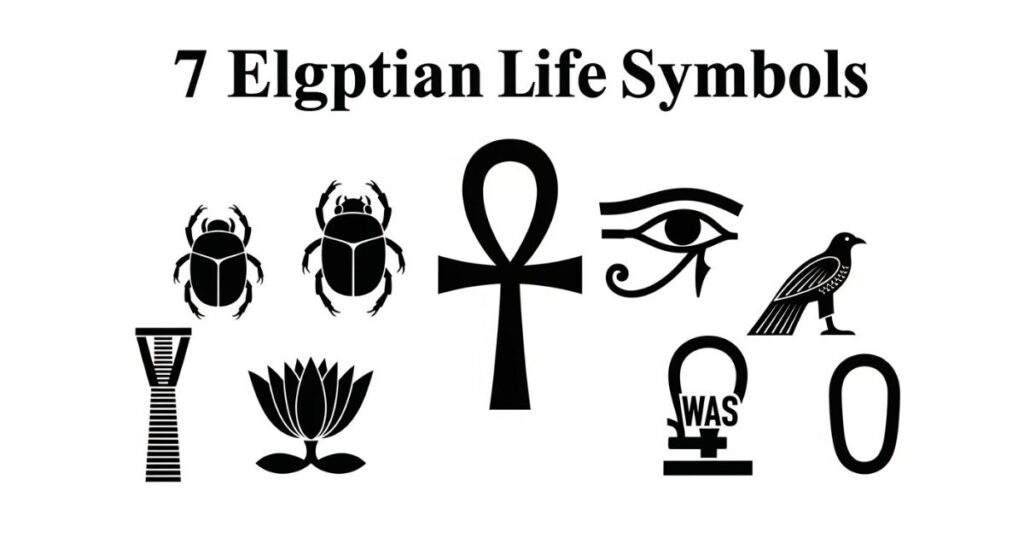
The Ankh
Dating to approximately 3100 BCE, the Ankh symbol meaning is straightforward: life. It was the Egyptian hieroglyphic character for the word “life” and is one of the oldest written symbols in existence. Gods were depicted holding it by the loop and offering it to pharaohs as the gift of eternal life. Today it appears in tattoos and jewelry worldwide as a symbol of immortality and eternal existence.
The Scarab Beetle
The scarab beetle was sacred in ancient Egypt because Egyptians observed it rolling balls of dung across the ground, which they connected to the sun god Khepri rolling the sun across the sky each morning. This made the scarab a powerful symbol of rebirth, renewal, and solar energy. Scarab amulets were placed with the deceased to ensure protection and resurrection in the afterlife.
The Djed Pillar
The Djed pillar represented stability, strength, and endurance and was associated with Osiris, god of the afterlife and resurrection. Shaped like a column with horizontal bands at the top, it was called “the backbone of Osiris” and symbolized the kind of strength required not just for life but for eternal life. It appears frequently in tomb art alongside the Ankh.
The Eye of Horus
The Eye of Horus (Wedjat) represents protection, healing, and the restoration of life. According to Egyptian mythology, Horus lost his eye in battle with Set and had it magically restored. This story made the Eye of Horus a symbol of healing and wholeness. It’s important to distinguish this from the Eye of Ra, which represents the destructive and protective power of the sun god rather than healing and restoration.
Life Symbols With Meaning
Connecting life symbols with meaning to real human experiences makes them far more powerful than abstract definitions ever could.
Someone navigating grief often connects most deeply with the lotus, because it blooms through darkness and mud. It says: your pain is not the end of your story. Someone celebrating survival after illness or hardship finds the phoenix most resonant because it turns destruction into new beginning. Someone focused on family and legacy naturally gravitates toward the Tree of Life.
Here’s a practical guide to matching symbols with life experiences:
| Life Experience | Best Matching Symbol | Core Message |
| Overcoming trauma | Phoenix | Strength through destruction |
| Spiritual growth | Lotus Flower | Beauty from darkness |
| Family and heritage | Tree of Life | Roots and branches |
| New beginnings | Butterfly or Sunrise | Transformation and fresh starts |
| Eternal love | Infinity Symbol | No beginning, no end |
| Inner strength | Circle or Spiral | Wholeness and continuous growth |
Life Symbols Casket Corners
Life symbols on casket corners serve a deeply meaningful purpose: they communicate hope, faith, and the belief that physical death is not the final word. Families and funeral directors select these symbols with care because they represent the deceased’s spiritual beliefs and bring comfort to those left behind.
Common casket corner symbols include the dove (peace and the soul’s journey), the cross (resurrection and eternal life in Christian tradition), the lily (purity and the restored soul), and the wheat sheaf (a life fully harvested, a metaphor for completion). The butterfly also appears frequently, representing the soul’s release and transformation.
These symbols have been part of funeral traditions for thousands of years because they do something essential: they reframe death within the context of life’s larger cycle, offering meaning when grief makes everything feel meaningless.
Life Life Symbols and Meanings
The cycle of life itself is perhaps the deepest concept that life symbols attempt to capture. Birth, living, aging, death, and rebirth form a continuous loop that every human eventually experiences.
The Ouroboros (serpent eating its own tail) is the most direct symbol of this cycle, appearing first in Egyptian texts around 1600 BCE. It says: endings and beginnings are the same thing. The circle expresses the same truth more simply. The phases of the moon (waxing, full, waning, dark, and new again) offer a monthly visual reminder of this cycle in nature. The changing seasons from winter’s death to spring’s rebirth carry this message in the most observable, everyday way possible.
Understanding that life operates in cycles rather than straight lines changes how you experience difficulty. If life is a cycle, then dark phases aren’t permanent endings. They’re necessary passages between one phase and the next.
Everyday Life Symbols
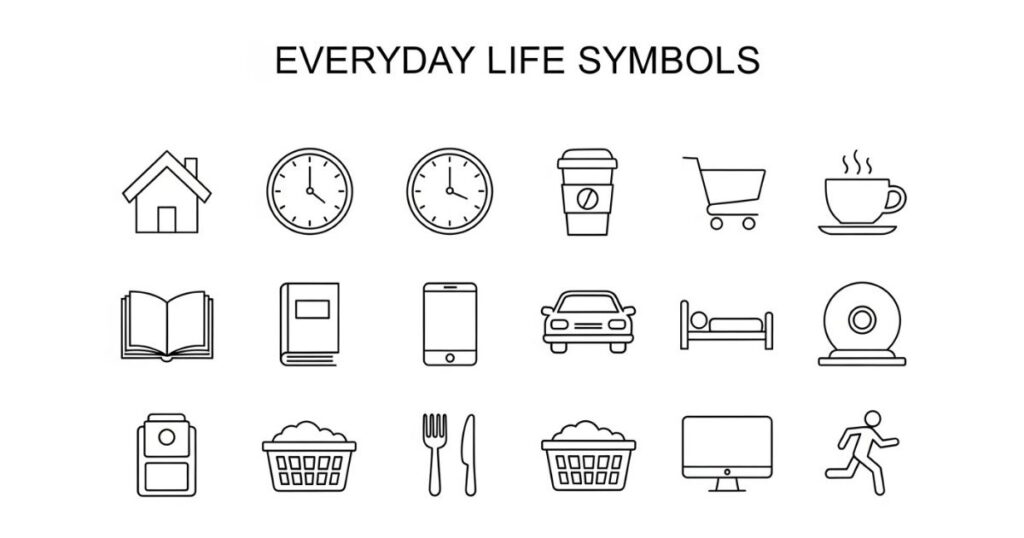
You encounter everyday life symbols constantly without necessarily recognizing them as such.
The heart you tap on a social media post carries thousands of years of symbolism connecting emotion to existence. The wedding ring is a circle: the universal symbol of eternity and the endless nature of committed love. A clock represents life measured in time, the most precious and non-renewable resource any human possesses.
Even a green traffic light carries a life symbol’s energy: proceed, move forward, keep going. These everyday symbols prove that the human impulse to surround life with meaningful imagery hasn’t diminished in the modern age. It’s simply taken new forms.
Real Life Symbols
Real life symbols drawn from actual nature and human experience carry a different kind of power than mythological ones. They’re immediately observable and personally relatable.
A mountain represents life’s challenges and the strength required to climb them. Mountains don’t move for you. You develop the strength to climb them yourself. A river represents life’s constant movement and the wisdom of flowing around obstacles rather than fighting them. A storm followed by sunshine is perhaps the most emotionally resonant real-life symbol: proof that darkness is always followed by light.
People also create deeply personal real-life symbols. A specific song that played during a pivotal moment. A place where something important happened. A photograph that captured who you were before something changed. These personal symbols carry the same emotional power as ancient ones because meaning is never just about history. It’s always also about your story.
Meaning of Life Symbols
Why do symbols carry meaning at all? The answer combines psychology, neuroscience, and cultural history.
Carl Jung proposed that certain symbols are archetypal: they emerge from the collective unconscious, a layer of the human psyche shared across all people regardless of culture. This explains why a spiral feels meaningful in Ireland, Japan, and Peru simultaneously. These shapes tap into something deeper than individual experience.
Neuroscience adds another layer: symbols activate multiple brain regions at once, combining visual processing, emotional memory, and conceptual understanding. A symbol can communicate in milliseconds what a paragraph of text takes minutes to convey. That efficiency is why symbols spread and survive across generations.
The meaning of life symbols is ultimately co-created: the symbol offers a framework, and you bring your experience to it. The result is something more powerful than either alone.
Real Life Symbols of Rebellion
Symbols of rebellion are also life symbols because they represent the fight for the right to live freely, with dignity and self-determination.
The raised fist has represented solidarity and resistance since the 1910s labor movement and became globally recognized during the civil rights movement of the 1960s. The broken chain symbolizes liberation from oppression and has appeared in abolition movements, women’s suffrage, and labor rights campaigns. The peace sign, designed in 1958 by Gerald Holtom for the British nuclear disarmament movement, combined the semaphore signals for “N” and “D” into one of the most recognized symbols in modern history.
The clenched rose of democratic socialist movements represents both the beauty of life (the rose) and the determination to protect it (the clenched fist). These symbols remind us that fighting for life’s value is itself a form of honoring life.
Deep Symbolic Meaning of Life Symbols
Spiritual Meaning
On a spiritual level, life symbols represent the eternal nature of the soul and the continuation of consciousness beyond physical death. Every major spiritual tradition teaches that the physical body is temporary while the soul is not. Life symbols externalize this belief, giving form to something that cannot be seen or measured. The Tree of Life connecting heaven and earth, the lotus emerging from darkness, the phoenix rising from ash: all of these say the same thing spiritually. You are more than your body. Your existence matters beyond what you can observe.
Psychological Meaning
Psychologically, life symbols represent growth, healing, and personal transformation. Jung’s work demonstrated that symbols help the psyche process experiences too complex or painful for linear thought. When someone chooses a phoenix tattoo after surviving something devastating, they’re not just making a design choice. They’re using symbolic language to reframe their experience: I was not destroyed. I was transformed. This is why life symbols consistently appear in therapeutic contexts, grief rituals, and recovery communities.
Cultural Meaning
Culturally, life symbols carry generational wisdom and connect individuals to their ancestors. When you wear an Ankh or display a Tree of Life in your home, you’re participating in a tradition that stretches back thousands of years. That connection to something ancient and larger than yourself is one of the most powerful psychological benefits symbols offer. Culture uses symbols to say: you are not alone. Others have walked this path before you and left these signs to guide the way.
Types and Variations of Life Symbols
1. The Tree of Life
A tree with deep roots and expansive branches. It appears in Norse mythology, Celtic tradition, Jewish mysticism, and Christianity. It represents growth, connection, and the continuity of life across generations.
2. The Ankh
A cross with a loop at the top, originating in ancient Egypt around 3100 BCE. It represents eternal life and immortality and is one of the oldest written symbols for life in human history.
3. The Infinity Symbol
A sideways figure-eight (∞). Originally a mathematical symbol formalized in 1655 by John Wallis, it was adopted by spiritual traditions to represent endless life, infinite love, and limitless possibility.
4. The Spiral
Found in nature (shells, galaxies, DNA), ancient Celtic art, and sacred geometry. Represents the soul’s evolutionary journey: always moving, always expanding, always becoming something more.
5. The Lotus Flower
A flower blooming above muddy water. Central to Buddhist and Hindu spiritual practice. Represents rebirth, purity, and the emergence of beauty from difficult circumstances.
6. The Phoenix
A bird of fire rising from its own ashes. Found in Greek, Egyptian, and Chinese mythology. Represents resurrection, transformation, and immortality through renewal.
7. The Circle
The most universal geometric life symbol. Appears in every culture throughout history. Represents unity, wholeness, and the endless cycle of existence with no beginning and no end.
Life Symbols Across Cultures
Ancient Egypt
Egyptian civilization built its entire afterlife philosophy around life symbols. The Ankh, Scarab, and Eye of Horus all pointed toward the same belief: physical death was a transition, not an ending. Pharaohs were buried surrounded by these symbols to ensure safe passage into eternal life.
Celtic Culture
Celtic life symbols centered on interconnection and nature. The Tree of Life connected human, earthly, and spiritual realms. The Triquetra (triple knot) represented eternal existence through its continuous, unbroken form. Celtic symbols expressed a worldview where everything in nature was alive, connected, and sacred.
Eastern Cultures
In Buddhism and Hinduism, the lotus flower is life’s central symbol. In Chinese culture, the dragon represents life force, prosperity, and cosmic energy. The Om (Aum) symbol in Hinduism represents the primordial vibration from which all life emerged. Eastern life symbols tend to emphasize spiritual awakening and the cyclical nature of existence.
Greek Mythology
The Greeks contributed the phoenix, the olive branch, and the Rod of Asclepius to the world’s treasury of life symbols. Greek life symbolism often paired beauty with struggle: the phoenix must burn to be reborn, the olive tree must be tended to produce fruit. Life, in Greek understanding, was earned through effort and endurance.
Native American Culture
Native American life symbols emphasize harmony with nature and the interconnection of all living things. The circle (sacred hoop) represents the unity of life. The feather represents connection to the sky, the divine, and the freedom of the spirit. The Thunderbird represents the life-giving power of storms and the sky’s creative energy.
Life Symbols in Art, Movies and Pop Culture
Movies
The phoenix appears throughout film as a shorthand for characters who rebuild themselves after trauma. In the Harry Potter series, Dumbledore’s phoenix Fawkes literally bursts into flame and is reborn, visually demonstrating the symbol’s meaning. Terrence Malick’s film The Tree of Life (2011) uses the tree symbol to explore family, grief, and cosmic existence across time.
Paintings
Gustav Klimt’s “The Tree of Life” (1909) is one of the most celebrated paintings in Western art, depicting an ornate golden tree whose branches spread across the entire canvas. Van Gogh’s Starry Night features swirling spiral patterns in the sky that many art historians interpret as visual representations of life energy and the universe’s dynamic, living quality.
Tattoos
The most popular life symbols used in tattoos in the USA include the phoenix (overcoming hardship), the infinity symbol (eternal love or endless possibility), the Tree of Life (family and growth), the lotus (spiritual journey), and the butterfly (personal transformation). Each represents a life story told through permanent imagery.
Fashion and Jewelry
Ankh necklaces experienced a major revival in the 1990s and remain popular today. Infinity rings are among the best-selling jewelry designs in American markets. Lotus earrings and Tree of Life pendants are consistently among the top-searched spiritual jewelry items. People wear these symbols as daily reminders of their values and the stories they’re living.
Spiritual and Dream Meaning of Life Symbols
When life symbols appear in dreams, many psychological and spiritual traditions consider them significant messages from the unconscious mind.
Dreaming of a Tree of Life is often interpreted as a sign of personal growth underway or a call to reconnect with your roots and values. A phoenix in a dream frequently signals that you’re in or emerging from a major life transition. Water dreams connect to emotional flow and the need to let feelings move rather than stagnate. A spiral appearing in dreams often indicates that life is about to expand into a new phase.
From a psychological perspective, dream symbols reflect what your conscious mind hasn’t fully processed. From a spiritual perspective, they can feel like guidance from a deeper source of wisdom. Either way, paying attention to which life symbols appear in your dreams is a meaningful form of self-reflection.
Positive and Negative Meaning of Life Symbols
Positive Meaning
Life symbols carry extraordinary positive meaning: growth, hope, renewal, strength, eternal existence, and new beginnings. The phoenix represents triumph. The lotus represents beauty. The sunrise represents possibility. These positive meanings explain why life symbols appear so consistently in motivational contexts, healing environments, and celebrations of achievement.
Negative Meaning
What many guides fail to acknowledge is that life symbols carry shadow meanings as well, and those shadow meanings make them more truthful, not less. The phoenix requires total destruction before rebirth. The lotus requires darkness and mud to bloom. The ouroboros includes death as part of its eternal cycle. The Tree of Life loses its leaves every winter.
These shadow elements reflect the honest reality that growth requires loss, transformation requires dissolution, and new beginnings require endings. Life symbols that acknowledge this full spectrum are ultimately more comforting than those that promise only light, because they reflect the actual texture of a human life.
Why Humans Are Attracted to Life Symbols
Humans are pattern-recognition creatures by evolutionary design. Our ancestors survived by reading signs in nature: recognizing which plants were safe, which weather patterns signaled danger, which animal behaviors meant predators were near. That deep-wired tendency to find meaning in shapes and patterns is the same impulse that draws people to life symbols.
Beyond evolution, symbols provide emotional anchoring during uncertainty. When life feels chaotic, a meaningful symbol offers a stable point of reference. It says: this truth has held for thousands of years. It will hold now. That continuity is profoundly comforting.
Symbols also serve as identity markers. When someone wears an Ankh or displays a Tree of Life in their home, they’re communicating something essential about who they are and what they believe without needing to explain themselves in words. In that sense, choosing a life symbol is one of the most personal statements a human being can make.
Carl Jung argued that symbols are the language of the soul, operating below conscious thought and speaking directly to the parts of us that words can’t reach. Whether you approach that idea scientifically, spiritually, or simply practically, the result is the same: life symbols matter deeply to human beings and always have.
FAQ’s
What is the most powerful life symbol in the world?
The Tree of Life is widely considered the most powerful because it appears in more cultures, religions, and historical periods than any other single life symbol, representing growth, connection, and eternity universally.
What symbol represents life and death together?
The Ouroboros (serpent eating its own tail) most directly represents both life and death as a single continuous cycle. The Yin-Yang also expresses this balance through its dual nature.
What tattoo symbolizes new life or a fresh start?
The phoenix, butterfly, lotus flower, and sunrise are the most popular tattoo choices for representing new life. Each reflects transformation and the beginning of something meaningful after difficulty.
What is the universal symbol for life?
The circle is the most universal life symbol because no single culture owns it and every civilization has independently used it to represent the eternal cycle of life.
What symbol means eternal life in different religions?
The Ankh in ancient Egyptian religion, the Cross in Christianity, the Infinity symbol in modern spirituality, and the Lotus in Buddhism all represent forms of eternal life within their respective traditions.
What does the Tree of Life mean spiritually?
Spiritually, the Tree of Life represents the connection between heaven, earth, and the underworld. It symbolizes the soul’s journey through different realms and the eternal nature of existence across all major spiritual traditions that use it.
What is the oldest known life symbol in history?
The Ankh is among the oldest, dating to approximately 3100 BCE. However, spiral carvings found at Newgrange in Ireland date to around 3200 BCE and are also considered ancient life symbols.
What symbol represents life in Native American culture?
The sacred circle (sacred hoop) is the most significant life symbol in many Native American traditions, representing the unity of all living things and the cyclical nature of existence.
What do life symbols on caskets mean?
Casket symbols like the dove, lily, cross, and butterfly represent peace, purity, resurrection, and the soul’s transformation respectively. They bring comfort by placing death within the larger context of eternal life.
How do I choose the right life symbol for myself?
Identify the aspect of life most meaningful to your personal story. If you’ve overcome hardship, the phoenix or lotus fits. If family and roots matter most, choose the Tree of Life. If you value infinite possibility, the infinity symbol speaks to you. Your symbol should reflect where you’ve been and where you’re going.
Conclusion
Life symbols are far more than decorative images. They’re mirrors held up to the human experience, reflecting our struggles, our hopes, our deepest questions, and our most enduring truths. From the Ankh carved in ancient Egyptian stone to the phoenix tattooed on a survivor’s skin in modern America, these symbols have followed humanity across every era and every culture because they speak to something that never changes: the need to find meaning in being alive.
Every symbol covered in this guide carries thousands of years of human wisdom. When you encounter one that resonates, it’s not random. It’s recognition. Something in you is responding to something that countless others have also felt and chosen to mark as meaningful.
Whether you wear a life symbol, display one in your home, or simply carry one in your mind as a personal anchor, let it remind you of this: you are part of an ongoing story. One that began long before you arrived and will continue long after. Life is not a straight line from birth to death. It’s a spiral, always expanding, always growing, always becoming something more.

Hi, I’m Ethan Brooks, the admin of SymbolHubz.com. Passionate about symbols, emojis, kaomojis, and text art, helping users discover creative ways to express themselves online.