
Figuring out what time it was 12 hours ago seems simple until the clock crosses midnight or noon. Many people get confused switching between AM and PM, especially when the date also changes. This guide breaks down the exact math, gives real examples, and shows you the fastest way to calculate any time in the past.
Whether you are checking security footage, planning a call across time zones, or just curious, this article gives you a clear, no-fuss method. You will also learn common mistakes people make and how to avoid them every single time.
What Time Was It 12 Hours Ago?
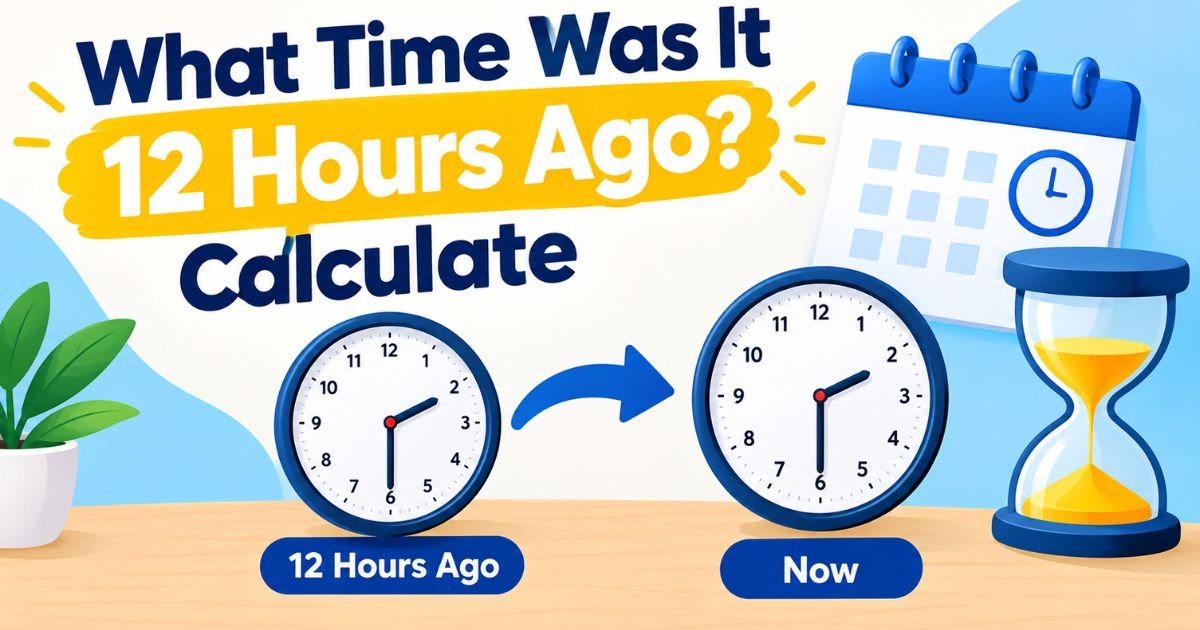
To find the time 12 hours ago, simply subtract 12 hours from the current time. Since a full day has 24 hours, subtracting 12 always flips AM to PM or PM to AM.
- If it is currently 3:00 PM, 12 hours ago it was 3:00 AM.
- If it is currently 9:30 AM, 12 hours ago it was 9:30 PM the previous day.
- The minutes always stay exactly the same during this calculation.
This flip happens because 12 hours is exactly half of a 24 hour cycle, splitting the day evenly.
Understanding the Mathematics Behind Time Calculation
Clocks operate on a 12 hour or 24 hour cycle, and subtraction works differently depending on which format you use. In the 24 hour clock, subtracting 12 is a straightforward numeric operation. In the 12 hour clock, you also have to swap AM and PM manually.
- 24 hour format: 14:00 minus 12 hours equals 02:00.
- 12 hour format: 2:00 PM minus 12 hours equals 2:00 AM.
- Minutes and seconds never change, only the hour and sometimes the date shift.
Understanding this logic removes the guesswork and prevents errors when doing mental math quickly.
What Happens When You Cross Midnight?
When the current time is earlier than 12:00 PM, subtracting 12 hours pushes you into the previous calendar day. This is the part most people forget, and it causes date confusion.
- If it is 5:00 AM today, 12 hours ago it was 5:00 PM yesterday.
- The hour and minute stay identical, but the date rolls back by one full day.
- This matters heavily when checking logs, messages, or timestamps tied to a specific date.
Always check whether your starting time is before or after noon to know if the date will change.
Read More: What Time Was It 11 Hours Ago? Calculate the Exact Time
Why AM and PM Switch Every Twelve Hours
The 12 hour clock is divided into two identical blocks: AM from midnight to noon, and PM from noon to midnight. Since each block lasts exactly 12 hours, moving 12 hours in either direction always lands you in the opposite block.
- AM always becomes PM when you subtract or add exactly 12 hours.
- This rule has zero exceptions, making it one of the most reliable shortcuts in time math.
- It works the same whether you are adding 12 hours forward or going 12 hours backward.
This is why many people use the “flip AM and PM” trick instead of doing full subtraction every time.
What Time Was It 12 Hours Ago: Practical Examples
Seeing real numbers makes the concept click faster than theory alone. Below are five scenarios covering different times of day, including edge cases like midnight and noon.
Example One
If the current time is 8:15 PM, then 12 hours ago it was 8:15 AM on the same calendar day. No date change happens here because 8:15 PM is after noon. This is one of the simplest examples since both times fall within the same day.
Example Two
If the current time is 4:45 AM, then 12 hours ago it was 4:45 PM the previous day. Since 4:45 AM is before noon, the date rolls back automatically. This is a common mistake point for people doing quick mental math.
Example Three
If the current time is exactly 12:00 PM noon, then 12 hours ago it was exactly 12:00 AM midnight the same day. Many people wrongly assume midnight belongs to the next day here, but it does not. Noon and midnight are the two trickiest reference points in time math.
Example Four
If the current time is 12:00 AM midnight, then 12 hours ago it was 12:00 PM noon the previous day. This is the reverse of Example Three and confuses people just as often. Always double check whether you are dealing with 12 AM or 12 PM.
Example Five
If the current time is 6:30 PM, then 12 hours ago it was 6:30 AM on the same day. This falls into the standard afternoon to morning pattern with no date rollback. It is one of the easiest calculations since it avoids the midnight and noon edge cases entirely.
| Current Time | 12 Hours Ago | Date Change? |
| 8:15 PM | 8:15 AM | No |
| 4:45 AM | 4:45 PM (prev day) | Yes |
| 12:00 PM | 12:00 AM | No |
| 12:00 AM | 12:00 PM (prev day) | Yes |
| 6:30 PM | 6:30 AM | No |
Why People Search “What Was 12 Hours Ago From Now”
People search this phrase for many practical reasons, not just curiosity. It often relates to work, security, or coordinating with someone in another part of the world.
- Verifying when a message, email, or notification was actually sent.
- Checking alibis or timestamps for security and legal purposes.
- Calculating medication schedules or feeding times for babies and pets.
- Coordinating meetings or calls with people in opposite time zones.
The search reflects a real, immediate need rather than casual interest, which is why accuracy matters so much.
The Role of Time Zones
Twelve hours ago in your location is not the same moment everywhere else in the world. Time zones shift the actual clock reading even though the elapsed time remains identical.
- Someone in New York and someone in Tokyo experience different clock times for the same 12 hour mark.
- Daylight saving time can add an extra layer of confusion during transition periods.
- Always confirm which time zone a schedule or timestamp refers to before calculating.
Ignoring time zones is one of the biggest sources of scheduling errors in remote work and international communication.
Using Online Time Calculators
Online time calculators remove human error entirely by automating the subtraction process. You simply enter the current time, and the tool instantly displays the result 12 hours earlier.
- Most calculators also let you adjust for different time zones automatically.
- Many tools display both 12 hour and 24 hour formats side by side.
- Some calculators include the exact date, removing any doubt about day rollback.
These tools are especially useful when dealing with multiple time zones or when precision truly matters.
Human Perception of Time
People often misjudge how much time has actually passed, even when the math is simple. This happens because our internal sense of time is influenced by emotion, activity, and attention rather than actual clock minutes.
- Busy periods make 12 hours feel shorter than they actually were.
- Waiting or boredom makes the same 12 hour span feel much longer.
- Sleep breaks up our sense of continuous time, making calculations feel less intuitive.
This is part of why people rely on calculators or written formulas instead of trusting gut feeling alone.
What Time Was It 12 Hours Ago in the 24-Hour Clock?
The 24 hour clock, also called military time, makes 12 hour subtraction purely numeric with no AM or PM flipping required. You just subtract 12 from the hour value directly.
- If it is currently 18:00, 12 hours ago it was 06:00.
- If it is currently 05:00, subtracting 12 gives a negative number, so you add 24 instead, resulting in 17:00 the previous day.
- This format is widely used in aviation, military, and international scheduling to avoid AM and PM confusion.
Many professionals prefer the 24 hour format specifically because it eliminates the ambiguity of the 12 hour system.
Read More: How Long Until 4:30 PM? Easy Time Calculator & Guide
Common Mistakes People Make When Subtracting 12 Hours
Even simple time math trips people up regularly, usually due to small oversights. Below are the four most frequent mistakes and why they happen.
Forgetting the Date Changes
People often subtract the hours correctly but forget the calendar date shifts backward when starting before noon. This creates confusion when matching timestamps to specific days. Always ask whether the original time was AM or PM before finalizing your answer.
Mixing Up Noon and Midnight
Because both noon and midnight display as “12” on a standard clock, people frequently swap AM and PM by accident. This mistake is extremely common in scheduling and legal documentation. Writing 12:00 PM for noon and 12:00 AM for midnight clearly helps prevent this error.
Changing the Minutes
Some people mistakenly round or adjust the minutes when subtracting 12 hours, but minutes should never change. Only the hour value shifts, and occasionally the date. Keeping the minutes locked in place is the easiest way to check your work.
Ignoring Time Zones
When coordinating across regions, people often calculate 12 hours ago using their own local time without adjusting for the other person’s zone. This leads to missed calls, meetings, or deadlines. Always clarify which time zone applies before sharing a calculated time with someone else.
Real-Life Situations Where Knowing 12 Hours Ago Matters
Knowing how to calculate 12 hours ago is not just an academic exercise. It applies directly to daily routines, safety, and professional responsibilities.
Work Schedules
Shift workers often need to know what time their previous shift started or ended exactly 12 hours earlier. This helps with payroll accuracy and confirming overtime hours. It is especially relevant for night shift employees whose schedules cross midnight regularly.
Travel Planning
Travelers frequently calculate 12 hours ago or ahead when booking flights that cross multiple time zones. This helps avoid confusion about departure and arrival times. It also helps when calling family or hotels in a different region.
Reviewing Security Footage
Security teams often need to check footage from exactly 12 hours before an incident was reported. Getting the timestamp wrong can mean reviewing the wrong day entirely. Accurate time subtraction is critical in investigations and evidence gathering.
Medication Reminders
Many medications are scheduled every 12 hours, so patients need to know exactly when the last or next dose falls. Missing this calculation can lead to taking doses too close together or too far apart. This is especially important for antibiotics and heart medications with strict timing.
Online Gaming and Events
Gamers and event organizers often deal with servers or leaderboards that reset every 12 hours. Knowing the exact reset time helps players plan their sessions strategically. Missing this window can affect rankings, rewards, or event participation.
A Simple Formula to Remember
You do not need a calculator for basic cases if you remember this simple rule. It works for almost every situation except the midnight and noon edge cases.
- Keep the minutes exactly the same.
- Flip AM to PM, or PM to AM.
- If the original time was before noon, move the date back by one day.
This three-step formula covers the vast majority of everyday time calculations accurately.
Examples Using Everyday Times
Applying the formula to common daily moments makes it easier to remember for future use. These examples reflect times people check most often throughout a normal day.
- 7:00 AM minus 12 hours equals 7:00 PM the previous day.
- 1:30 PM minus 12 hours equals 1:30 AM the same day.
- 10:45 PM minus 12 hours equals 10:45 AM the same day.
- 11:20 AM minus 12 hours equals 11:20 PM the previous day.
Practicing with familiar times like these builds confidence for calculating any time instantly.
What About Seconds and Milliseconds?
For most everyday purposes, seconds and milliseconds are ignored when calculating 12 hours ago. However, in technical fields like computing or scientific research, precision down to the millisecond matters significantly.
- Server logs and timestamps often include seconds and milliseconds for exact tracking.
- When subtracting 12 hours in these systems, only the hour value changes, while seconds and milliseconds remain untouched.
- This precision is critical in fields like cybersecurity, finance, and scientific data logging.
For casual use, sticking to hours and minutes is more than accurate enough.
Why Time Feels Different Than It Really Is?
Our brains do not process time the same way clocks do, which is why 12 hours can feel drastically different depending on context. Emotional state, activity level, and even age affect this perception significantly.
- Children often perceive time passing more slowly than adults do.
- Stressful or exciting situations compress our sense of elapsed time.
- Repetitive or boring tasks stretch out perceived time significantly.
This gap between real and perceived time is exactly why relying on actual clock math, rather than instinct, gives the most reliable results.
FAQ’s
What time was it 12 hours ago if it is 9 PM now?
It was 9 AM on the same day, since 9 PM is after noon and no date change occurs.
Does the date always change when subtracting 12 hours?
No, the date only changes if the current time is before noon, meaning it is in the AM period.
Is 12 hours ago the same as 12 hours from now?
No, they land on the same clock time due to the 24 hour cycle, but represent opposite directions in time.
How do I calculate 12 hours ago in a different time zone?
First convert the current time to the target zone, then subtract 12 hours using the same AM and PM flip rule.
Why do noon and midnight cause confusion in time math?
Both display as “12” on standard clocks, so people often mix up whether it is 12 AM midnight or 12 PM noon.
Conclusion
Calculating what time it was 12 hours ago becomes simple once you remember the core rule: keep the minutes, flip AM and PM, and check if the date rolls back. The trickiest moments are midnight and noon, so double checking those specific cases avoids most errors. For anything involving time zones or exact precision, an online calculator removes all guesswork instantly. With the formula and examples in this guide, you can confidently work out any time calculation on your own, every single time.

Hi, I’m Ethan Brooks, the admin of SymbolHubz.com. Passionate about symbols, emojis, kaomojis, and text art, helping users discover creative ways to express themselves online.