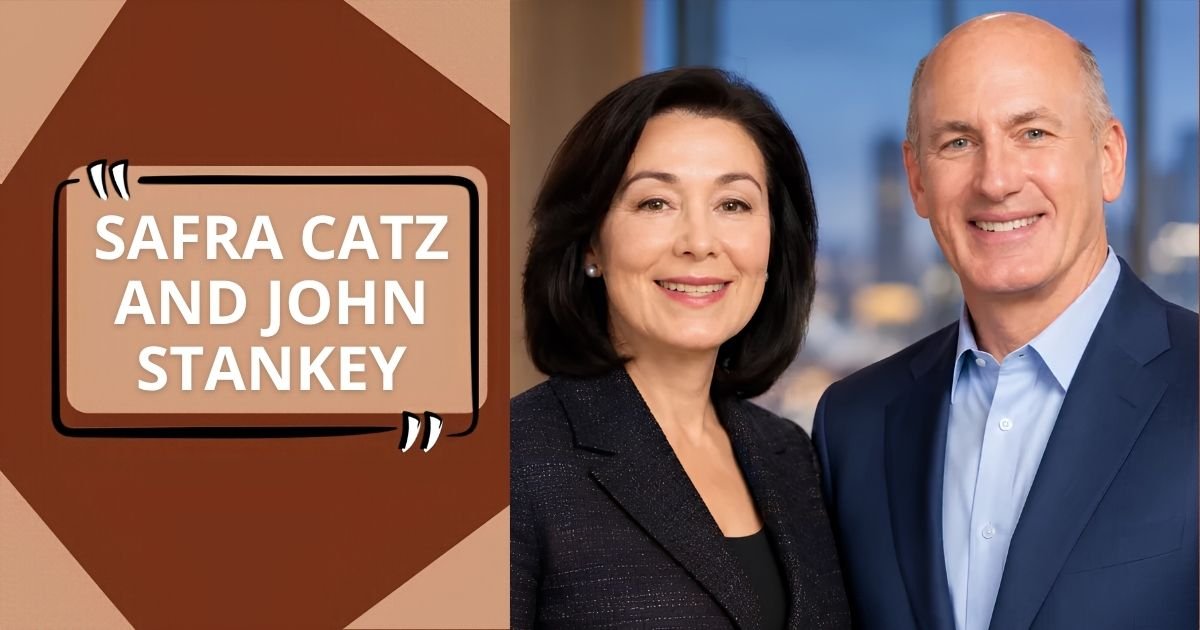

Two executives sit at the center of two very different corporate stories in 2026. Safra Catz moved from Oracle CEO to Executive Vice Chair. John Stankey leads AT&T as both CEO and Chairman.
Many articles still list outdated titles for both. This guide gives you the current picture, backed by recent filings and company announcements.
You will learn who each leader is, how they got here, what they changed, and where they stand today.
Who Is Safra Catz?
Safra Catz is an Israeli-American business executive. She is best known for running Oracle, the enterprise software and cloud giant, for more than a decade.
She was born in Holon, Israel, in December 1961. She has been at Oracle since 1999 and on its board since 2001.
Quick facts:
- Current title: Executive Vice Chair of Oracle’s board
- Former roles: CFO, President, co-CEO, CEO
- Education: University of Pennsylvania (undergraduate and law degrees)
- Other roles: Board member at In-Q-Tel and Paramount Skydance, and lecturer at Stanford Graduate School of Business
Safra Catz’s Early Career and Finance Background
Catz did not start in software. She started in investment banking.
She joined Donaldson, Lufkin & Jenrette in 1986. Over the years she rose to senior vice president and later managing director, where she covered technology clients.
That work shaped her style. She learned to read balance sheets quickly and to judge whether a deal made financial sense.
Larry Ellison, Oracle’s founder, recruited her in 1999. She joined as a senior vice president and was promoted to executive vice president within months.
That finance-first background explains much of her later reputation for discipline and cost control.
How Safra Catz Built Her Career at Oracle
Her climb at Oracle followed a clear path:
- 1999: Joins Oracle as senior vice president
- 2001: Joins the board of directors
- 2011: Named co-president and chief financial officer
- 2014: Becomes co-CEO alongside Mark Hurd
- 2019: Becomes sole CEO after Hurd’s health leave
- 2025: Becomes Executive Vice Chair
Colleagues often describe her as the operator who kept the company running while Ellison focused on technology. That reputation helped Oracle through several major shifts.
Read More: Diane von Furstenberg and Jake Gyllenhaal
Oracle Acquisitions and Business Strategy
Oracle grew largely through acquisitions, and Catz was deeply involved in many of them. Notable deals during her tenure include:
- PeopleSoft (2005): Expanded Oracle’s business applications
- Sun Microsystems (2010): Added hardware and the Java platform
- NetSuite (2016): Strengthened its cloud software lineup
- Cerner (2022): Pushed Oracle into healthcare technology
The pattern is consistent. Buy established products, integrate them, cut overlap, and protect margins.
Her later strategy leaned on Oracle Cloud Infrastructure (OCI) and artificial intelligence. In her words at the time of her transition, Oracle had become a cloud of choice for both AI training and inferencing.
From Oracle CEO to Executive Vice Chair
In September 2025, Oracle announced a leadership change. Clay Magouyrk and Mike Sicilia became co-CEOs, and Catz moved into the Executive Vice Chair role.
Magouyrk previously led OCI. Sicilia ran Oracle Industries, which builds industry-specific applications with AI built in.
Catz described the moment as the right time to hand the CEO job to the next generation. She stayed on the board and kept working on strategy.
Who Is John Stankey?
John Stankey is the Chairman and CEO of AT&T. He has held the CEO role since July 2020 and added the chairman title in February 2025.
He holds an MBA from UCLA and an undergraduate degree from Loyola Marymount University. He also serves on the board of UPS.
Quick facts:
- Current titles: Chairman, CEO and President of AT&T
- Joined AT&T: 1985
- Time in the CEO seat: About six years as of 2026
- Predecessor: Randall Stephenson
John Stankey’s Long Career Across AT&T
Stankey is a true company veteran. He has spent roughly four decades inside AT&T and its predecessor companies.
His résumé covers almost every part of the business:
- Corporate strategy and mergers
- Chief Technology Officer
- CEO of AT&T Business Solutions
- CEO of AT&T Operations
- CEO of the Entertainment Group
- CEO of WarnerMedia
That breadth matters. He understands networks, enterprise customers, consumer products and media. Few telecom CEOs can say the same.
John Stankey’s Climb Through AT&T
His rise was gradual and well documented. Randall Stephenson’s board began succession planning in 2017, and the decision to promote Stankey was unanimous.
From Technology Executive to AT&T CEO
Stankey became president and chief operating officer in October 2019. He remained head of WarnerMedia at the same time.
On July 1, 2020, he took over as CEO from Stephenson, who had led the company for 13 years. In February 2025, he also became board chair, succeeding William Kennard, who moved to lead independent director.
Holding both titles gives him strong influence over long-term strategy.
AT&T and the Shift Away From DirecTV
The biggest theme of his tenure is simplification. Stankey reshaped AT&T from a sprawling media and telecom conglomerate into a focused connectivity company.
Key steps:
- 2021: Sold a 30% stake in DirecTV to TPG, with cash distributions of about $19 billion
- 2022: Completed the WarnerMedia combination with Discovery, creating Warner Bros. Discovery
- 2025: Agreed to sell the remaining 70% DirecTV stake to TPG for about $7.6 billion
After the DirecTV announcement, Stankey said the company was repositioned around its connectivity strengths. The goal was to become the leading provider of converged 5G and fiber services.
What Stankey Changed Inside AT&T
His changes fall into two big buckets: how AT&T sells to customers, and how it uses technology.
A Customer-Focused Business Strategy
Stankey’s central idea is convergence. That means selling fiber home internet and wireless service together, so customers stay longer and spend more.
AT&T has backed that idea with large investments:
- Fiber growth: AT&T passed 30 million fiber locations in 2025 and aims to exceed 60 million by 2030
- Lumen deal: A $5.75 billion purchase of Lumen’s consumer fiber business closed in February 2026
- EchoStar spectrum: A roughly $23 billion deal closed on July 28, 2026, adding 30 MHz of 3.45 GHz mid-band and 20 MHz of 600 MHz low-band spectrum
- Fiber build plans: Stankey said 2026 would be AT&T’s largest year for fiber expansion, with about 8 million new locations, including over 4 million acquired from Lumen
The EchoStar spectrum supports AT&T Internet Air, its fixed wireless service, and boosts 5G speeds and capacity.
There is a financial tradeoff. AT&T expects its leverage to rise to about 3.2 times after the EchoStar close. It plans to bring that back to roughly 2.5 times within about three years.
AI and Technology at AT&T
Stankey connects the network build to the AI era. On a recent earnings call, he said AT&T achieved over $1 billion in cost savings last year. He plans to speed up efficiency gains by using AI and moving more customer transactions online.
He also argues that fiber and spectrum will matter as AI traffic grows. AI tools need strong upload speeds and low delay. AT&T says its 600 MHz low-band spectrum helps with exactly that.
The company has also said it is working with cloud providers on fiber links into AI data centers.
Safra Catz and John Stankey: A Side-by-Side Look
These two leaders run different businesses. Still, their careers share useful parallels.
Different Industries, Similar Corporate Responsibilities
Oracle sells databases, enterprise applications and cloud infrastructure. AT&T sells wireless, fiber internet and business connectivity.
Yet both leaders carry similar duties:
- Allocating capital across large, long-term bets
- Managing big acquisitions and integrations
- Balancing debt, growth and shareholder returns
- Preparing for demand created by artificial intelligence
- Planning succession and leadership transitions
AI infrastructure links them. Oracle builds the cloud capacity AI runs on. AT&T builds the networks that carry AI traffic to and from it.
Two Different Paths to Corporate Leadership
Their routes to the top look quite different.
| Factor | Safra Catz | John Stankey |
| Starting point | Investment banking | Telecom operations and strategy |
| Joined current company | 1999 | 1985 |
| Became CEO | 2014 (co-CEO), 2019 (sole CEO) | 2020 |
| Core strength | Finance and deal making | Operations and network strategy |
| Defining move | Large software and cloud acquisitions | Refocusing on fiber and 5G |
| 2026 title | Executive Vice Chair | Chairman and CEO |
Catz came from outside the industry and learned it through finance. Stankey grew up inside one company and rotated through nearly every division.
Read More: The Truth Behind Peter Orszag’s Hair: Bald, Balding, or Wig?
Safra Catz and John Stankey in 2026
In 2026, one leader is in a post-CEO advisory phase, and the other is in a heavy execution phase.
Catz is helping guide strategy from the board while new co-CEOs run daily operations. Stankey is still deep in operations, integrating Lumen and deploying new spectrum.
Where Each Leader Stands in 2026
Titles change quickly, so this section reflects the most recent filings and announcements.
Safra Catz’s Current Role at Oracle
Oracle’s 2026 proxy statement lists Catz as Executive Vice Chair, a role she has held since September 2025. She has been a director since 2001.
Her current profile includes:
- Executive Vice Chair of Oracle’s board
- Chair of the Oracle Education Foundation
- Trustee at In-Q-Tel
- Lecturer at Stanford Graduate School of Business
She is no longer Oracle’s CEO. Magouyrk and Sicilia hold that job as co-CEOs.
John Stankey’s Current Role at AT&T
AT&T filings list Stankey as Chairman of the Board, CEO and President. He has led the company since 2020.
His 2026 priorities are clear:
- Finish integrating Lumen’s fiber assets
- Deploy the EchoStar spectrum, including 600 MHz over roughly the next year
- Grow fiber and wireless customers together
- Lower leverage back toward the 2.5 times target
- Use AI to cut costs and improve service
What Their 2026 Positions Show
Both leaders show how large companies handle change.
Oracle chose a planned handoff while the business was growing quickly. The founder-era leadership team stayed involved, and two executives closer to cloud and industry products took over.
AT&T chose continuity. A long-tenured insider consolidated power as CEO and chairman, then used it to push a narrow, infrastructure-heavy plan.
Readers should also note a caution. Both companies carry real risks, including debt, heavy spending and fast-changing technology. Their strategies are bets, not guarantees.
Conclusion
Safra Catz and John Stankey lead very different organizations, yet their stories share a common thread: long careers, big deals and careful succession.
Catz built Oracle through acquisitions and a pivot toward cloud and AI. In 2025, she passed the CEO role to two co-CEOs and moved into an Executive Vice Chair position.
Stankey simplified AT&T after the media era. He is now pushing fiber, 5G, spectrum and AI-ready networks as the company’s core.
FAQs
Is Safra Catz still the CEO of Oracle?
No. Catz became Executive Vice Chair in September 2025, and Clay Magouyrk and Mike Sicilia now serve as co-CEOs.
What does an Executive Vice Chair do at Oracle?
An Executive Vice Chair sits on the board and helps guide long-term strategy. Day-to-day operations sit with the co-CEOs.
When did Safra Catz join Oracle?
She joined in April 1999 as a senior vice president and joined the board in 2001.
Who is the CEO of AT&T in 2026?
John Stankey is CEO of AT&T. He has held the role since July 2020.
Is John Stankey also the chairman of AT&T?
Yes. He became chairman in February 2025, succeeding William Kennard.
Why did AT&T sell DirecTV?
AT&T sold DirecTV to focus on 5G and fiber. The remaining 70% stake went to TPG for about $7.6 billion.
What did AT&T buy from EchoStar?
AT&T bought about 50 MHz of spectrum for roughly $23 billion. The deal closed on July 28, 2026.
What is AT&T’s convergence strategy?
It means selling fiber internet and wireless service together. The aim is to keep customers longer and raise value per household.
Hi, I’m Ethan Brooks, the admin of SymbolHubz.com. Passionate about symbols, emojis, kaomojis, and text art, helping users discover creative ways to express themselves online.