
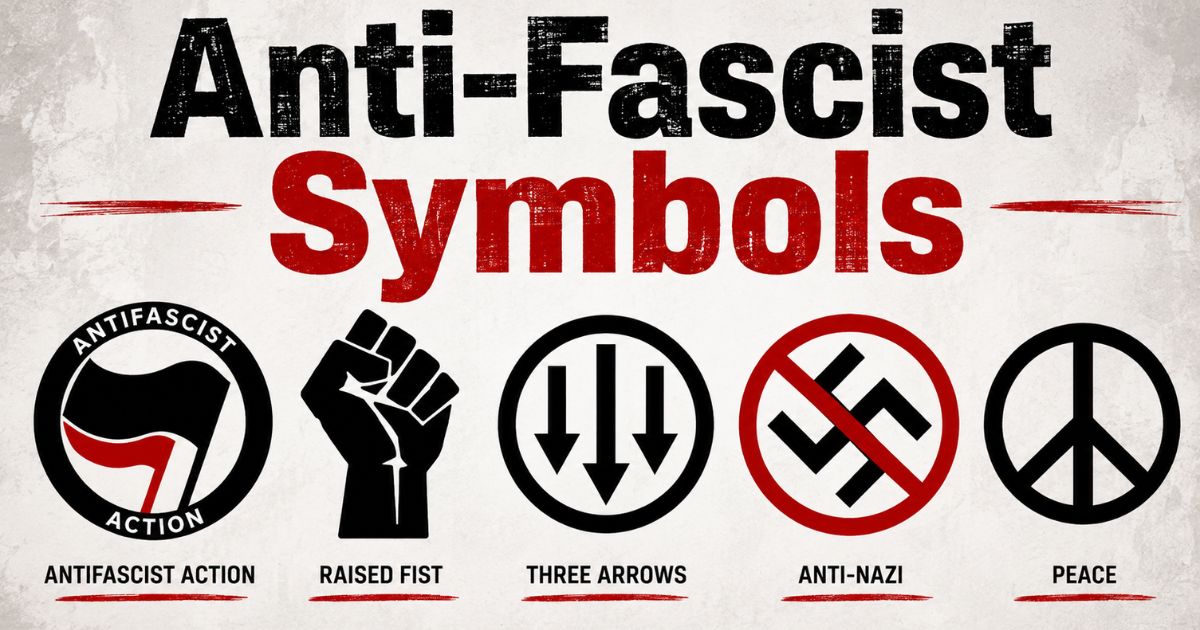

Anti-fascist symbols have shaped protest culture, political art, and collective memory for nearly a century. From the Three Arrows of 1930s Germany to the modern Antifa flag, these images carry messages of resistance, unity, and defiance against authoritarian rule. This guide breaks down over 100 anti-fascist symbols, tracing their origins, meanings, and use across different countries and eras.
Whether you are researching history, designing artwork, or simply curious about what these symbols represent, this article gives you clear, accurate, and practical information you can trust.
What Are Anti-Fascist Symbols?
Anti-fascist symbols are visual markers used by individuals and groups to express opposition to fascism, authoritarianism, and far-right extremism. They range from simple geometric shapes to detailed flags and emblems.
- They communicate political identity without requiring words
- They often originate from historical resistance movements
- They are used in protests, artwork, clothing, and digital media
- Many combine colors like red and black to signal specific ideologies
These symbols serve as a shorthand for shared values. People recognize them instantly, which makes them powerful tools for organizing and signaling solidarity across borders and languages.
History and Origins of Anti-Fascist Symbols
Anti-fascist symbolism emerged directly in response to the rise of fascist movements in Europe during the early 20th century. As fascist parties gained power in Italy and Germany, opposition groups needed visual tools to unify their resistance.
- The 1930s saw the birth of iconic symbols like the Three Arrows
- Trade unions, socialists, and communists often collaborated on shared imagery
- World War II intensified the use of anti-fascist iconography across occupied Europe
- Post-war movements adapted older symbols for new political struggles
Germany’s Iron Front, founded in 1931, is credited with creating some of the earliest organized anti-fascist visual identity. Their designs influenced resistance symbolism for decades afterward.
The symbols evolved again during the 1970s and 1980s as European anti-fascist and anti-racist skinhead subcultures adopted and modified earlier designs. This gave rise to the flags and logos most associated with modern Antifa movements today.
More Symbols: Holy Thursday Symbols
Most Famous Anti-Fascist Symbols and Their Meanings
Some anti-fascist symbols have become globally recognized. Each carries a distinct history and visual language, even though they share a common purpose of opposing authoritarian rule.
Three Arrows Symbol
The Three Arrows symbol originated with Germany’s Social Democratic Party in the early 1930s as a direct response to Nazi and Communist symbolism. Each arrow represented opposition to a specific threat: fascism, communism, and monarchism.
- Designed by Sergei Chakhotin, a Russian emigre political scientist
- Used by the Iron Front paramilitary organization
- Still appears in some European social democratic movements today
- Symbolizes coordinated, multi-front resistance
The three downward-pointing arrows visually represent piercing through opposing ideologies. It remains one of the most historically significant anti-fascist emblems.
Antifa Symbol
The modern Antifa symbol features two flags, one red and one black, often overlapping in a circle. This design became widely recognized starting in the 1980s in Germany and spread internationally afterward.
- Red flag traditionally represents socialism and labor movements
- Black flag represents anarchism and autonomous resistance
- The circular arrangement suggests unity between different anti-fascist tendencies
- Widely used on flags, patches, and protest banners
This symbol does not represent a single organization. Instead, it functions as a general banner for decentralized anti-fascist activism across many countries.
Raised Fist Symbol
The raised fist is one of the oldest and most widely recognized protest symbols in the world. It predates modern anti-fascism but became strongly associated with resistance movements during the 20th century.
- Used by labor unions since the early 1900s
- Adopted by anti-fascist fighters during the Spanish Civil War
- Later embraced by civil rights and anti-authoritarian movements globally
- Represents strength, unity, and defiance
Because of its broad usage, the raised fist carries multiple layered meanings depending on context, but its core message of collective power remains constant.
Circle-A Symbol
The Circle-A, an “A” enclosed within a circle, is primarily an anarchist symbol but is frequently used within anti-fascist contexts due to overlapping ideological roots.
- Popularized in the 1960s by anarchist youth movements in France
- The “A” stands for anarchy, the circle represents order
- Often paired with anti-fascist slogans in graffiti and posters
- Common in punk and DIY protest culture
While not exclusively anti-fascist, the symbol’s association with anti-authoritarian resistance makes it a frequent companion to other anti-fascist imagery.
No Fascism Symbol
The No Fascism symbol typically shows a swastika or fascist emblem crossed out with a diagonal line, similar to a standard prohibition sign.
- Directly communicates rejection without ambiguity
- Common in public awareness campaigns and educational materials
- Used internationally due to its universally understood format
- Frequently appears on stickers, pins, and digital graphics
This symbol prioritizes clarity over stylistic complexity, making it effective for mass communication and quick recognition.
Red and Black Anti-Fascist Symbols
Red and black color schemes dominate anti-fascist visual identity because they represent the two major political traditions historically opposed to fascism.
| Color | Traditional Meaning | Associated Movement |
| Red | Socialism, labor rights | Social Democrats, Communists |
| Black | Anarchism, autonomy | Anarchist and autonomist groups |
| Red and Black together | Unified resistance | Modern Antifa movements |
This combination appears in flags, patches, banners, and digital graphics across nearly every country with an active anti-fascist presence.
Anti-Fascist Flags and Banners
Flags remain central to anti-fascist visual culture because they are highly visible in marches and demonstrations. Different regions have developed their own variations.
- The classic red and black diagonal split flag
- Regional flags incorporating national colors alongside anti-fascist symbols
- Union-specific banners combining trade symbols with resistance imagery
- Custom designs created for specific protests or commemorations
Flags allow groups to display identity at scale, making them essential tools during large public demonstrations and historical commemorations alike.
Anti-Fascist Symbols and Their Meanings
Beyond their visual designs, anti-fascist symbols consistently represent a handful of core values. Understanding these underlying meanings helps explain why certain designs endure across generations.
Symbol of Resistance
Resistance is the foundational meaning behind nearly every anti-fascist symbol. These images signal active opposition rather than passive disagreement with authoritarian systems.
- Symbols often depict action, such as arrows or raised fists
- Historical resistance fighters used these images for identification
- Modern activists continue this tradition in protests today
The theme of resistance connects symbols created decades apart, linking historical struggles to contemporary movements.
More Symbols: Mental Health Symbols
Symbol of Freedom
Freedom from oppression is a recurring theme, especially in symbols created during periods of occupation or dictatorship.
- Broken chains frequently appear in anti-fascist artwork
- Open hands and doves sometimes accompany resistance imagery
- Freedom symbolism often pairs with national liberation movements
These designs emphasize liberation as the ultimate goal behind anti-fascist organizing, not just opposition for its own sake.
Symbol of Solidarity
Solidarity symbols emphasize collective action over individual struggle. Anti-fascism has always relied on coalitions between different political groups.
- Interlocked hands or arms appear in many designs
- Multi-colored flags represent coalition politics
- Shared symbols allow diverse groups to march under one banner
This unifying function is one reason anti-fascist symbols have remained relevant across such a wide range of political contexts.
Symbol of Equality
Equality-focused symbols often intersect with anti-racist and anti-discrimination movements, reflecting fascism’s historical basis in racial and ethnic hierarchy.
- Symbols combining anti-fascist and anti-racist imagery are common
- Rainbow and multicultural elements sometimes appear in modern designs
- Equality themes connect anti-fascism to broader human rights movements
This overlap explains why anti-fascist symbols frequently appear alongside civil rights and anti-discrimination campaigns today.
Symbol of Opposition to Fascism
Direct opposition remains the clearest and most literal meaning across this entire category of symbols, distinguishing them from broader protest iconography.
- Many symbols directly reference or negate fascist imagery
- Historical accuracy in symbol design helps preserve collective memory
- Educational use of these symbols supports awareness of fascism’s history
This direct, unambiguous opposition is what separates anti-fascist symbols from general anti-authoritarian or protest imagery.
Anti-Fascist Symbols by Country and Region
Anti-fascist symbolism has developed distinct regional characteristics, shaped by each area’s specific historical experience with fascism and authoritarian rule.
Anti-Fascist Symbols in Europe
Europe holds the deepest historical connection to anti-fascist symbolism, given the continent’s direct experience with fascist regimes during the 20th century.
- Germany: birthplace of the Three Arrows and modern Antifa flag
- Italy: partisan symbols from the World War II resistance
- Spain: imagery from the Spanish Civil War and anti-Franco movements
- Greece: symbols tied to resistance against military dictatorship
European anti-fascist symbols often carry specific historical weight tied to named events, battles, or resistance organizations from the 1930s and 1940s.
Anti-Fascist Symbols in the United States
American anti-fascist symbolism largely draws from European traditions while adapting to domestic political movements and civil rights history.
- Widespread use of the red and black Antifa flag since the 2000s
- Overlap with anti-racist and civil rights symbolism
- Local chapter-specific patches and designs
- Integration with broader anti-authoritarian protest culture
US-based symbols tend to emphasize connections between anti-fascism and domestic struggles against racism and political extremism.
Anti-Fascist Symbols in Latin America
Latin American countries developed anti-fascist symbolism largely in response to military dictatorships and authoritarian regimes throughout the 20th century.
- Chile: symbols linked to resistance against the Pinochet regime
- Argentina: imagery tied to the Dirty War and disappeared persons
- Brazil: symbols opposing military rule from 1964 to 1985
- Regional adaptation of European red and black iconography
These symbols often merge anti-fascist themes with human rights advocacy, given the widespread use of state violence during these dictatorships.
Anti-Fascist Symbols in Asia
Asian anti-fascist symbolism developed differently, often tied to anti-imperialist and anti-militarist movements rather than direct opposition to European-style fascism.
- Japan: post-war pacifist and anti-militarist symbols
- South Korea: imagery from pro-democracy movements against military rule
- India: symbols connected to anti-colonial and anti-authoritarian struggles
While less globally recognized, these regional symbols share the same underlying commitment to opposing authoritarian control.
Anti-Fascist Symbols in the Middle East
Middle Eastern anti-fascist symbolism often intersects with anti-imperialist and pro-democracy movements, reflecting the region’s complex political history.
- Symbols opposing authoritarian nationalist regimes
- Overlap with broader human rights and pro-democracy imagery
- Localized adaptations rather than direct European symbol imports
This region’s anti-fascist symbolism tends to be less standardized, reflecting diverse political contexts across different countries.
Three Arrows and Other Historical Anti-Fascist Symbols
The Three Arrows symbol deserves special attention as one of the most historically documented anti-fascist designs, but it was not the only historical symbol of its era.
- Three Arrows: created by the Iron Front in 1932 Germany
- Clenched Fist Salute: used by Republican forces in the Spanish Civil War
- V for Victory: adopted by resistance movements across occupied Europe
- Broken Cross: an inverted or damaged swastika used in protest art
Each of these historical symbols emerged from specific organizational needs. The Three Arrows, for example, was designed specifically to counter the visual dominance of Nazi and Communist party symbols during German elections.
These historical designs laid the groundwork for the more standardized anti-fascist imagery used today, proving that visual resistance strategies have remained consistent across nearly a century.
More Symbols: Healing Symbols
Antifa Symbols: Meanings, History and Variations
Antifa, short for anti-fascist, refers to a decentralized political movement rather than a single organization. Its symbolism has evolved significantly since its German origins.
- Original German Antifa flag: created in the 1980s, red and black double flag design
- Regional variations: countries often add national colors or local text
- Text-based designs: some variations include words like “Antifaschistische Aktion”
- Simplified modern versions: streamlined for use on patches, stickers, and digital graphics
Because Antifa is not centrally organized, no single authority controls symbol usage. This has led to significant creative variation while the core red and black visual identity remains consistent.
| Variation | Region | Distinguishing Feature |
| Original German design | Germany | Text banner with flags |
| US adaptation | United States | Simplified flag-only version |
| European regional versions | Various | National color accents |
| Digital era designs | Global | Minimalist, icon-based |
Understanding these variations helps clarify why the same general symbol can look slightly different depending on where and when it was produced.
Anti-Fascist Symbols in Art, Music and Popular Culture
Anti-fascist symbolism extends well beyond protest signs into broader cultural production, particularly within punk, hardcore, and politically engaged art movements.
- Punk rock bands frequently incorporate anti-fascist imagery into album art
- Street artists use symbols like the Circle-A and raised fist in murals
- Documentary filmmakers reference historical symbols to provide context
- Museums preserve original resistance-era materials for public education
Music scenes, particularly punk and hardcore, have played a major role in keeping historical anti-fascist symbols visible to younger generations. Bands often use these images on merchandise and stage backdrops.
Visual artists have also reinterpreted classic symbols using modern techniques, blending historical accuracy with contemporary design sensibilities to keep the imagery relevant for new audiences.
Anti-Fascist Symbols for Tattoos and Design
Many people choose anti-fascist symbols for tattoos and personal design projects as a permanent statement of political identity or historical remembrance.
- Raised fist tattoos remain among the most popular choices
- Circle-A designs work well in minimalist tattoo styles
- Three Arrows tattoos appeal to those interested in specific European history
- Custom combinations blending multiple symbols are increasingly common
Before getting a tattoo, research the specific historical origin of your chosen symbol. Some designs carry region-specific meanings that may not translate the same way in every country.
Designers working on merchandise or graphics should also verify that any symbol they use is factually and historically accurate, since misrepresenting these images can cause confusion or unintended offense.
Anti-Fascist Symbols Copy and Paste
For digital use, several anti-fascist related characters and simple symbols can be copied directly using standard text characters, useful for social media bios or quick graphics.
| Symbol | Character | Common Use |
| Raised Fist | ✊ | Social media, protest posts |
| Circle | ⭕ | Base for custom Circle-A designs |
| Star | ★ | Combined with other resistance symbols |
| Cross Mark | ✗ | Used in “No Fascism” style graphics |
| Peace Sign | ☮ | Paired with anti-war messaging |
For more complex symbols like the Antifa double flag or Three Arrows, a proper vector graphic or image file is recommended instead of text characters, since these designs cannot be accurately represented with standard Unicode symbols.
Difference Between Anti-Fascist and Fascist Symbols
Understanding the distinction between anti-fascist and fascist symbols is essential, since confusing the two can lead to serious historical and ethical misunderstandings.
| Aspect | Anti-Fascist Symbols | Fascist Symbols |
| Purpose | Oppose authoritarian rule | Promote authoritarian nationalism |
| Origin | Resistance movements | State propaganda apparatus |
| Common colors | Red and black | Black, red, and white with rigid geometry |
| Modern legality | Generally unrestricted | Banned in several countries |
| Associated values | Solidarity, equality, resistance | Hierarchy, nationalism, exclusion |
Fascist symbols, such as the swastika or fasces used by Mussolini’s regime, are explicitly designed to promote authoritarian control and exclusionary nationalism. Anti-fascist symbols exist specifically to oppose these ideas.
Several European countries have laws restricting the public display of fascist symbols due to their historical association with genocide and war crimes. Anti-fascist symbols generally do not face the same legal restrictions.
Modern Use and Significance of Anti-Fascist Symbols
Today, anti-fascist symbols continue to play an active role in political movements, education, and cultural expression across the globe.
- Used in ongoing protests against far-right political movements
- Featured in educational materials about 20th century history
- Adapted for digital activism on social media platforms
- Incorporated into clothing, art, and merchandise by independent creators
These symbols remain significant because the historical conditions that produced them, namely authoritarian nationalism and state violence, continue to resurface in various forms around the world.
As new generations encounter these symbols, understanding their historical roots becomes increasingly important for accurate and respectful use, whether in activism, education, or creative projects.
Frequently Asked Questions
What is the most recognized anti-fascist symbol?
The red and black Antifa flag and the raised fist are the two most globally recognized anti-fascist symbols today.
Where did the Three Arrows symbol originate?
It was created in 1932 Germany by the Iron Front to visually oppose fascism, communism, and monarchism simultaneously.
Is the Circle-A symbol exclusively anti-fascist?
No, it is primarily an anarchist symbol but is frequently used alongside anti-fascist imagery due to shared political roots.
Are anti-fascist symbols legal everywhere?
Yes, anti-fascist symbols are generally legal worldwide, unlike some fascist symbols which are banned in certain countries.
What do the colors red and black represent in Antifa symbols?
Red represents socialist and labor traditions, while black represents anarchist and autonomous resistance movements.
Can anti-fascist symbols be used in tattoos?
Yes, many people choose these symbols for tattoos, though researching historical accuracy beforehand is recommended.
Is the raised fist only an anti-fascist symbol?
No, it originated in labor movements and has since been used by civil rights, anti-authoritarian, and anti-fascist movements alike.
Final Thoughts
Anti-fascist symbols carry nearly a century of history, evolving from specific European resistance organizations into a globally recognized visual language of opposition to authoritarianism. Understanding their origins, from the Three Arrows to the modern Antifa flag, helps clarify their meaning beyond surface-level recognition.
Whether encountered in historical archives, street art, music culture, or personal design projects, these symbols consistently represent resistance, solidarity, freedom, and equality. Approaching them with accurate historical context ensures their meaning remains respected and correctly understood across new generations and diverse cultural contexts.

Hi, I’m Ethan Brooks, the admin of SymbolHubz.com. Passionate about symbols, emojis, kaomojis, and text art, helping users discover creative ways to express themselves online.