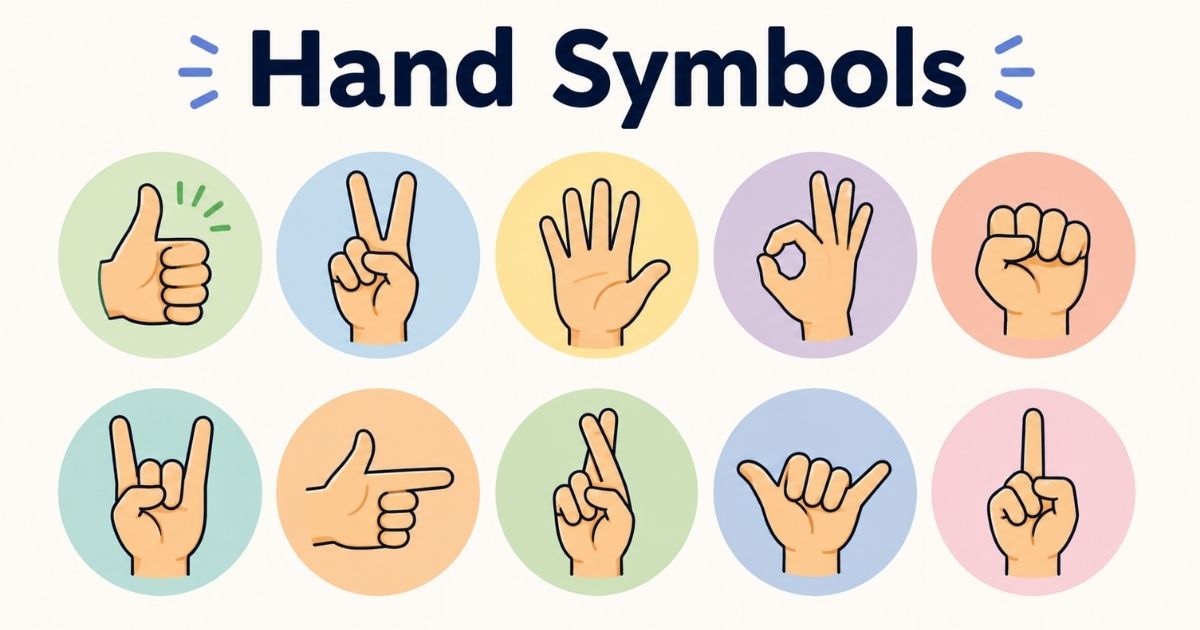

Hand symbols are gestures or hand-shaped images that communicate ideas, beliefs, and emotions without a single word being spoken. Think about the last time you waved goodbye, gave a thumbs up, or pressed your palms together to say thanks. You didn’t need a sentence. Your hand did the talking.
Long before humans wrote the first word, they painted handprints on cave walls. They raised open palms to show they meant no harm. They pressed two hands together to pray. Hand symbols have followed us through every era of human history, and in 2026, they’re just as alive in emojis, TikTok trends, and protest signs as they were in ancient temples.
This guide breaks down the meaning, history, and psychology behind the world’s most recognized hand gestures, so you’ll never look at a raised fist or a folded palm the same way again.
What Are Hand Symbols?
Hand symbols are any gesture, hand position, or image of a hand that carries meaning beyond its physical shape. They show up in religious art, street culture, sign language, and everyday body language. A single open hand can say “stop,” “hello,” or “I come in peace,” depending entirely on context.
What makes hand symbols so powerful is that they’re universal in a way spoken language isn’t. You don’t need to speak French to understand a wave or a clenched fist. This gesture communication taps into something older than language itself, our shared instinct to read intention through movement.
Hand Symbols And Meanings Guide
Hand symbols rarely mean just one thing. The same gesture can shift in meaning depending on the culture, the setting, or even the speed and force behind it. That’s what makes hand symbolism in culture such a rich and sometimes tricky subject to study.
Below, we’ll unpack the most searched questions about hand symbols, one small piece at a time, so you walk away with real answers instead of vague generalities.
You Can Also Explore: German Symbols
Hand Symbols And Meanings
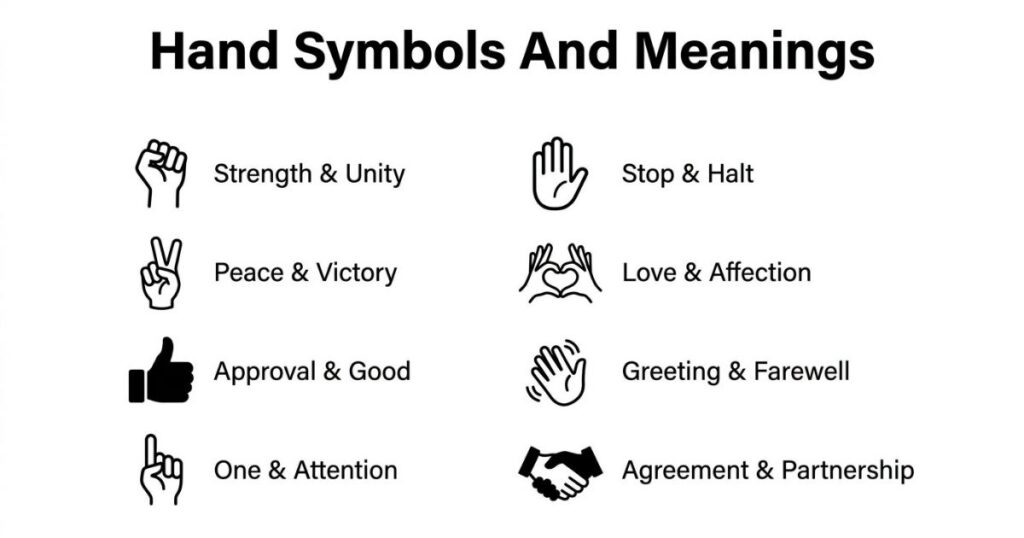
At their core, hand symbols fall into four buckets: protection, power, communication, and connection. A protective hand symbol like the Hamsa wards off bad energy, while a handshake builds trust between two people. Knowing which bucket a gesture falls into is the fastest way to understand its purpose.
Hand Symbol Meanings
The exact same gesture can carry opposite meanings. A closed fist might represent strength and solidarity at a rally, but anger and aggression in a heated argument. Hand gesture psychology tells us that tone, facial expression, and setting shape how a gesture gets interpreted just as much as the gesture itself.
Hand Symbol Meaning
If you’re trying to decode a single hand symbol, ask four questions: What shape is it? Who’s using it? Where is it happening? What’s their tone? This simple framework works for nearly any gesture you come across, from ancient religious art to a modern selfie.
Hand Symbol Meaning Spiritual
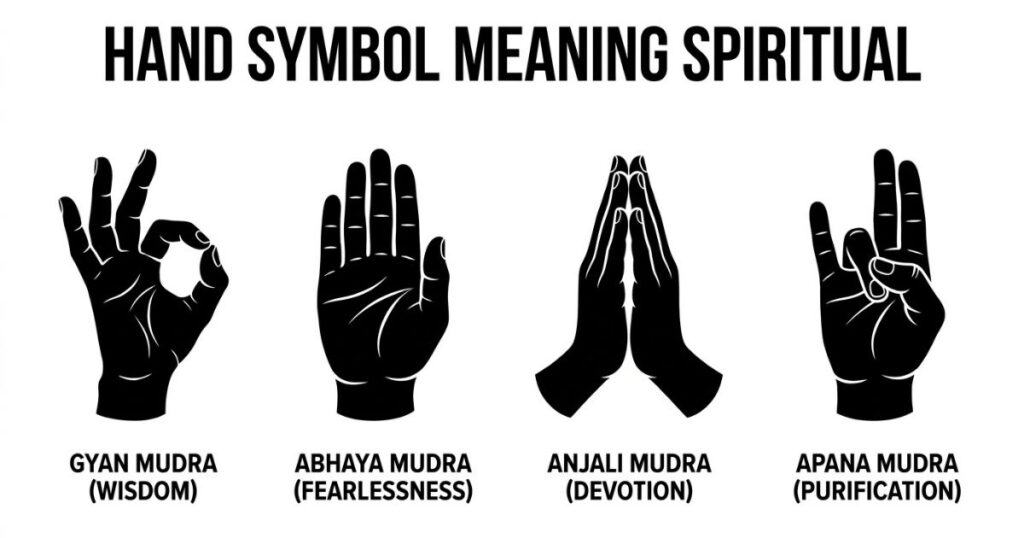
Spiritually, hands are often seen as channels of energy. Many traditions, including meditation hand gestures used in yoga, believe the hands can direct, receive, or balance the body’s inner force. This is why spiritual hand gestures appear so often in prayer, healing rituals, and sacred art across the world.
Hand Symbol
In its simplest form, a hand symbol is any gesture or image of a hand used to represent an idea instead of stating it outright. It’s symbolic shorthand, built into how humans have always communicated.
Hand Symbolism
Hand symbolism goes one layer deeper than the gesture itself. It’s the meaning system behind the movement, the cultural agreement that says “this shape equals this idea.” Without that shared understanding, a gesture is just a hand in the air.
Hand Symbolism Meaning
The meaning behind hand symbolism usually traces back to one of three roots: religion, authority, or survival instinct. A blessing gesture borrows from religious tradition. A raised fist borrows from political history. An open palm borrows from our oldest instinct, proving we’re not holding a weapon.
Hands Symbolism
When two hands are involved instead of one, the meaning often shifts toward connection. Prayer hands, clasped hands, and handshakes all use both hands to represent unity, agreement, or devotion rather than individual expression.
What Do Hands Symbolize?
Hands generally symbolize power, protection, care, and unity, but the specific meaning always depends on how they’re positioned and used. An outstretched hand can offer help. A pointed finger can issue a command. Same body part, completely different message.
What Do Hands Represent?
Beyond symbolism, hands represent action itself. They’re the part of the body most directly tied to doing, building, creating, fighting, healing. That’s part of why human hand symbolism carries so much emotional weight; we associate hands with what people actually do, not just what they say.
You Can Also Explore: Symbols of Friendship
What Does The Hand Symbol Mean?
There’s no single universal answer here. The meaning changes with design, culture, and context, which is exactly why this guide breaks gestures down individually instead of offering one blanket definition.
What Does A Hand Represent?
A hand represents human connection and effort. It’s the part of us that reaches out first, whether that’s a handshake at a job interview or a parent’s hand guiding a toddler’s first steps.
Symbolism Of Hands
Across nearly every culture studied by anthropologists, hands link physical action to deeper emotional and spiritual meaning. That dual nature, practical and symbolic at once, is what keeps hand symbolism such a rich topic centuries later.
Hand Gestures And Modern Meanings
Modern life runs on hand gestures meaning something instantly. We use them in texting, video calls, sports, and casual greetings dozens of times a day, often without thinking twice. Some are warm and welcoming. Others can land as rude or even offensive, depending on where in the world you’re using them.
Understanding the difference matters more than ever in 2026, especially with how globally connected everyday communication has become.
Hand Gestures Meaning With Pictures
Visual context makes gestures instantly clearer. A thumbs up pointed upward typically signals approval in the United States. A wave at chest height usually means hello or goodbye. Picture-based learning helps because gestures often look subtly different depending on hand angle and finger spacing.
Hand Gestures And Their Meanings List
Here are some of the most common symbolic hand signs people use daily:
- Open palm – honesty, peace, or “stop”
- Thumbs up – approval or agreement
- Peace sign – calm, victory, or nonviolence
- Fist – strength, solidarity, or anger
- Wave – greeting or farewell
- Finger guns – playful approval (mostly U.S. slang)
- OK sign – approval in the U.S., but offensive in parts of Latin America
Hand Signs With Meaning
Hand signs differ slightly from casual gestures because they’re usually intentional and tied to a specific subculture, sport, or community. Think of referee signals in football or hand signs used between musicians during a live performance.
Hand Signs
A hand sign is a deliberate, often standardized gesture used to communicate a specific message quickly, without needing any spoken explanation.
Hand Signs Meanings
Sign language is the clearest example of structured hand signs with fixed meanings. American Sign Language (ASL) assigns exact hand shapes to letters and words, making it one of the most precise forms of hand signs and meanings in everyday use.
Hand Signs And Meanings
Regional and cultural context heavily shapes how hand signs get interpreted. A celebratory gesture at a U.S. football game might mean something completely different at an international match, which is why athletes and travelers alike benefit from learning local norms.
Hand Signs With Deep Meaning
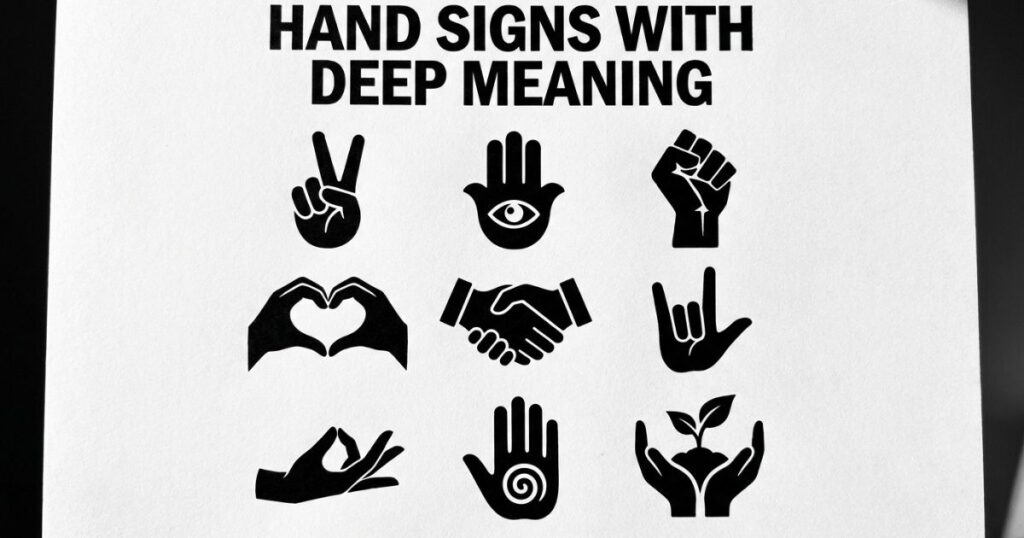
Some hand signs carry layers of meaning tied to identity and belonging, like fraternity and sorority signs, military hand signals, or religious blessing gestures. These aren’t casual; they’re markers of membership in a specific group.
Modern Hand Signs
Social media has created an entirely new wave of modern hand signs. The finger heart, popularized by Korean pop culture, has become a global symbol of affection. The “this is fine” hand wave and various TikTok dance gestures now carry meaning that didn’t exist a decade ago.
7 Powerful Hand Gestures
Some of the most widely recognized powerful hand symbols include:
- Raised fist for strength and resistance
- Open palm for peace and honesty
- Heart hand sign for love and affection
- Victory sign for success
- Prayer hands for faith and gratitude
- Pointing finger for direction or emphasis
- Clapping hands for appreciation
You Can Also Explore: Filipino Symbols
Bad Hand Gestures Meaning With Pictures
Cultural awareness matters here. The OK sign, friendly in the U.S., is considered vulgar in Brazil. A thumbs up, positive in most Western countries, is offensive in parts of the Middle East and West Africa. If you’re traveling internationally, it’s worth double-checking common gestures before using them casually.
Spiritual, Ancient And Cultural Hand Symbols
Spirituality and hand gestures have been linked since the earliest recorded civilizations. Ancient hand symbols appear in Egyptian hieroglyphs, Roman statues, and prehistoric cave paintings, often representing divine power, protection, or life force itself.
These weren’t decorative choices. Ancient artists and priests used hand positions deliberately, the same way modern religious leaders still do during ceremonies and blessings today.
Hand Symbol Meanings Spiritual
In spiritual contexts, hands are often seen as conduits of energy that connect the physical and divine. This belief spans continents, from Hindu mudras to Christian blessing gestures.
Hand Symbols Spiritual
Many spiritual practices treat the hands as tools for focus during prayer or meditation, channeling intention into a physical, repeatable form.
Spiritual Hand Symbols
These symbols typically aim to invite protection, healing, or enlightenment. They’re found in temples, churches, and meditation spaces around the world.
Spiritual Hand Symbols And Meanings
The Hamsa hand invites protection and blessings, while Buddhist mudras direct specific spiritual outcomes like fearlessness or compassion. Each carries centuries of accumulated meaning passed down through religious teaching.
Hand Meaning Symbol
A symbol’s meaning is rarely accidental. It usually traces back to a specific religious text, cultural belief, or historical event that shaped how people understood that particular gesture.
Hand Symbols Meanings
Across faiths, certain themes repeat: protection, devotion, and transformation. These shared themes are part of why so many spiritual hand symbols feel intuitively familiar, even across unrelated religions.
Hands Symbol Meaning
Two hands joined together almost universally signal unity, devotion, or surrender, whether in Christian prayer, Buddhist mudras, or simple human comfort.
Powerful Hand Symbols
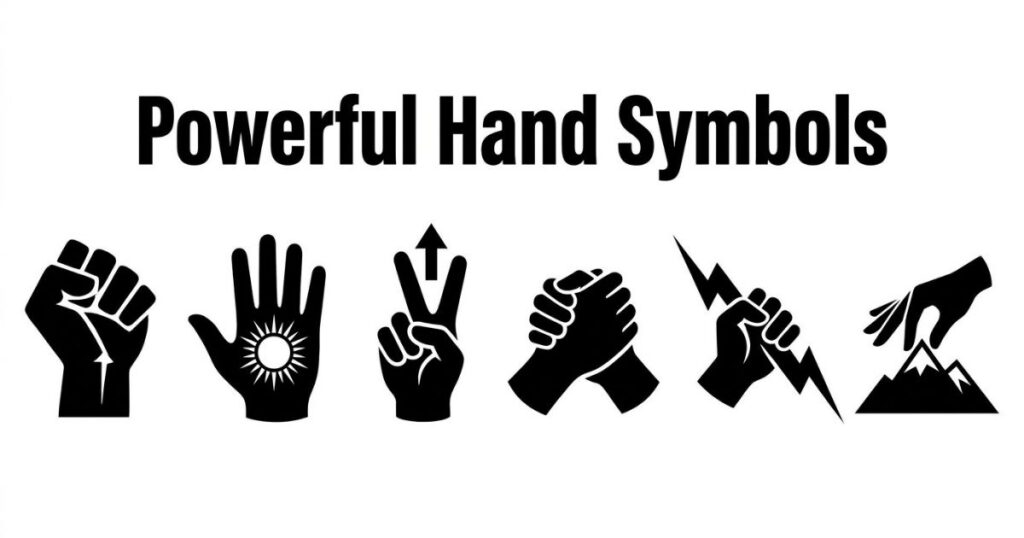
The Hamsa, the raised fist, and prayer hands rank among the most visually and emotionally powerful hand symbols still in active use today, spanning religious, political, and everyday contexts.
Ancient Hand Symbols And Meanings
In Ancient Egypt, hand gestures in art symbolized authority and divine life force. In Ancient Greece and the Roman Empire, open hands in sculpture often represented oratory power and philosophical thought. Prehistoric handprints found in caves across Europe and Indonesia, some over 40,000 years old, are believed to be among humanity’s earliest forms of self-expression.
Hand Symbols And Their Meaning
Each ancient symbol tells a story shaped by the values of its time, whether that’s divine protection, political power, or simple proof of human presence.
Religious, Occult And Pop Culture Hand Symbols
Religious and spiritual traditions have used hand gestures as sacred communication for thousands of years. From a priest’s raised hand in blessing to a monk’s meditative mudra, religious hand symbols carry weight precisely because they’re rarely used casually.
It’s worth noting that meanings here can be deeply contested or sensitive, especially when symbols cross over into conspiracy culture or get reinterpreted by pop culture far outside their original context.
Christian Hand Symbols
In Christianity, the raised hand in blessing and the sign of the cross are two of the most recognized blessing hand gestures. Statues and paintings of religious figures frequently show hands positioned to convey grace, protection, or divine authority.
Buddhist Hand Symbols
Buddhism uses mudras extensively. The Abhaya mudra (palm facing outward) represents fearlessness, the Dhyana mudra represents meditation, and the Bhumisparsha mudra represents the moment of enlightenment. Each mudra has a specific spiritual function tied directly to Buddha‘s teachings.
Satanic Hand Symbols
This gesture, often shown as two raised fingers with the others folded down, is widely recognized in heavy metal and rock culture as a symbol of rebellion rather than literal religious devotion in most everyday use.
Satanic Hand Symbols And Meanings
It’s worth separating pop-culture usage from actual LaVeyan Satanism, where the symbol carries a more specific philosophical meaning tied to individualism rather than what’s commonly assumed.
Demonic Hand Symbols
These gestures appear most often in horror films and fictional media rather than real religious practice, used to visually signal danger, evil, or the supernatural to an audience.
Occult Hand Symbols
Occult traditions use hand gestures as part of hidden or mystical rituals, often intended to be understood only by initiated members of a specific practice or order.
Illuminati Hand Symbols
The triangle hand gesture, formed by joining the thumbs and index fingers, is frequently linked to conspiracy theories about secret societies, though its actual documented connection to any real organization remains unproven.
Masonic Hand Symbols
Freemasonry uses hand gestures as part of its ritual structure, historically meant to help members recognize one another. These gestures date back centuries and remain part of Masonic tradition today.
Freemason Hand Symbols
Beyond ritual, these gestures historically functioned as recognition signs, allowing members from different lodges to identify one another even without prior introduction.
Sorority Hand Symbols
Greek life organizations use specific hand signs tied to each chapter, often representing their letters or founding values. These signs function similarly to a visual handshake among members.
Entertainment And Specialized Hand Signs
Pop culture has created its own universe of hand symbols, some purely fictional, others rooted in real-world practice. These gestures matter because they shape how younger audiences first encounter the idea of symbolic hand movements.
From anime to music classrooms, these specialized signs prove that hand symbols and meanings keep evolving well past their ancient and religious origins.
Naruto Hand Symbols
In the anime Naruto, characters perform hand seals like Tiger, Snake, and Ram to “activate” fictional ninja techniques. These seals are loosely inspired by real mudras, repurposed for storytelling rather than spiritual practice.
Domain Expansion Hand Symbols
Popularized by Jujutsu Kaisen, these gestures represent a character unleashing immense fictional power. They’ve become genuinely popular among fans recreating poses for photos and social media.
Solfege Hand Symbols
Used in music education, Curwen hand signs assign a specific hand shape to each musical note (do, re, mi, and so on), helping students visualize pitch relationships during singing lessons.
Deep Symbolic Meaning of Hand Symbols
Spiritual Level
Spiritually, hand symbols often represent divine protection, healing, and energy flow. Open palms symbolize surrender and trust, closed fists represent resistance, and two hands joined together symbolize unity. In many traditions, the right hand represents giving while the left represents receiving, a distinction still honored in several modern spiritual practices.
Psychological Level
Body language experts have long noted that hands reveal emotion faster than words do. Clenched fists signal anger before a person even speaks. Open hands build trust because they show, instinctively, that no weapon is hidden. This is a survival-based response wired deep into the human brain, and it’s part of why hand gesture psychology remains such an active area of behavioral research today.
Cultural Level
Culturally, hand symbols carry collective memory. A single raised fist can unite a crowd of thousands at a protest. A peace sign can cross borders without needing translation. Communities give these symbols power simply by agreeing, often without realizing it, on what they mean.
Types and Variations of Hand Symbols
| Symbol | Meaning | Origin/Where It Appears |
| Hamsa Hand | Protection from the evil eye | Middle East, North Africa, Islamic and Jewish traditions |
| Mudras | Spiritual energy, balance, focus | Hinduism, Buddhism |
| Raised Fist | Resistance, solidarity | Civil rights movements, activism |
| Peace Sign | Peace, victory, harmony | 1960s counterculture, global use |
| Handshake | Trust, agreement | Business, diplomacy, everyday greetings |
| Open Palm Blessing | Divine protection | Christian religious art |
1. Hamsa Hand
The Hamsa hand, shaped like an open palm with an eye at its center, is one of the most recognized protective hand symbols and meanings in the world. Popular across Islamic and Jewish traditions, it’s believed to ward off the evil eye and invite blessings, strength, and good fortune to whoever wears or displays it.
2. Mudras
Mudras are precise finger positions used during yoga and meditation to direct spiritual energy. The Gyan mudra, joining thumb and index finger, promotes focus and wisdom. The Anjali mudra, palms pressed together at the chest, represents gratitude and respect. These mudra hand positions remain central to Hindu and Buddhist spiritual practice.
3. Raised Fist
The raised fist symbolism became globally recognized during 20th century civil rights and labor movements. Today it still represents resistance, unity, and collective power, appearing at protests and rallies around the world.
4. Peace Sign
The peace sign meaning of calm and nonviolence took hold during Vietnam War protests in the 1960s. Formed with the index and middle finger raised in a V shape, it remains one of the most universally understood gestures on the planet.
5. Handshake
The handshake symbolism of trust and equality dates back to ancient times, when extending an empty right hand proved you weren’t holding a weapon. It remains the default greeting in business and diplomacy across most of the Western world.
6. Open Palm Blessing
In Christian art, figures like Jesus are frequently depicted with a raised, outward-facing palm. This blessing hand gesture represents divine protection and grace, a visual shorthand still used in religious ceremonies today.
Hand Symbols Across Cultures
Ancient Civilizations
In Ancient Egypt, hand gestures in hieroglyphs symbolized life force and royal authority. In Ancient Greece, sculpted hands conveyed philosophical thought and dramatic emotion, visible in surviving statues today.
South Asian Traditions
In India and Nepal, mudras remain central to spiritual practice and classical dance, where intricate hand gestures tell entire stories without a single spoken word.
Middle Eastern Cultures
The Hamsa remains a deeply sacred protective symbol, commonly worn as jewelry or displayed at home entrances to ward off negative energy.
Western Culture
In the U.S. and broader Western culture, hand symbols dominate everyday life: courtroom oaths, concert hand signs, sports celebrations, and casual greetings all rely heavily on cultural hand gestures.
East Asian Symbolism
In Japan and China, specific hand gestures used in martial arts represent discipline and inner balance, often passed down through generations of formal training.
Hand Symbols in Art, Movies and Pop Culture
Few scenes capture hand symbolism better than Titanic, where Jack and Rose’s hands pressed against the glass during the ship’s final moments symbolize love and irreversible separation. It’s a wordless image that still resonates decades later.
In Michelangelo‘s The Creation of Adam, the nearly touching fingertips of God and Adam represent the spark of life itself, arguably the most famous hand symbol in art history. Superhero films lean on the same instinct: villains clench fists, heroes extend open hands. Even emojis follow this pattern, with a thumbs up approving and folded hands expressing thanks or prayer in seconds.
Spiritual and Dream Meaning of Hand Symbols
In folklore and dream interpretation traditions, hand symbols often represent control, connection, or vulnerability. Dreaming of open hands is traditionally associated with readiness to receive something new, while dreaming of injured hands is linked to feelings of powerlessness.
These interpretations come from cultural and spiritual tradition rather than clinical psychology, so it’s worth treating them as reflective tools rather than scientific fact. Still, many people find genuine value in journaling these symbols when they appear in dreams or meditation.
Positive vs Negative Meaning of Hand Symbols
The same symbolic hand movement can carry opposite meanings depending entirely on context:
| Gesture | Positive Meaning | Negative Meaning |
| Open Hand | Honesty, peace | Surrender, weakness |
| Raised Fist | Justice, unity | Aggression, threat |
| Joined Hands | Unity, devotion | Dependence |
This duality is exactly what makes hand symbols so powerful. They reflect the full range of human emotion, not just one fixed idea, which is part of why context always matters more than the gesture alone.
Why Humans Are Attracted to Hand Symbols
Humans are drawn to hand symbols because hands are an extension of identity itself. From the moment we’re born, we reach for connection: a baby grips a finger, a child waves goodbye, a couple holds hands in silence.
Neurologically, a disproportionately large area of the human brain is dedicated to hand movement and sensation, more than almost any other body part relative to size. That’s why we respond to hand gestures almost instantly. They signal safety, threat, love, or power within a split second, long before our conscious brain catches up.
FAQ’s
What does it mean when someone shows you their palm?
Showing an open palm typically signals honesty, peace, or a request to stop. It’s one of the oldest trust gestures in human history.
What’s the difference between a hand sign and a hand gesture?
A hand sign is usually intentional and tied to a specific group or meaning, while a hand gesture is often casual, like waving or pointing.
Is the OK hand sign offensive?
In the U.S., it generally means approval. In Brazil and parts of the Middle East, it can be considered offensive, so context matters when traveling.
What do crossed fingers mean?
Crossing your fingers is a Western superstition believed to bring good luck or to silently “cancel” a promise you don’t intend to keep.
What does a heart hand sign mean on social media?
Popularized through Korean pop culture, the finger heart represents affection, gratitude, or love, and has become a global gesture on platforms like Instagram and TikTok.
Are hand symbols the same across all cultures?
No. While some gestures like an open palm are nearly universal, many others, like the OK sign or thumbs up, vary dramatically depending on the country.
What’s the meaning of touching your heart with your hand?
This gesture commonly represents gratitude, sincerity, or heartfelt emotion, often used as a silent way to say “thank you” or “I mean this.”
Conclusion
Hand symbols are far more than simple gestures. They’re a living record of human belief, emotion, and history, connecting cave painters to modern activists, monks to filmmakers, and strangers to loved ones. Every time you raise a hand, extend a palm, or clasp someone else’s fingers, you’re speaking a language older than words themselves.
The next time you notice a hand symbol, whether in a painting, a protest, or a simple text message, take a second look. It might be carrying centuries of meaning in a single, silent shape.

Hi, I’m Ethan Brooks, the admin of SymbolHubz.com. Passionate about symbols, emojis, kaomojis, and text art, helping users discover creative ways to express themselves online.