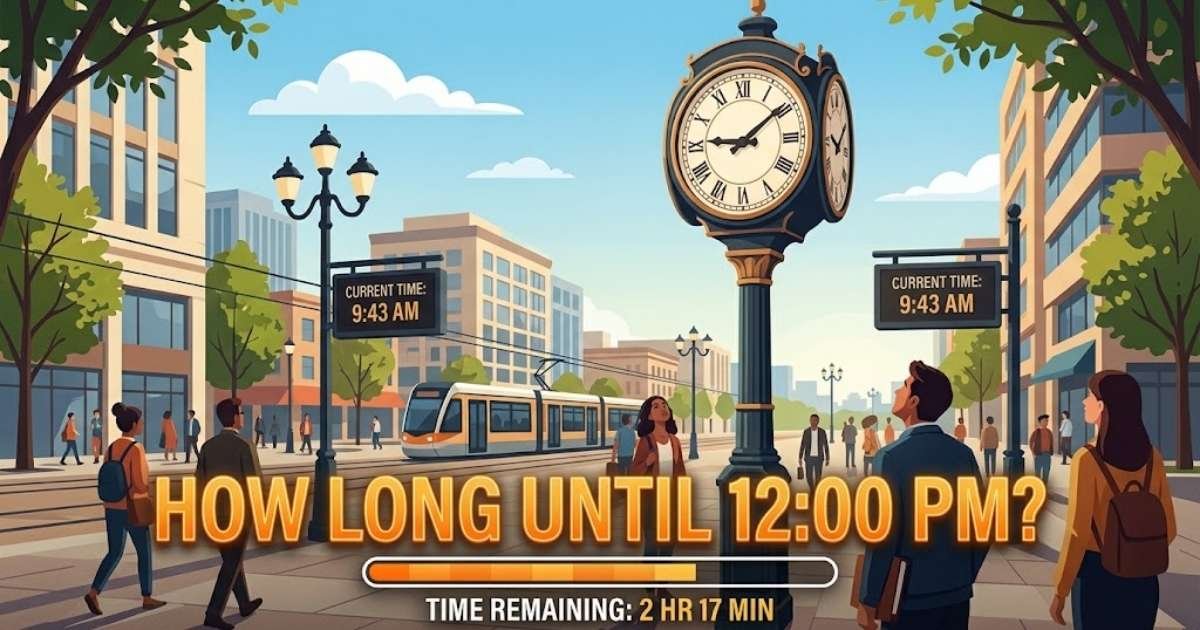

Knowing exactly how much time is left until 12:00 PM can help you plan your morning with precision. Whether you are racing to finish a task, prepping for a meeting, or simply curious about the clock, a quick calculation gives you clarity. This guide breaks down noon countdowns, time conversions, and time zone effects in simple terms. You will also find manual calculation steps and practical ways to use this information daily.
Understanding How Long Until 12:00 PM
The phrase “how long until 12:00 PM” refers to the exact duration between the current moment and noon. This countdown changes every second, which is why live tools are more accurate than a one time glance at the clock. Noon marks the midpoint of the daytime hours, making it a natural checkpoint for tracking progress. People use this countdown to structure tasks, meals, and breaks around a fixed target. Understanding this concept helps you make better use of your morning hours.
- Noon is always 12:00 PM, never 12:00 AM
- The countdown resets daily at midnight
- It applies differently depending on your local time zone
- Live countdown tools update automatically without manual math
Why People Search “How Long Until 12:00 PM”
Millions of people check countdown queries every day for very practical reasons. Some are tracking a deadline that falls right at noon, such as a school assignment or work submission. Others use it to gauge how much morning time remains before lunch or a scheduled call. Parents and students often check this to manage school pickup or exam timing. This search reflects a broader need for quick, accurate time awareness without doing mental math.
- Meeting a noon deadline for work or school
- Planning lunch or a midday break
- Tracking fasting windows that end at noon
- Coordinating noon-based events across time zones
How Countdown Timers Help With Daily Planning
Countdown timers turn an abstract number into a visual, easy to understand format. Instead of calculating hours and minutes yourself, the timer does it instantly and keeps counting down live. This reduces the mental load of checking the clock repeatedly throughout the morning. Many people use countdowns to stay accountable during focused work sessions or study blocks. The visual pressure of a shrinking timer often improves focus and task completion speed.
| Benefit | How It Helps |
| Saves time | No manual calculation needed |
| Reduces stress | Clear visual of remaining time |
| Improves focus | Creates a sense of urgency |
| Increases accuracy | Automatically adjusts every second |
Time Conversion: From AM and PM to 24-Hour Format
Many calculators and scheduling tools use the 24-hour format instead of AM and PM. Converting between the two systems is simple once you understand the basic rule. For AM hours, the 24-hour format matches the standard number, except midnight, which becomes 00:00. For PM hours, you add 12 to the standard number, except 12:00 PM itself, which stays as 12:00. Knowing this conversion prevents confusion when working with digital tools or international schedules.
- 12:00 AM becomes 00:00 in 24-hour format
- 9:00 AM stays as 09:00
- 12:00 PM stays as 12:00
- 3:00 PM becomes 15:00
- 11:00 PM becomes 23:00
Read More: How Long Until 3:00 PM? Calculate the Exact Time Remaining Today
How Time Zones Affect the Noon Countdown
Noon does not happen at the same moment everywhere in the world, since each time zone has its own local 12:00 PM. If you are coordinating a task or call with someone in another region, your countdown to noon may differ by several hours from theirs. This is especially important for remote teams, online classes, or global events scheduled around midday. Daylight saving time can also shift the countdown by an hour during certain months. Always confirm which time zone a noon deadline refers to before finalizing plans.
- Local noon depends on your specific time zone
- UTC offset determines the exact time difference
- Daylight saving time changes noon calculations twice a year
- Cross-time zone planning requires checking both parties’ local times
Creative Ways to Use a Noon Countdown
A countdown to noon is not just a number, it can be a practical tool for structuring your entire morning. Different people apply it in different ways depending on their goals and daily routine. Below are four common and effective ways to use this countdown creatively. Each approach turns a simple time check into a productivity strategy.
Morning Productivity Challenge
Set a personal goal to complete your top three tasks before the noon countdown hits zero. This creates healthy urgency without the pressure of an external deadline. Many people find they accomplish more when working against a visible time limit. Try breaking your task list into smaller chunks that fit within the remaining hours.
Study Sessions
Students often use the noon countdown to structure revision sessions before a midday exam or class. Splitting study time into blocks based on the remaining hours helps prevent last minute cramming. This method works well with the Pomodoro technique, using short focused bursts. Tracking progress against the clock also builds better time management habits.
Work Planning
Professionals use the countdown to allocate morning hours to specific projects or meetings. Knowing exactly how much time remains helps prioritize urgent tasks over less critical ones. This is especially useful before a noon deadline for reports or client deliverables. It also helps in scheduling short breaks without losing track of time.
Travel Preparation
Travelers use noon countdowns to plan packing, transportation, and check-out times before midday flights or trains. This ensures nothing is rushed at the last minute. A countdown timer can also help manage time zone differences when traveling internationally. It keeps the entire morning routine organized and stress free.
How to Calculate How Long Until 12:00 PM Manually
You do not always need an app to figure out the remaining time before noon. A simple manual method works well if you know the current time. Follow these steps to calculate it yourself in under a minute.
- Note the current time, including hours and minutes
- Subtract the current hour from 12
- If there are leftover minutes, subtract them from 60 and adjust the hour count
- Add the two results together for the final countdown
- Double check by adding your result to the current time, it should equal 12:00 PM
For example, if it is currently 9:45 AM, there are 2 hours and 15 minutes remaining until noon. This manual method is useful when you do not have internet access or want a quick mental check.
What Happens If It Is Already After 12:00 PM?
If the current time has already passed 12:00 PM, the countdown naturally shifts to the next day’s noon. This means the calculation now spans the remaining hours of today plus the morning hours of tomorrow. Most online calculators handle this automatically, showing a full 24 hour cycle instead of a negative number. This feature is useful for planning next day tasks tied to a noon deadline. Always check whether a tool defaults to “today” or “next occurrence” to avoid confusion.
- The system rolls over to the next calendar day
- The total countdown becomes closer to 24 hours
- This is common in recurring daily countdown tools
- Useful for setting reminders that repeat every noon
Why Noon Is an Important Time Marker
Noon has held significance across history and daily life for centuries, serving as a natural midpoint in the day. It is often used as a reference point for schedules, contracts, and even legal deadlines. Many cultures traditionally mark noon as the time for the main meal or a break from work. In modern business, noon deadlines are common because they split the workday evenly. This makes the noon countdown a practical and widely recognized time target.
- Historically used for solar time measurement
- Common deadline time in business and legal documents
- Marks the midpoint between sunrise and sunset in many regions
- Frequently used as a checkpoint in daily routines
Read More: What Time Was It 11 Hours Ago? Calculate the Exact Time
Understanding the Difference Between 12:00 AM and 12:00 PM
Confusion between 12:00 AM and 12:00 PM is extremely common, even though the difference is simple once explained. 12:00 AM refers to midnight, the very start of a new day. 12:00 PM refers to noon, the middle of the day when the sun is typically at its highest point. Mixing these two up can lead to missed deadlines or scheduling errors, especially in written communication. Using the 24-hour format avoids this confusion entirely in professional settings.
| Term | Meaning | 24-Hour Format |
| 12:00 AM | Midnight, start of day | 00:00 |
| 12:00 PM | Noon, middle of day | 12:00 |
Using a Live Countdown for Better Planning
A live countdown updates in real time, giving you an always accurate view of the remaining hours and minutes. Unlike a static calculation, it removes the need to repeat the math every time you check the clock. This is particularly helpful during busy mornings when checking the time manually is inconvenient. Many websites and apps offer embeddable countdown widgets for this exact purpose. Using a live tool ensures your planning stays accurate without any extra effort.
- Updates automatically every second
- Removes the need for manual recalculation
- Useful for embedding on personal or business websites
- Helps track multiple countdowns at once if needed
How Online Time Calculators Work
Online time calculators rely on your device’s system clock to determine the current time accurately. They then compare this to the target time, in this case 12:00 PM, and calculate the difference instantly. Most calculators also account for your local time zone automatically using browser settings. Some advanced tools allow you to manually select a different time zone for comparison. This automation is what makes online calculators faster and more reliable than manual math.
- Uses device system time as the base reference
- Automatically detects local time zone settings
- Calculates the difference in hours, minutes, and seconds
- Some tools allow manual time zone selection for global planning
Noon Countdown for Different Daily Activities
Different activities require different levels of precision when tracking the countdown to noon. Some tasks only need a rough estimate, while others depend on exact minute level accuracy. Below is a quick reference table showing how various activities typically use this countdown.
| Activity | Precision Needed | Common Use Case |
| Work deadlines | High | Submitting reports or projects |
| Study sessions | Medium | Structuring revision blocks |
| Meal planning | Low | Deciding lunch timing |
| Fasting windows | High | Ending a fasting period exactly at noon |
| Travel schedules | High | Catching flights or trains before noon |
Making the Most of the Time Before Noon
The hours before noon are often considered the most productive part of the day for many people. Using this time wisely requires a bit of structure and a clear plan. Here are five practical steps to maximize your pre noon hours effectively.
1. Identify Your Priority
Start by listing the single most important task you need to complete before noon. Focusing on one priority prevents your morning from becoming scattered across minor tasks. This clarity helps you use the countdown as a motivating tool rather than a source of stress. Write it down where you can see it throughout the morning.
2. Estimate the Required Time
Once you know your priority, estimate how long it will realistically take to finish. Be honest about your pace rather than assuming the best case scenario. This estimate should be based on past experience with similar tasks. Adjust your schedule if the estimate leaves too little buffer time.
3. Add a Small Buffer
Always add extra minutes to your estimate to account for unexpected interruptions. A buffer of ten to fifteen minutes is usually enough for most morning tasks. This prevents the countdown from creating unnecessary panic near the end. It also allows flexibility if something takes longer than planned.
4. Check Your Progress
Halfway through your available time, pause briefly to check how much progress you have made. This checkpoint helps you decide if you need to speed up or adjust your approach. Skipping this step often leads to rushed work in the final minutes. A quick glance at the countdown timer makes this easy to do.
5. Prepare for the Afternoon
As noon approaches, use the last few minutes to wrap up and transition smoothly into the next part of your day. This might include saving your work, planning lunch, or reviewing your afternoon schedule. Ending the morning with a clear transition improves overall productivity. It also reduces the mental clutter of unfinished morning tasks.
Frequently Asked Questions
Is 12:00 PM noon or midnight?
12:00 PM is noon, the middle of the day. 12:00 AM is midnight, the start of the day.
How do I calculate the time left until 12:00 PM?
Subtract the current hour and minutes from 12:00 using simple subtraction, or use an online countdown calculator for instant results.
Does the noon countdown change with time zones?
Yes, noon occurs at different moments across time zones, so the countdown depends entirely on your local time zone setting.
What happens if the current time is already past 12:00 PM?
The countdown automatically shifts to calculate the time remaining until the next day’s 12:00 PM instead.
Why do people track the countdown to noon specifically?
Noon is a common deadline for work, study, meals, and fasting schedules, making it a widely used daily time marker.
Conclusion
Calculating how long until 12:00 PM is a small but genuinely useful skill for daily planning. Whether you use a manual method or a live online calculator, understanding this countdown helps you manage mornings with more control. From work deadlines to study sessions and travel prep, noon serves as a reliable checkpoint across many parts of life. Keep the time zone differences and AM and PM distinctions in mind to avoid scheduling mistakes. With the tips shared here, you can turn a simple countdown into a practical tool for a more productive day.

Hi, I’m Ethan Brooks, the admin of SymbolHubz.com. Passionate about symbols, emojis, kaomojis, and text art, helping users discover creative ways to express themselves online.