

Figuring out what time it was six hours ago sounds simple, but small mistakes can throw off your answer. Whether you are checking a medication schedule, tracking sleep, or coordinating with a coworker in a different shift, accuracy matters. This guide breaks down the exact steps to calculate time backward, explains why the date sometimes changes, and shows real examples using both 12-hour and 24-hour clocks. By the end, you will be able to work out any “hours ago” question in seconds, without a calculator or app.
Understanding What Time Was It 6 Hours Ago?
Calculating time six hours ago means subtracting six full hours from the current time. It is basic subtraction, but the tricky part comes when the hours cross midnight. Many people get confused because subtracting hours can also shift the date backward by one day.
- The current time is your starting reference point.
- Six hours is subtracted from that reference.
- The result may fall on the previous calendar day.
- Minutes and seconds always stay the same during subtraction.
Understanding this concept helps with everyday tasks like tracking overnight work hours or checking when a message was actually sent in your local time.
How to Calculate 6 Hours Ago?
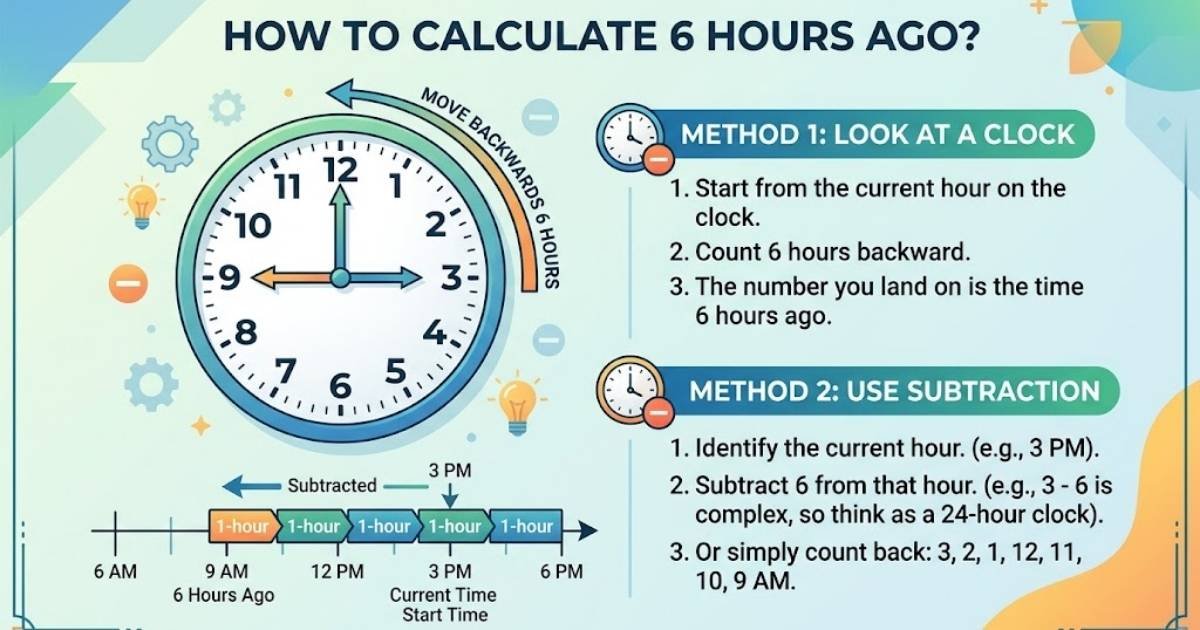
Calculating six hours ago only takes three simple steps. Most errors happen because people skip one of these steps or rush through the math. Following the process in order removes guesswork and gives a reliable answer every time. Below, each step is explained separately for clarity.
Step 1: Check the Current Time
Start by noting the exact current time, including minutes. For example, if it is currently 3:45 PM, write that down before doing any subtraction. Skipping this step often leads to using an outdated or rounded time by mistake.
- Always check a reliable clock or device.
- Note whether it is AM or PM.
- Confirm the current date as well.
- Avoid rounding minutes for accuracy.
Step 2: Subtract Six Hours
Once you have the current time, subtract six from the hour value only. The minutes remain untouched throughout this process. Using the 3:45 PM example, subtracting six hours gives 9:45 AM. This step is where most calculation mistakes happen if AM and PM are not tracked properly.
- Subtract only from the hour number.
- Keep minutes exactly the same.
- Watch for the AM or PM switch.
- Double check using the 24-hour format if unsure.
Read More: What Time Was It 15 Hours Ago? Calculate the Exact Time Easily
Step 3: Check Whether the Date Changes
If subtracting six hours pushes the time before midnight, the date moves back by one day. For example, 3:00 AM minus six hours becomes 9:00 PM the previous day. This step is easy to forget but essential for accurate records.
- Time before 6:00 AM will roll back a day.
- Always verify the new date, not just the time.
- This matters most for late night or early morning calculations.
- Digital calendars usually update this automatically.
Why People Search “What Was 6 Hours Ago From Now”
People search this phrase for practical, time-sensitive reasons rather than curiosity alone. It usually relates to verifying an event, message, or action that happened earlier in the day. Search intent here is transactional and quick, meaning users want an instant answer without extra explanation.
- Checking when a text or email was actually sent.
- Verifying work hours for payroll or shift logs.
- Confirming medication or dosage timing.
- Reviewing app notifications or activity logs.
This search term is common among remote workers, caregivers, and anyone juggling multiple time zones. The demand for instant, accurate answers is why time calculators and simple guides rank well for this query.
Everyday Situations Where Time Six Hours Earlier Matters
Six hour time calculations appear more often in daily life than most people realize. From health tracking to global communication, precise timing affects decisions and safety. Below are the most common real world scenarios where this calculation becomes essential.
Work Shifts
Employees working rotating or night shifts often need to calculate hours backward to verify clock in times. Payroll systems rely on accurate time logs, and a six hour miscalculation can cause payment disputes. Shift workers frequently check what time it was six hours ago to confirm break schedules too.
Medication Schedule
Many medications require dosing every six hours to maintain effectiveness in the bloodstream. Patients or caregivers need to know the exact previous dose time to avoid overlapping doses. This is especially critical for antibiotics, pain management, and time sensitive prescriptions.
Sleep Tracking
Sleep apps and wearable devices track when a user fell asleep by calculating backward from wake time. If someone wakes up at 6:00 AM and slept for six hours, the app calculates a 12:00 AM sleep start. Accurate backward time calculation improves sleep quality reports and health insights.
Customer Support
Support teams operating across time zones use six hour calculations to determine when a customer submitted a request. This helps prioritize response times and measure service level agreements accurately. Miscalculating support timestamps can lead to missed response deadlines.
Flight Schedules
Travelers calculate hours backward to determine departure prep time or connecting flight windows. Airlines and travelers use this to confirm boarding times relative to landing schedules. Time zone differences make this calculation even more important for international flights.
Time Arithmetic Made Simple
Time math becomes easier once you treat it like a 24 hour cycle instead of two separate 12 hour halves. Thinking in 24-hour format removes confusion around AM and PM switching. This method is especially useful for people who work with schedules, logs, or programming.
| Current Time (24-hr) | Minus 6 Hours | Result |
| 14:00 | -6 | 08:00 |
| 03:00 | -6 | 21:00 (previous day) |
| 20:30 | -6 | 14:30 |
| 09:15 | -6 | 03:15 |
Using this table format, anyone can quickly cross-check their manual calculation. Once the pattern becomes familiar, mental math becomes fast and reliable.
Examples Using Both 12-Hour and 24-Hour Clock
Different regions and industries use different time formats, so understanding both is useful. The logic stays the same, but the presentation changes. Below are separate examples for each format to avoid confusion.
12-Hour Clock
- 7:00 PM minus 6 hours equals 1:00 PM.
- 2:30 AM minus 6 hours equals 8:30 PM (previous day).
- 11:45 AM minus 6 hours equals 5:45 AM.
- 5:00 PM minus 6 hours equals 11:00 AM.
24-Hour Clock
- 19:00 minus 6 hours equals 13:00.
- 02:30 minus 6 hours equals 20:30 (previous day).
- 11:45 minus 6 hours equals 05:45.
- 17:00 minus 6 hours equals 11:00.
Read More: How Long Until 2:45 PM? Calculate the Exact Time Remaining Today
What Time Will It Be in 6 Hours?
Calculating forward works the same way but in reverse, adding six hours instead of subtracting. If it is currently 10:00 AM, adding six hours results in 4:00 PM the same day. The date only changes forward if the addition crosses midnight.
- Add six directly to the current hour.
- Minutes stay unchanged during addition.
- Crossing midnight moves the date forward by one day.
- Useful for planning meetings, alarms, or reminders.
Knowing both directions of calculation, backward and forward, gives a complete understanding of relative time.
Time Zones Can Change Everything
Six hours ago in one location is not the same moment as six hours ago somewhere else. Time zones shift the actual clock reading, even though the elapsed hours remain identical. This becomes especially important for remote teams and international communication.
- A six hour difference already exists between some time zones naturally.
- Daylight saving time can add an extra hour of confusion.
- Always confirm which time zone is being referenced.
- Digital tools usually auto-adjust based on device location.
Ignoring time zones is one of the most common reasons people get inaccurate results when checking past times.
Technology Depends on Accurate Time Calculation
Modern technology relies heavily on precise time tracking behind the scenes. Servers, apps, and databases timestamp every action, and errors can cause major issues. Even a six hour miscalculation can break scheduling systems or data logs.
- Cloud servers sync time across global data centers.
- Apps use timestamps to sort notifications and messages.
- Financial systems depend on exact transaction timing.
- Security systems log access times for audits.
This is why most platforms use Coordinated Universal Time (UTC) internally, converting it to local time only for the user interface.
Using an Hours Ago Calculator
An online hours ago calculator removes manual effort and reduces the chance of mistakes. These tools automatically account for date changes and time zone differences. They are especially useful for people who calculate time frequently for work or health tracking.
- Simply enter the current time and number of hours.
- The tool instantly displays the past time and date.
- Most calculators support both 12-hour and 24-hour formats.
- Some tools also allow time zone selection for accuracy.
Using a calculator is recommended when precision is critical, such as medical dosing or payroll verification.
Common Mistakes People Make
Even simple time subtraction can go wrong due to small oversights. Recognizing these common mistakes helps you double check your own calculations. Below are the most frequent errors people make when calculating hours ago.
Forgetting the Date
Many people calculate the correct time but forget to update the date when it rolls backward. This is common with early morning times crossing into the previous day. Always check both the time and the date together.
Mixing Up AM and PM
Switching AM and PM incorrectly is one of the most frequent errors in 12-hour format calculations. A six hour subtraction from morning hours often flips to PM, and vice versa. Careless AM or PM labeling can create a twelve hour error.
Changing the Minutes
Some people accidentally round or adjust the minutes while subtracting hours. Minutes should remain exactly the same unless the calculation involves partial hours. This mistake is more common when doing quick mental math without writing it down.
Ignoring Time Zones
Assuming everyone shares the same time zone leads to major miscommunication. This is especially risky in remote work, global meetings, or international shipping schedules. Always clarify the time zone before sharing a calculated time.
Confusing Six Hours Ago With Six Hours From Now
Subtracting and adding are opposite operations, yet people sometimes mix them up under time pressure. This mistake usually happens when reading a request quickly without full attention. Double checking the direction, past or future, prevents this error.
Why Relative Time Feels Different From Exact Time
Relative time, like “six hours ago,” feels less precise than an exact clock time because it depends on a moving reference point. As the current time changes, so does the resulting past time. This is why relative time expressions are useful in conversation but less reliable for records.
- Exact time is fixed and does not change.
- Relative time shifts based on when it is calculated.
- Records and logs should always use exact timestamps.
- Conversational use of relative time is fine for casual context.
Understanding this difference helps decide when to use relative phrases versus exact time stamps.
Frequently Asked Questions
How do I calculate what time it was 6 hours ago?
Subtract six from the current hour and keep the minutes the same. Check if the date needs to move back a day.
Does the date always change when subtracting 6 hours?
No, the date only changes if the resulting time falls before midnight. Otherwise, the date stays the same.
Is 6 hours ago the same in every time zone?
No, six hours ago refers to elapsed time, but the actual clock reading depends on the local time zone. Always confirm the reference time zone.
Can I use a calculator instead of manual math?
Yes, an hours ago calculator is faster and reduces errors, especially for date changes and time zones. It is recommended for critical timing needs.
Why do medication schedules use 6 hour intervals?
Many medications are designed to stay effective in the body for about six hours. This ensures consistent dosage without overlap or gaps.
Conclusion
Calculating what time it was six hours ago becomes simple once you follow a clear process: check the current time, subtract six hours, and confirm whether the date shifts backward. This small skill has real value in daily life, from managing medication schedules to verifying work hours and understanding sleep patterns. Being mindful of AM and PM, time zones, and date changes prevents the most common mistakes. Whether you calculate manually or use an online tool, accuracy in time tracking helps you stay organized, informed, and on schedule.

Hi, I’m Ethan Brooks, the admin of SymbolHubz.com. Passionate about symbols, emojis, kaomojis, and text art, helping users discover creative ways to express themselves online.