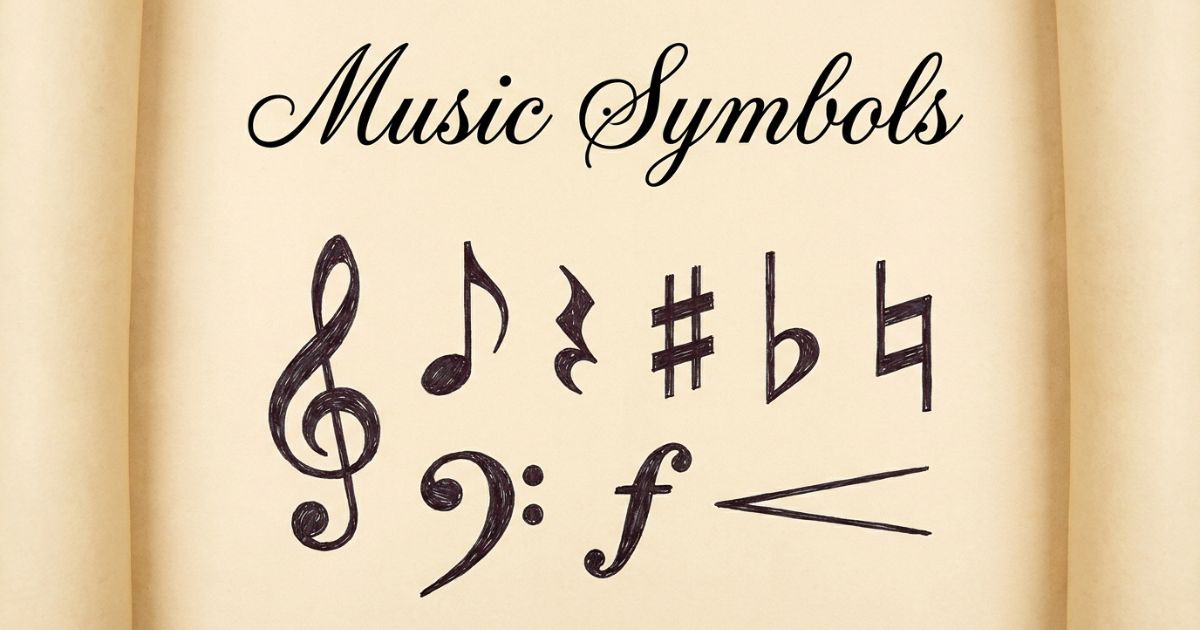

Music symbols are more than decoration. They carry centuries of meaning, from the pitch of a note to the mood of a passage. Whether you are a musician reading sheet music, a designer picking icons, or someone searching for a symbol to copy and paste into a bio, understanding these marks makes communication easier.
This guide brings together every major category of music symbols in one place. You will find notation marks, copy-paste emojis, tattoo-friendly designs, and historical symbols from around the world. Each section is built to be scannable, so you can jump straight to what you need.
By the end, you will know what each symbol means, where it comes from, and how to use it correctly, whether that is in a song score, a caption, or a piece of body art.
Music Symbols With Names: Complete List
Musical notation uses a fixed set of symbols that every musician learns early. Knowing their names helps when reading sheet music, discussing compositions, or searching for the right character online. Below is a reference list covering the most common ones.
| Symbol | Name | Basic Meaning |
| ♩ | Quarter Note | One beat in standard time |
| ♪ | Eighth Note | Half a beat |
| ♫ | Beamed Eighth Notes | Two eighth notes joined |
| ♬ | Beamed Sixteenth Notes | Four short notes grouped |
| ♭ | Flat | Lowers pitch by a half step |
| ♯ | Sharp | Raises pitch by a half step |
| ♮ | Natural | Cancels a sharp or flat |
| 𝄞 | Treble Clef | Marks higher-pitched notes |
| 𝄢 | Bass Clef | Marks lower-pitched notes |
| 𝄡 | Alto Clef | Used mainly for viola music |
| 𝄆 𝄇 | Repeat Signs | Repeat the enclosed section |
| 𝄐 | Fermata | Hold the note longer than written |
Each of these symbols has a fixed Unicode value, which is why they display consistently across most devices and fonts.
Music Symbols Copy and Paste
Sometimes you just need a quick symbol without opening a music app. These characters work in most text fields, social captions, and documents since they are standard Unicode.
- ♩ ♪ ♫ ♬ (note symbols)
- ♭ ♯ ♮ (flat, sharp, natural)
- 𝄞 𝄢 𝄡 (clefs)
- 𝄆 𝄇 (repeat marks)
- 𝄐 𝄑 (fermata and breath mark)
- 🎵 🎶 🎼 🎹 🎸 (emoji-style icons)
Copying these is simple: highlight the character, copy it, then paste it wherever needed. Most smartphones also let you long-press an emoji keyboard to find music icons without searching manually.
If a symbol shows as a blank box on your screen, it usually means the font you are using does not support that Unicode character. Switching fonts or using the emoji version instead usually solves this.
More Symbols: Mental Health Symbols
Music Note Symbols
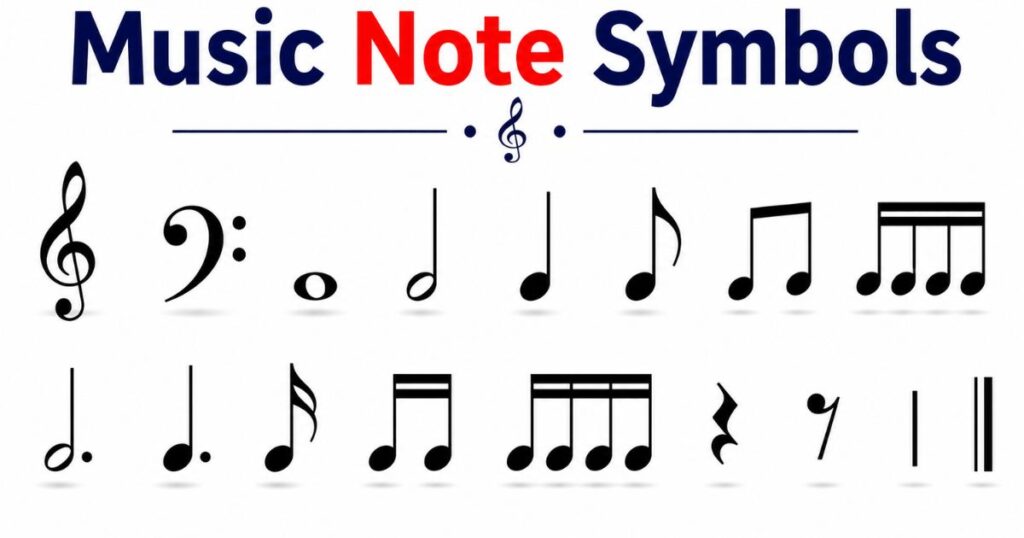
Music note symbols represent duration and rhythm rather than pitch. Each shape tells a musician exactly how long to hold or play a note. This is one of the oldest visual languages still in daily use.
- Whole note (𝅝): held for four beats in common time
- Half note (𝅗𝅥): held for two beats
- Quarter note (♩): held for one beat
- Eighth note (♪): held for half a beat
- Sixteenth note (𝅘𝅥𝅯): held for a quarter beat
Rests mirror these same durations but represent silence instead of sound. A whole rest, half rest, and quarter rest each pause the music for the same length as their note counterparts. Learning notes and rests together gives a complete picture of rhythm.
Musical Symbols and Their Meanings
Beyond notes, musical notation includes symbols for volume, tempo, and articulation. These marks tell performers how to shape a piece emotionally, not just technically. Understanding them turns flat notation into expressive music.
| Symbol | Term | Meaning |
| p | Piano | Play softly |
| f | Forte | Play loudly |
| mf | Mezzo-forte | Moderately loud |
| < | Crescendo | Gradually get louder |
| > | Decrescendo | Gradually get softer |
| . | Staccato | Play short and detached |
| ‾ | Tenuto | Hold the full note value |
| 𝄻 | Whole Rest | Silence for a full measure |
These symbols appear above or below the staff and apply directly to the notes near them. Composers rely on this shorthand to communicate dynamics without writing full sentences on every page.
Mastering these marks is often the difference between playing notes correctly and playing music expressively.
Music Symbols and Emojis
Emojis have made music symbols part of everyday digital conversation. Unlike formal notation, these icons are designed for quick visual recognition rather than technical accuracy. They work well in captions, texts, and casual design work.
- 🎵 Single musical note, general music reference
- 🎶 Multiple notes, often used for singing or dancing
- 🎼 Musical score, used for composing or sheet music context
- 🎧 Headphones, associated with listening or DJing
- 🎤 Microphone, linked to singing or performance
- 🎸 Guitar, represents rock or acoustic music
- 🎹 Piano keys, used for keyboard or classical themes
- 🥁 Drum, represents rhythm or percussion
These emojis are supported across nearly all modern devices and platforms, making them more reliable for casual use than some rarer Unicode notation symbols.
More Symbols: Jeep Dashboard Symbols
Music Symbols for Text
Text-based platforms often limit which characters render correctly, so it helps to know which music symbols are safest to use. These are widely compatible across messaging apps, websites, and word processors.
- ♪ and ♫ are the most universally supported note symbols
- ♭, ♯, and ♮ work well in most fonts
- 🎵 and 🎶 emojis are safe on nearly every platform
- 𝄞 (treble clef) may not render on older systems
For usernames, bios, or captions, a short combination like “♪ Music Lover ♫” reads clearly without visual clutter. Overusing symbols in text can reduce readability, so one or two per sentence is usually enough.
If you are designing for a website, testing symbols across different browsers is worth the extra step, since rendering can vary.
Music Symbols for Instagram and Social Media
Social media profiles often use music symbols to signal a person’s interests or profession. Instagram bios, TikTok captions, and Twitter handles all support standard Unicode characters, making these symbols easy to add.
- Bio taglines: “🎧 Beats & Vibes 🎶”
- Username styling: “DJ_♪_Mike”
- Caption endings: “New track out now 🎼🔥”
- Story stickers: many apps include built-in music note stickers
Because character limits are tight on most platforms, shorter symbols like ♪ or 🎵 work better than longer notation strings. They add visual interest without taking up valuable space in a bio or caption.
Consistency also matters. Creators who use the same one or two symbols across posts build a recognizable personal style over time.
Music Symbols for Tattoos
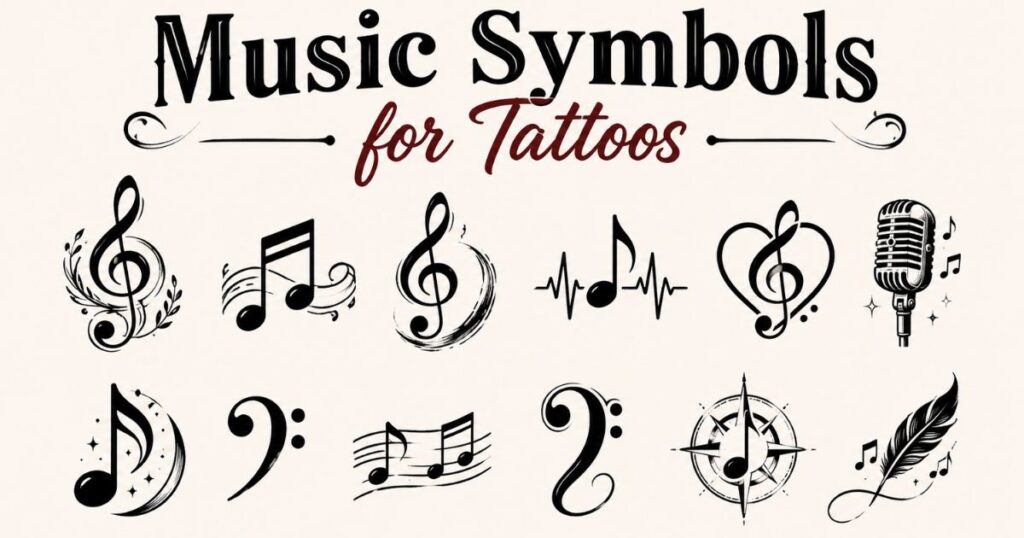
Music symbols are a popular tattoo choice because they are simple, meaningful, and easy to place on small areas like wrists, ankles, or behind the ear. Each symbol carries a distinct personal or artistic meaning.
- Treble clef: represents a love of music or a musical career
- Music notes (single or in a row): symbolize rhythm, memory, or a favorite song
- Fermata: can represent pausing to appreciate a moment
- Sound wave designs: often personalized with a voice memo or heartbeat pattern
- Sheet music lines: used for tattoos referencing a specific song
Placement affects how detailed a design can be. Small wrist tattoos usually work best with a single note or clef, while larger back or forearm pieces can include full musical phrases.
Before getting inked, it is worth double-checking the symbol’s accuracy, since incorrect notation is a common tattoo mistake that musicians tend to notice immediately.
Music Note Emojis and Symbols
There is often confusion between music note emojis and formal notation symbols, since they look similar but serve different purposes. Emojis are colorful, platform-styled icons, while notation symbols are precise Unicode characters used in written music.
| Type | Example | Best Use |
| Emoji | 🎵 🎶 | Captions, texts, casual design |
| Notation Symbol | ♩ ♪ ♫ | Sheet music references, formal text |
| Clef Symbol | 𝄞 𝄢 | Music theory or educational content |
Emojis render differently depending on the operating system, such as Apple, Android, or Windows, while notation symbols generally stay visually consistent. Knowing this difference helps when choosing which to use for a specific project or platform.
For most everyday communication, emojis are the more practical choice.
More Symbols: One Piece Symbols & Emojis
Common Musical Notation Symbols
Reading sheet music requires recognizing a set of core notation symbols that appear in nearly every piece. These symbols form the basic grammar of written music, regardless of genre or instrument.
- Staff: the five horizontal lines music is written on
- Time signature: numbers showing beats per measure, such as 4/4
- Key signature: sharps or flats placed at the start of a staff
- Bar line: vertical line separating measures
- Double bar line: marks the end of a section or piece
- Dynamic markings: p, f, mf, and similar volume indicators
- Tempo markings: words like Allegro or Andante indicating speed
These symbols work together as a system. A single note means little without its position on the staff, its duration shape, and the surrounding dynamic and tempo markings.
Musicians learn to read all of these simultaneously, which is why sight-reading takes consistent practice to master.
Piano and Keyboard Music Symbols
Piano notation includes a few symbols specific to keyboard instruments, since piano music often requires two staves played at once. These marks help pianists coordinate both hands.
- Grand staff: combines the treble and bass clef staves for piano
- *Pedal marks (Ped. and ): indicate when to press and release the sustain pedal
- Fingering numbers (1 to 5): show which finger plays each note
- Ottava symbols (8va, 8vb): signal playing an octave higher or lower
Because pianists read two lines of music simultaneously, these symbols are placed carefully to avoid visual confusion. Pedal marks especially require precise timing to avoid muddying the sound.
Beginners usually learn the grand staff and finger numbers first, adding pedal notation once basic reading skills are established.
Ancient and Traditional Music Symbols
Modern notation is a relatively recent development. Many cultures used their own symbol systems for centuries before staff notation became standard, and some of these systems are still studied or used today.
- Neumes: early medieval European symbols showing pitch direction rather than exact notes
- Cheironomic notation: hand-gesture based systems used in ancient Egypt and parts of the Middle East
- Byzantine notation: symbols still used in Eastern Orthodox chant traditions
- Solfège hand signs: a teaching method using hand shapes to represent pitch, still used in music education
These older systems focused more on melodic shape and memory cues than precise rhythm, since much of this music was passed down orally alongside the written symbols.
Studying ancient notation shows how much modern music theory borrowed and refined from earlier traditions.
Famous Music Symbols Around the World
Different cultures have developed distinct notation systems suited to their musical traditions. Comparing them highlights how music theory adapts to different scales, instruments, and performance styles.
| Region | System | Distinct Feature |
| Western Europe | Staff notation | Precise pitch and rhythm on a five-line staff |
| India | Sargam notation | Uses syllables like Sa, Re, Ga instead of letter names |
| China | Jianpu notation | Numbers represent scale degrees instead of staff lines |
| Middle East | Maqam notation | Focuses on melodic modes rather than fixed pitch |
| Japan | Traditional gagaku notation | Symbols represent finger positions on instruments |
These systems are not interchangeable, since each was built around the scales and instruments common to its region. A musician trained only in Western staff notation, for example, would need additional study to read Jianpu or Sargam accurately.
Understanding these differences is useful for anyone studying world music or working on cross-cultural musical projects.
FAQ’s
What is the most common music symbol?
The quarter note (♩) is the most widely recognized music symbol, representing one beat in standard time.
What does a fermata symbol mean?
A fermata (𝄐) tells the performer to hold a note or rest longer than its usual value.
Can I copy and paste music symbols into any app?
Most apps support standard Unicode music symbols, though rendering can vary by font or operating system.
What is the difference between a sharp and a flat?
A sharp (♯) raises a note by a half step, while a flat (♭) lowers it by a half step.
Which music symbol is best for a small tattoo?
A single music note or a simple treble clef works best for small tattoo placements like wrists or ankles.
Do all cultures use the same music symbols?
No, different regions use distinct systems such as Sargam in India or Jianpu in China, each suited to their musical traditions.
What does a natural symbol do in music?
A natural symbol (♮) cancels a previous sharp or flat, returning a note to its original pitch.
Final Thoughts
Music symbols connect centuries of tradition with everyday digital communication. From formal notation on a staff to a simple emoji in a text message, each symbol carries a specific meaning worth understanding.
Whether you are reading sheet music, styling a social media bio, or choosing a tattoo design, knowing what each symbol represents helps you use it correctly and meaningfully. Keep this guide handy as a quick reference whenever you need the right music symbol for the right context.

Hi, I’m Ethan Brooks, the admin of SymbolHubz.com. Passionate about symbols, emojis, kaomojis, and text art, helping users discover creative ways to express themselves online.