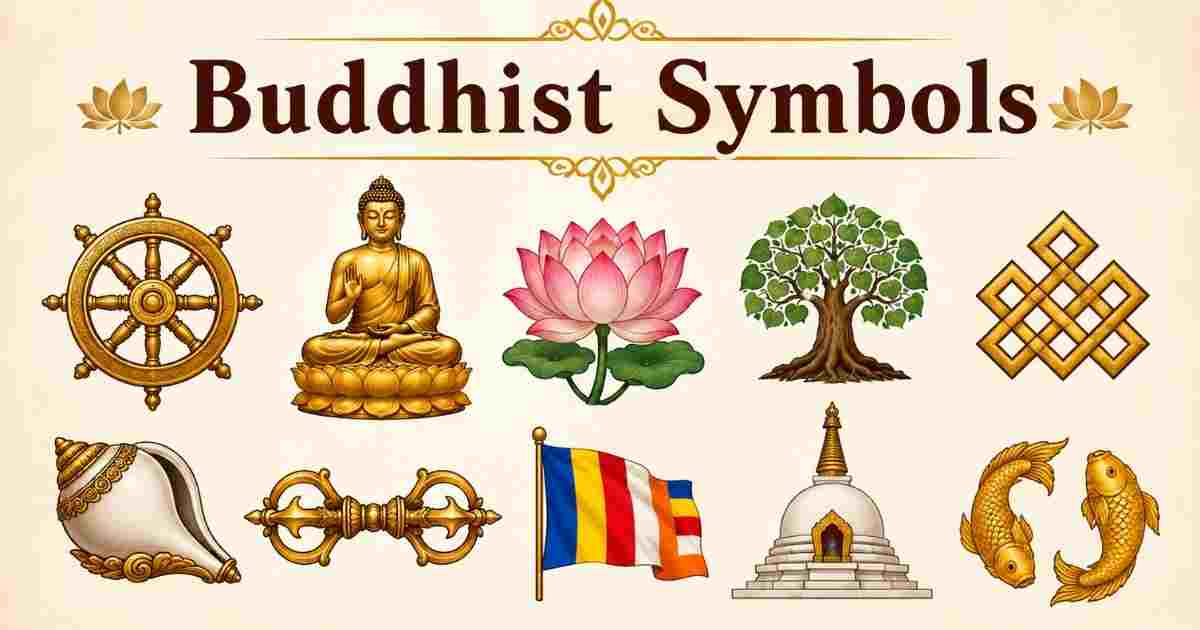

Buddhist symbols carry more than 2,500 years of spiritual history in a single image. Each shape, from a simple lotus to an intricate endless knot, holds a lesson about the mind, the path, and the nature of suffering.
This guide breaks down the most important Buddhist symbols and meanings in plain language. Whether you want a tattoo, a home decor piece, or a deeper understanding of practice, you will find clear answers here.
We cover the history, the main symbols, and how each one is used today. No jargon, just practical, accurate information you can trust.
What Are Buddhist Symbols?
Buddhist symbols are visual representations of core teachings, values, and milestones in the Buddha’s life. They act as memory tools, helping practitioners recall complex ideas through a single image.
Unlike idols, these symbols are not worshipped as objects of power. They point toward a concept, such as enlightenment, impermanence, or compassion.
Common categories include:
- Symbols tied to the Buddha’s life story
- Symbols representing the Eightfold Path
- Symbols used in rituals and offerings
- Symbols found in art, architecture, and mandalas
Each tradition, Theravada, Mahayana, and Vajrayana, emphasizes slightly different symbols. Yet most share a common visual language rooted in early Indian Buddhist art.
Understanding a symbol’s origin matters more than memorizing its shape. A lotus without context is just a flower, but a lotus tied to the Buddha’s teaching on impermanence becomes a lesson.
This distinction is why practitioners often study a symbol’s backstory before using it. It shifts the object from decoration into a genuine reminder of practice.
See Also: Italian Symbols and Meanings
History and Importance of Buddhist Symbols
Early Buddhism avoided depicting the Buddha in human form. Instead, artists used symbols like footprints, an empty throne, or a wheel to represent his presence and teachings.
This aniconic phase lasted for centuries after the Buddha’s death around 483 BCE. Sculptors believed a physical image could not capture enlightenment, so symbols became the respectful alternative.
By the 1st century CE, Buddhist art shifted under Greco-Buddhist influence in the Gandhara region. Human depictions of the Buddha began appearing alongside older symbolic traditions rather than replacing them.
Symbols mattered because they traveled easily across language barriers. As Buddhism spread from India to China, Tibet, and Southeast Asia, images communicated teachings faster than translated texts.
Today, these symbols remain central to:
- Temple architecture and stupas
- Meditation and ritual objects
- Personal jewelry and tattoos
- Flags, prayer wheels, and textiles
Their importance lies in continuity. A symbol carved 2,000 years ago still communicates the same idea to a modern practitioner.
This continuity also builds trust across cultures. A Buddhist visitor from Japan can recognize a Dharma wheel carved in a Sri Lankan temple without needing a translator.
That shared visual language is part of why Buddhist symbols remain popular even outside religious settings. Their meaning has stayed remarkably stable across centuries and continents.
Buddhist Symbols and Meanings
Below is a quick reference table of widely recognized Buddhist symbols and what each one represents.
| Symbol | Core Meaning |
| Lotus Flower | Purity rising from struggle |
| Dharma Wheel | The Buddha’s teachings and path |
| Endless Knot | Interconnection of all things |
| Bodhi Leaf | Enlightenment and awakening |
| Om (Aum) | Sacred sound of the universe |
| Conch Shell | Fearless proclamation of Dharma |
| Parasol | Protection from suffering |
| Victory Banner | Triumph over ignorance |
Each symbol connects to a specific teaching, so context matters when choosing one. A symbol picked for a tattoo, for example, should match personal meaning rather than trend alone.
Many symbols also appear together in combined artwork, such as a lotus supporting a Dharma wheel. This layering adds depth without needing extra text.
Regional differences also shape how a symbol looks. A Tibetan endless knot may appear more angular and colorful, while a Japanese version favors clean, minimal lines.
Recognizing these regional variations helps when researching a symbol’s authenticity for art, tattoos, or gifts. Style often signals which Buddhist tradition a piece draws from.
See Also: Holy Thursday Symbols
Main Symbol of Buddhism
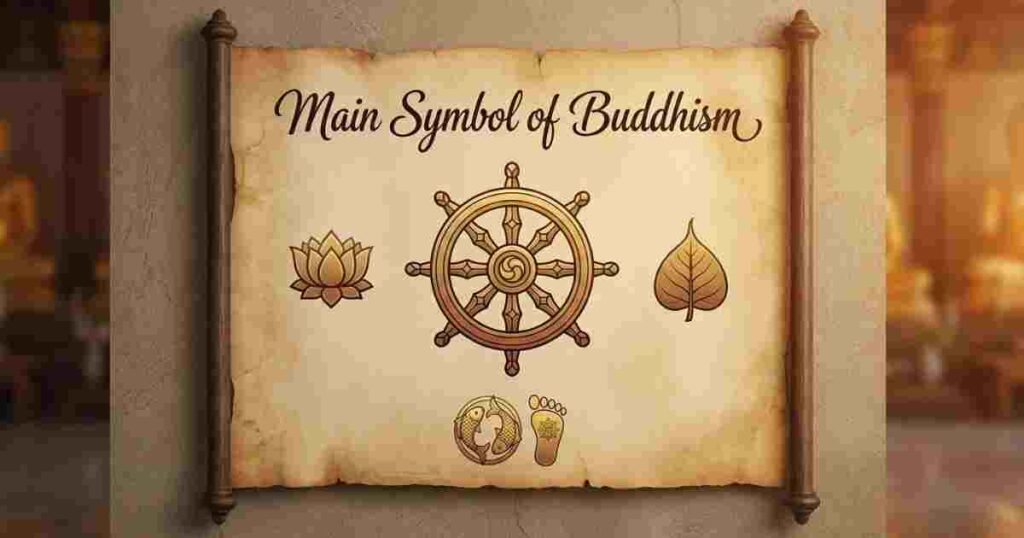
The Dharma Wheel, also called the Dharmachakra, is widely considered the main symbol of Buddhism. It represents the Buddha’s first sermon at Sarnath, where he set the wheel of teaching into motion.
The wheel typically has eight spokes, one for each step of the Noble Eightfold Path. This makes it both a religious emblem and a practical map for ethical living.
You will find the Dharma Wheel on:
- Temple gates and rooftops
- National flags, including Thailand’s Royal Standard elements
- Buddhist monastic robes and banners
- Modern jewelry and tattoo designs
While the lotus and Bodhi leaf are also iconic, the Dharma Wheel holds the strongest claim as Buddhism’s central emblem across nearly all schools.
Historians note the wheel predates Buddhism itself, originally symbolizing kingship and cosmic order in ancient India. The Buddha adopted this familiar image and gave it a spiritual meaning centered on truth rather than rulership.
That reinterpretation is part of why the symbol resonated so widely. People already understood the wheel as a mark of authority, so its new meaning spread quickly.
5 Symbols of Buddhism
Scholars and practitioners often narrow Buddhism’s vast symbolism down to five essential images. These five appear most frequently across temples, texts, and teachings worldwide.
- Lotus Flower — purity emerging from muddy water, representing spiritual growth
- Dharma Wheel — the Buddha’s teachings and the Eightfold Path
- Bodhi Tree/Leaf — the site and shape of the Buddha’s enlightenment
- Buddha’s Footprints — reverence for his physical presence on Earth
- Triratna (Three Jewels) — Buddha, Dharma, and Sangha combined in one emblem
These five cover the major pillars of Buddhist thought: growth, teaching, awakening, presence, and community. Learning them gives a strong foundation for understanding deeper Buddhist art.
Beginners often start with these five before exploring more complex imagery like the Wheel of Life or the eight auspicious symbols. They form a manageable starting point without oversimplifying the tradition.
Museums and art history courses frequently reference this same shortlist. It has become something of an informal standard for introducing Buddhist visual culture to newcomers.
See Also: Mental Health Symbols
Buddhist Symbol of Life
The Bhavachakra, or Wheel of Life, is the primary Buddhist symbol representing existence itself. It illustrates samsara, the endless cycle of birth, death, and rebirth.
The wheel is divided into six realms, each showing a different state of being shaped by karma. A fierce figure, Yama, holds the entire wheel, representing impermanence and the inevitability of change.
Key sections of the Wheel of Life include:
- The hub, showing the three poisons: greed, hatred, and delusion
- The six realms of rebirth, from gods to hell beings
- The outer rim, depicting the twelve links of dependent origination
This symbol is not meant to frighten but to teach. It shows practitioners exactly how craving and ignorance keep the cycle turning, and how the path leads out of it.
Tibetan monasteries often paint the Wheel of Life directly on entrance walls. Visitors see it before stepping inside, setting the tone for reflection right from the doorway.
Some versions also include a small image of the Buddha standing outside the wheel entirely. This detail signals that liberation from the cycle is possible, not just theoretical.
Buddhist Symbol for Love
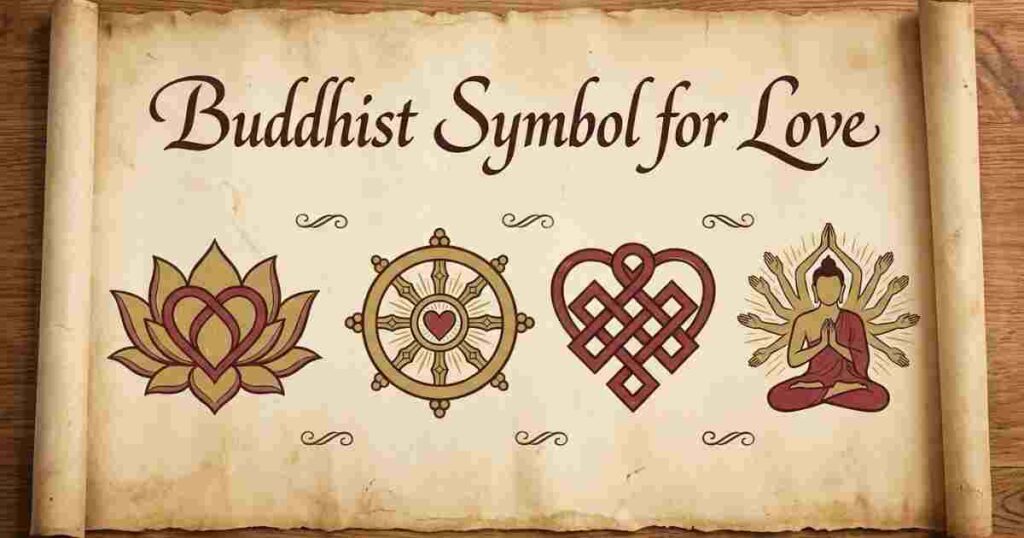
Buddhism frames love primarily through the concept of Metta, or loving kindness, rather than a single fixed symbol. Still, certain images have become associated with compassion and love in practice.
The most common visual for love and compassion is Avalokiteshvara, the Bodhisattva of Compassion, often shown with multiple arms reaching out to help all beings. In Tibetan Buddhism, this figure is known as Chenrezig.
Other symbols tied to love and compassion include:
- The open lotus, symbolizing an open heart
- Two intertwined endless knots, showing eternal connection
- The color pink or soft rose tones in mandala art
These symbols emphasize unconditional compassion over romantic love. That distinction matters for anyone choosing a Buddhist-inspired symbol for a relationship or gift.
Simple Buddhist Symbols
Not every symbol needs elaborate detail to carry meaning. Several simple Buddhist symbols work well for minimalist art, jewelry, or quick visual reference.
Popular simple options include:
- Single lotus outline — clean, recognizable, and versatile
- Om symbol — one character representing universal sound
- Bodhi leaf silhouette — a single leaf shape tied to enlightenment
- Small Dharma wheel — reduced to just the spokes and rim
- Infinity-style endless knot — simplified into a continuous loop
Simple designs are especially popular in modern minimalist jewelry and small tattoos. They retain the symbol’s meaning while fitting into compact, everyday spaces.
Buddhist Symbols and Meanings for Tattoos
Buddhist symbols are among the most requested spiritual tattoo designs worldwide. Their clean lines and deep meaning make them well suited to both small and large pieces.
Before choosing a Buddhist tattoo, it helps to understand cultural sensitivity. Some practitioners consider tattooing sacred symbols, especially Buddha’s face, disrespectful if placed on lower body areas.
Popular tattoo choices include:
- Lotus flower — personal growth and resilience
- Dharma wheel — commitment to a spiritual path
- Om symbol — connection to meditation practice
- Bodhi leaf — a reminder of awakening
- Endless knot — unity and interconnected life events
Placement matters in many Buddhist cultures. Choosing the arm, back, or chest is generally seen as more respectful than the feet, which are traditionally viewed as the body’s lowest and least honored part.
The Eight Auspicious Symbols of Buddhism
Known as the Ashtamangala, these eight symbols represent gifts offered to the Buddha and carry blessings of prosperity and protection. They appear frequently in Tibetan Buddhist art.
| Symbol | Meaning |
| Parasol | Protection from harm and suffering |
| Golden Fish | Freedom and fearlessness |
| Treasure Vase | Spiritual and material abundance |
| Lotus Flower | Purity and enlightenment |
| Conch Shell | Fearless proclamation of the Dharma |
| Endless Knot | Interconnection of all phenomena |
| Victory Banner | Triumph over obstacles and ignorance |
| Dharma Wheel | The Buddha’s teachings in motion |
These eight are often displayed together as a set on prayer flags, altar cloths, and temple murals. Each one complements the others, forming a complete picture of a well-lived spiritual life.
Lotus Flower Symbol in Buddhism
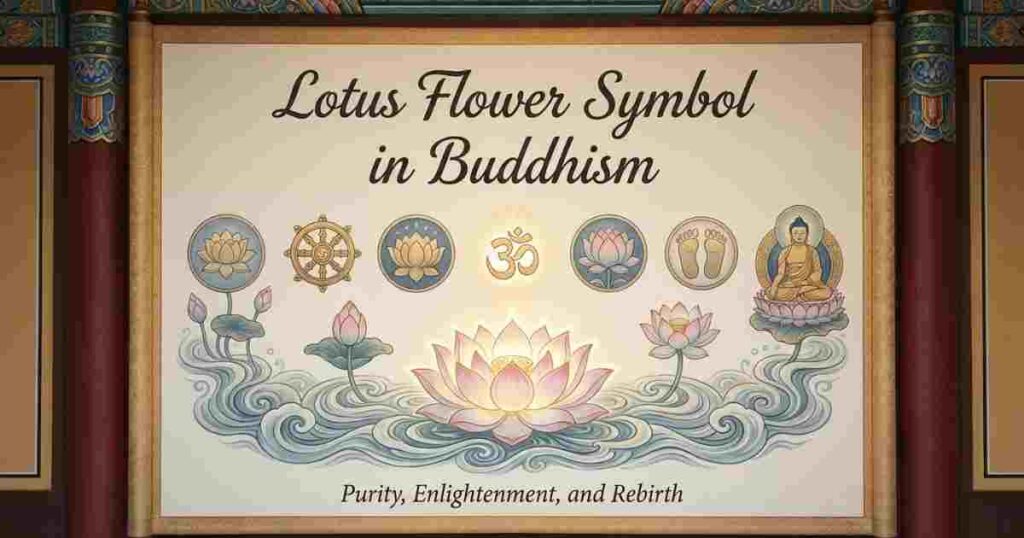
The lotus is arguably the most recognized Buddhist symbol outside of temple settings. It grows in muddy water yet blooms clean and untouched above the surface.
This growth pattern mirrors the Buddhist path. Practitioners face difficulty, confusion, or suffering, yet can still reach clarity and awakening despite those conditions.
Lotus colors carry their own meanings:
- White lotus — mental and spiritual purity
- Pink lotus — the supreme lotus, linked to the Buddha himself
- Red lotus — compassion and the heart
- Blue lotus — wisdom and knowledge
- Purple lotus — mysticism, often tied to esoteric schools
The number of petals also holds meaning in some traditions, with eight petals representing the Eightfold Path. This makes the lotus one of the most detailed and layered symbols in Buddhist art.
Dharma Wheel (Dharmachakra) Meaning
The Dharma Wheel represents the Buddha’s teaching set into motion after his enlightenment. Its Sanskrit name, Dharmachakra, translates roughly to “wheel of the law” or “wheel of truth.”
Most versions feature eight spokes, each representing a step of the Noble Eightfold Path: right view, right intention, right speech, right action, right livelihood, right effort, right mindfulness, and right concentration.
The wheel’s structure carries additional symbolism:
- The hub represents moral discipline, the core of practice
- The spokes represent wisdom, cutting through ignorance
- The rim represents meditative concentration holding it all together
Because it summarizes the entire path in one image, the Dharma Wheel is often placed at temple entrances. It signals that teaching, not worship of an object, is the heart of the space inside.
Endless Knot Symbolism
The endless knot, or Shrivatsa, is a continuous, interwoven design with no visible beginning or end. It represents the interconnected nature of all existence, including cause and effect.
This symbol also reflects the union of wisdom and compassion, two qualities Buddhists consider essential for enlightenment. Neither quality works fully without the other present.
Common interpretations include:
- Endless cycle of birth, death, and rebirth
- Interdependence of all beings and phenomena
- The intertwining of wisdom and method on the spiritual path
- Eternal continuity of the Buddha’s teachings
The endless knot appears frequently in Tibetan art, textiles, and modern jewelry. Its geometric symmetry also makes it a popular choice for tattoos and home decor.
Buddhist Symbols for Peace, Protection, and Wisdom
Different symbols serve different emotional and spiritual purposes. Some are chosen specifically for the sense of calm or safety they represent.
For peace:
- The lotus flower, symbolizing calm rising above chaos
- The Om symbol, tied to meditative stillness
- Prayer flags, believed to spread peaceful intentions on the wind
For protection:
- The parasol, shielding against harm and negative forces
- The Dharma protectors, or Dharmapalas, in Tibetan iconography
- The double vajra, symbolizing unshakeable spiritual strength
For wisdom:
- The blue lotus, directly tied to knowledge and insight
- The vajra (thunderbolt), representing indestructible clarity of mind
- The Prajnaparamita texts, personified as the “Mother of Wisdom” in some traditions
Choosing a symbol for a specific intention, such as protection during travel or wisdom before a big decision, is a common and accepted practice in many Buddhist cultures.
How Buddhist Symbols Are Used in Daily Life
Buddhist symbols extend well beyond temple walls and into everyday routines. Practitioners often keep small reminders nearby to reinforce mindfulness throughout the day.
Common daily uses include:
- Prayer beads, or malas, used during chanting and meditation
- Small Buddha statues placed on home altars
- Prayer flags hung outside homes to spread blessings
- Incense holders shaped with lotus or Dharma wheel motifs
- Jewelry featuring the Om symbol or endless knot for personal grounding
Businesses and public spaces also use these symbols to signal calm or hospitality, such as spas and yoga studios featuring lotus imagery. This crossover has made Buddhist symbols recognizable even to people outside the faith.
For practitioners, however, the symbols still carry their original weight. A mala is not just decoration, it is a counting tool used during hundreds of daily mantra repetitions.
Frequently Asked Questions
What is the most sacred symbol in Buddhism?
The Dharma Wheel is widely regarded as the most sacred and central symbol, representing the Buddha’s teachings and the path to enlightenment.
Is the lotus flower only a Buddhist symbol?
No, the lotus also appears in Hindu and Egyptian traditions, but in Buddhism it specifically represents purity rising from suffering.
What does the Om symbol mean in Buddhism?
Om represents the sacred sound of the universe and is often chanted at the start of mantras to center the mind before meditation.
Are Buddhist symbol tattoos disrespectful?
They can be, especially face depictions or placements on the feet, so research cultural context and placement before choosing a design.
What is the difference between the Dharma Wheel and the endless knot?
The Dharma Wheel represents the Buddha’s teachings and path, while the endless knot represents interconnection and the union of wisdom and compassion.
What are the eight auspicious symbols called?
They are called the Ashtamangala, a set of eight images including the lotus, conch shell, and treasure vase, each representing a blessing.
Can non-Buddhists use Buddhist symbols?
Yes, many people appreciate these symbols for their aesthetic and philosophical meaning, though showing basic respect for their origin is encouraged.
Conclusion
Buddhist symbols offer a visual shortcut into centuries of spiritual wisdom. From the humble lotus to the intricate endless knot, each image carries a specific lesson about growth, compassion, or awakening.
Understanding these meanings helps you choose symbols with intention, whether for a tattoo, home decor, or daily meditation practice. A little context turns a simple image into something personally meaningful.
Start with the symbol that resonates most with your own journey. Over time, you may find yourself drawn to explore the deeper teachings each one represents.
Whichever symbol you choose, treat it with the same respect its meaning deserves. That simple habit keeps the tradition’s original spirit alive, even in modern, everyday use.
Explore More Symbols:

Hi, I’m Ethan Brooks, the admin of SymbolHubz.com. Passionate about symbols, emojis, kaomojis, and text art, helping users discover creative ways to express themselves online.