
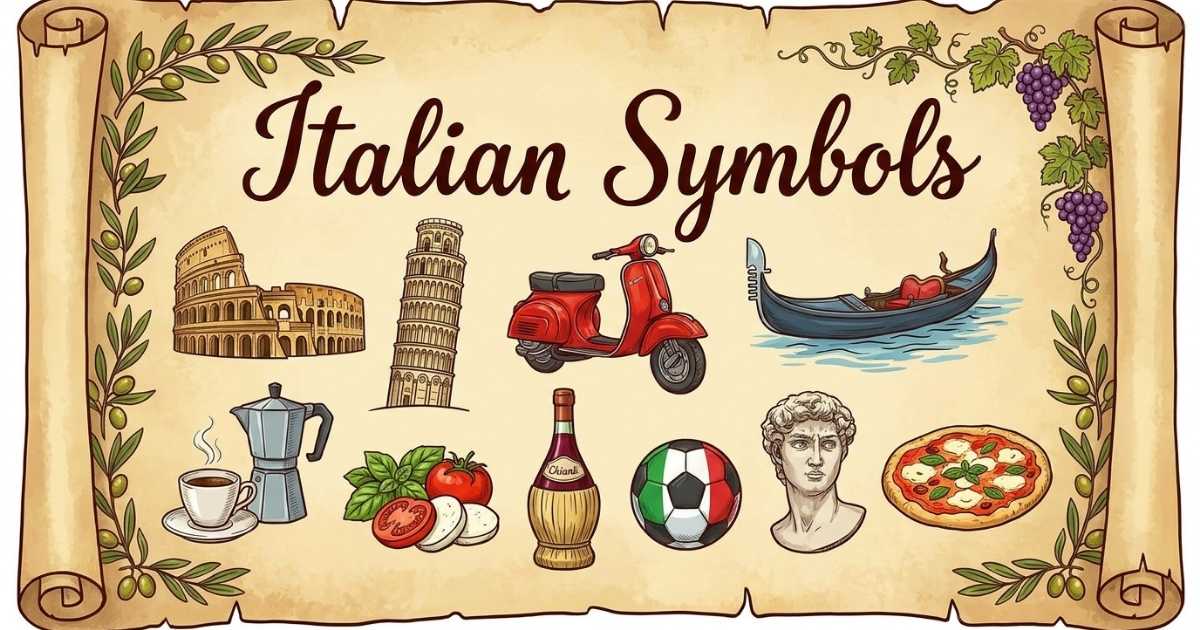

Italy is a country built on symbols. From the deep green, white, and red of its flag to the hand gestures used in daily conversation, every sign tells a story about identity, faith, and history.
This guide breaks down over 100 Italian symbols and meanings in simple, easy to understand sections. You will learn about ancient icons, national emblems, religious signs, and modern tattoo designs.
Whether you are researching your heritage, planning a tattoo, or simply curious about Italian culture, this article gives you accurate, well organized answers backed by history and tradition.
What Are Italian Symbols?
Italian symbols are visual, verbal, or gestural signs that represent the values, history, and identity of Italy and its people. They range from national emblems to regional folklore icons.
These symbols appear in flags, coats of arms, religious art, food, and even everyday hand movements. Each one carries a specific cultural weight passed down through generations.
Understanding Italian symbols helps you appreciate the country beyond tourism. It connects language, geography, and centuries of tradition into one visual vocabulary.
- National symbols: flag, emblem, anthem
- Cultural symbols: hand gestures, folklore icons
- Religious symbols: crosses, saints, rosaries
- Artistic symbols: architecture, sculpture, fashion motifs
Italian Symbols and Meanings
Every Italian symbol carries layered meaning shaped by regional history, religion, and politics. A single image can represent unity in one context and rebellion in another.
The table below summarizes some of the most recognized categories and what they generally represent across Italian culture.
| Symbol Category | General Meaning |
| National emblems | Unity, sovereignty, identity |
| Animal symbols | Strength, protection, heritage |
| Hand gestures | Communication, emphasis, emotion |
| Religious icons | Faith, protection, devotion |
| Family symbols | Loyalty, tradition, belonging |
These meanings are not fixed. Many symbols evolved differently across Italy’s twenty regions, each with its own dialects and local customs.
For example, a symbol tied to protection in Naples may carry a completely different story in Milan or Palermo. Regional pride often shapes how a single icon is interpreted.
This is why researching the origin of a symbol matters, especially before using it in tattoos, branding, or personal jewelry. Context changes meaning significantly.
See Also: God Symbols
The History of Italian Symbols
Italian symbolism dates back to the Etruscan and Roman civilizations, long before Italy became a unified nation in 1861. Early tribes used animals and geometric shapes to mark territory and status.
The Roman Empire introduced eagles, laurel wreaths, and fasces, symbols that still influence modern Italian iconography today. Christianity later layered religious meaning onto many pagan symbols.
During the Renaissance, art and architecture became powerful symbolic tools used by city states like Florence, Venice, and Milan to display wealth and power.
Unification in the 19th century created new national symbols, blending regional pride with a shared Italian identity for the first time in history.
The Risorgimento movement, which led to unification, produced many symbols still used today, including the tricolor flag and patriotic anthems. Leaders like Garibaldi became symbolic figures themselves.
Later, the 20th century brought new political symbols during Fascism, some of which were later rejected after World War II. Modern Italy carefully separates historical symbols from wartime propaganda.
Ancient Italian Symbols
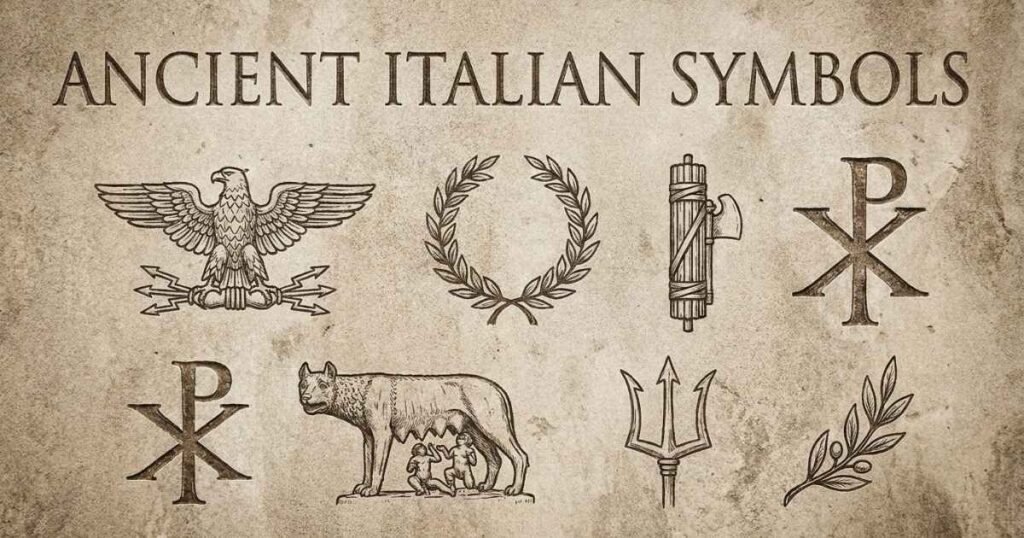
Ancient Italy was shaped by Etruscan, Greek, and Roman civilizations, each contributing lasting symbols still recognized today. These early signs often represented power, protection, or the divine.
Many of these symbols survived through Roman law, mythology, and architecture, later becoming foundational to Italian national identity.
- The Fasces: A bundle of rods symbolizing unity and authority, later adopted by the Roman state
- The Roman Eagle: Represented imperial power and military strength
- The Laurel Wreath: A symbol of victory, honor, and achievement
- She-Wolf of Rome: Represents the legendary founding of Rome by Romulus and Remus
- SPQR: Latin acronym meaning “The Senate and People of Rome,” still used today
These ancient symbols were not decorative. They carried legal, political, and spiritual authority in daily Roman life.
Etruscan tomb art also introduced early animal symbolism, including lions and griffins, which later influenced Roman heraldry. These designs traveled through trade routes across the Mediterranean.
Many ancient symbols were revived during the Renaissance, when scholars rediscovered classical texts and reintroduced Roman iconography into public art and architecture.
National Italian Symbols
National symbols represent Italy as a unified country and are recognized by law or long standing tradition. They appear on government buildings, passports, and official documents.
- The Italian Flag (Il Tricolore): Green, white, and red vertical stripes
- The Emblem of Italy: A five pointed white star on a red gear, flanked by olive and oak branches
- The National Anthem: “Il Canto degli Italiani,” also called “Inno di Mameli”
- The Italian Republic Motto: Unity, freedom, and equality principles from the 1948 constitution
The white star at the center of the national emblem is called the Stellone d’Italia, or “Great Star of Italy.” It has represented the Italian nation since ancient times.
The gear wheel on the emblem was added specifically to represent the working class, reflecting Italy’s identity as a republic founded on labor. This detail is often overlooked by casual observers.
Government buildings across Italy display this emblem prominently, reinforcing a consistent visual identity from Rome to smaller regional capitals.
See Also: Bold Woman Symbols
Famous Italian Symbols
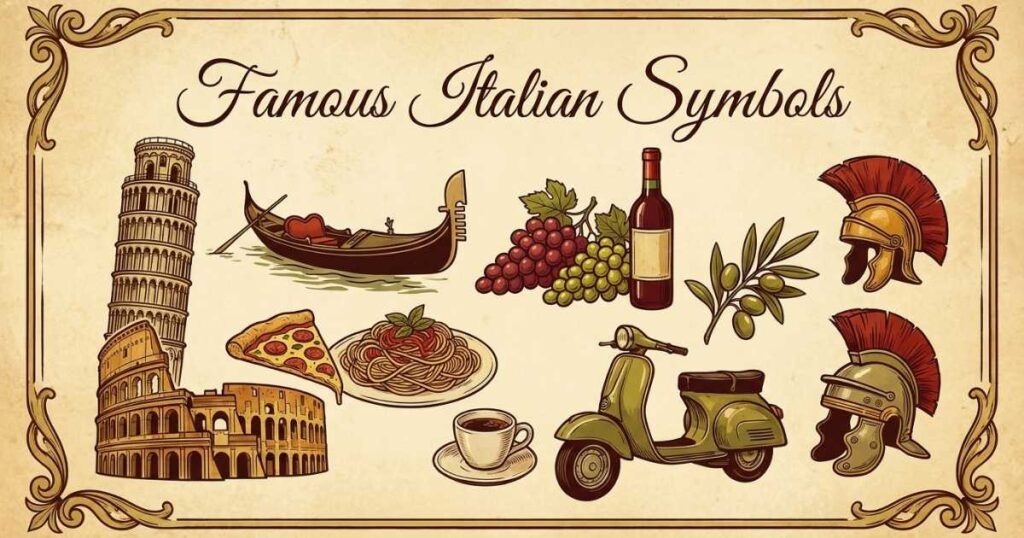
Famous Italian symbols extend beyond government icons into culture, food, and global recognition. These are the images most people associate with Italy worldwide.
Think of the Colosseum, the Leaning Tower of Pisa, or the red, white, and green of a pizza Margherita. These symbols blend history with everyday Italian life.
- The Colosseum, representing Roman engineering and history
- The Vespa scooter, symbolizing postwar Italian freedom and style
- Pizza Margherita, reflecting the colors of the Italian flag
- The Trevi Fountain, symbolizing wishes and Baroque artistry
- Gondolas in Venice, representing romance and tradition
These symbols are globally recognized largely due to tourism, cinema, and Italy’s influence on fashion and design industries.
Hollywood films and international media have amplified many of these images, sometimes simplifying complex history into instantly recognizable visuals for global audiences.
Despite this simplification, each symbol still holds authentic roots in Italian craftsmanship, geography, or centuries old tradition passed down locally.
21 Famous Italian Symbols & Meanings
Below is a detailed list of 21 widely recognized Italian symbols along with their core meanings.
| Symbol | Meaning |
| Italian Flag | National unity and identity |
| Roman Eagle | Power and imperial strength |
| She-Wolf of Rome | Origin and resilience |
| Fasces | Authority and unity |
| Laurel Wreath | Victory and honor |
| Cornicello (horn charm) | Protection from bad luck |
| Mano Cornuta (horned hand) | Warding off evil |
| Fleur de Lis (Florence) | Nobility and regional pride |
| Winged Lion of Venice | Strength and Saint Mark |
| Colosseum | Roman engineering legacy |
| Vespa Scooter | Freedom and postwar recovery |
| Trevi Fountain | Wishes and Baroque art |
| Leaning Tower of Pisa | Architectural resilience |
| Italian Tricolore Ribbon | Patriotism |
| Chef’s Kiss Gesture | Culinary passion |
| Rosary | Catholic devotion |
| Madonna Icon | Maternal protection and faith |
| Olive Branch | Peace and abundance |
| Grapevine | Harvest and hospitality |
| Tarantella Dance Symbolism | Celebration and folklore |
| Sicilian Trinacria | Sicily’s identity and history |
Each of these symbols connects to a specific region, era, or belief system, making Italian symbolism incredibly diverse for one country.
Some, like the Trinacria, remain strongly tied to a single region, while others, like the flag, unite all Italians under one shared visual identity.
Understanding this list helps travelers, designers, and researchers quickly identify the meaning behind commonly seen Italian imagery.
Italian Symbols for Family
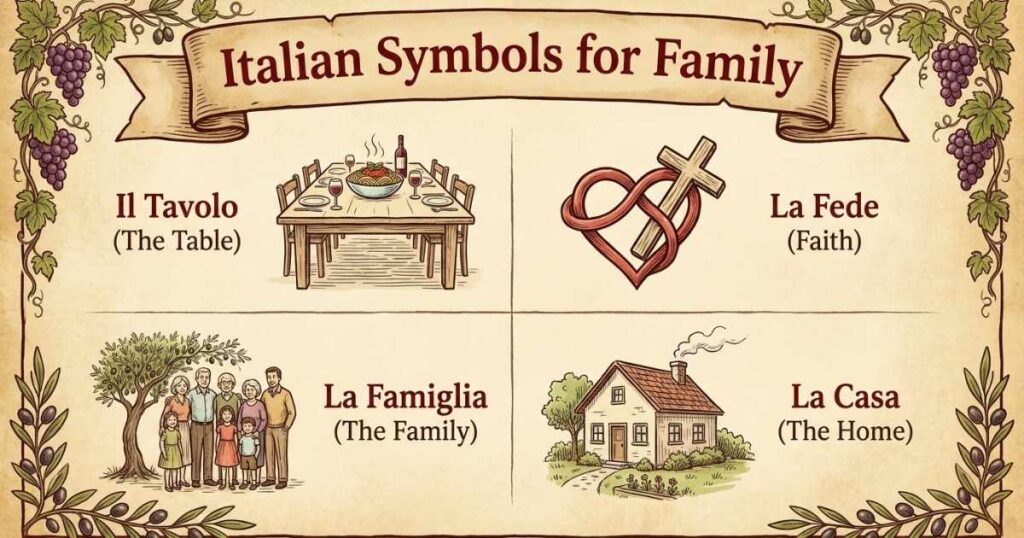
Family, or “la famiglia,” sits at the center of Italian culture, and several symbols reflect this deep bond. These symbols often appear in jewelry, home decor, and tattoos.
The dinner table itself is symbolic in Italian households, representing unity, generosity, and daily connection between generations.
- The Horn (Cornicello): Often gifted to protect family members from misfortune
- The Tree of Life: Represents family roots and generational growth
- Intertwined Rings: Symbolize marriage and family unity
- The Sacred Heart: Represents love, devotion, and protection within the household
- Grapevines and Olive Branches: Represent shared meals and family abundance
These symbols are frequently passed down as heirlooms, reinforcing the idea that family identity is something inherited, not just built.
Godparents in Italian families often gift symbolic jewelry, like a small cornicello or cross, during baptisms as a lasting mark of protection and belonging.
Even Italian surnames themselves function as symbols, often tied to a specific town, trade, or ancestor, carrying identity across generations.
Italian Symbols Hand
Hand gestures are one of the most recognizable parts of Italian communication, often used alongside or instead of words. Italy has one of the richest gesture vocabularies in the world.
Regional differences exist, but many gestures are understood nationwide and even internationally due to Italian cultural influence.
| Gesture | Common Meaning |
| Fingers pinched together, hand shaking | “What do you want?” or frustration |
| Chef’s kiss | Something is excellent |
| Mano Cornuta (horns) | Warding off bad luck |
| Hand slicing under chin | “I don’t care” or dismissal |
| Fingers tapping temple | “Think” or “use your head” |
These gestures are so embedded in daily life that Italians often use them unconsciously during conversation, especially in southern regions.
Linguists have studied Italian gestures extensively, noting that some carry meaning independent of spoken words entirely. A gesture alone can complete a sentence.
Tourists are often encouraged to learn a few basic gestures, since misunderstanding one in casual conversation can occasionally cause confusion or humor.
Italian Symbols Tattoos
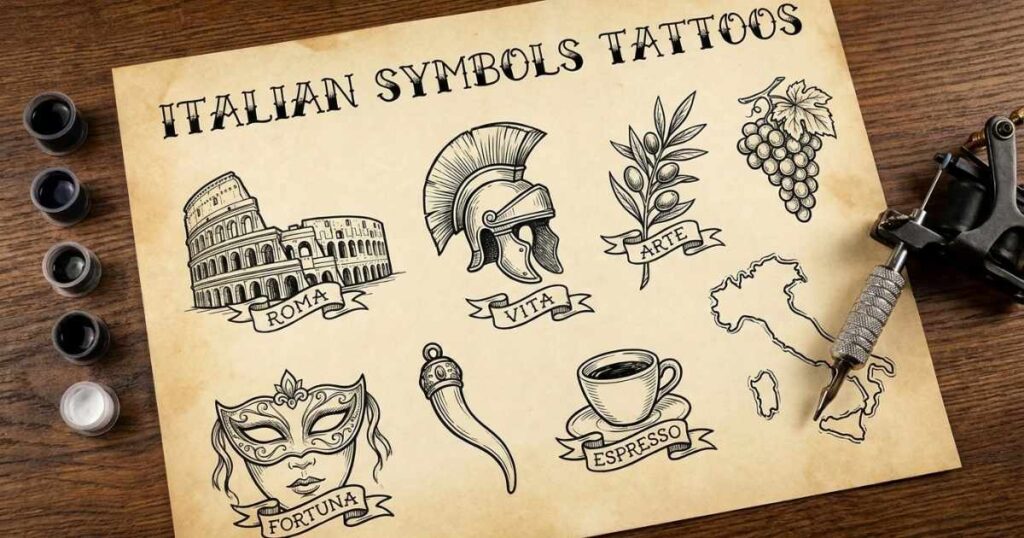
Italian symbol tattoos are popular worldwide, often chosen to represent heritage, family, or personal identity. Many people choose symbols with centuries of meaning behind them.
Before getting a tattoo, it helps to understand the symbolic weight, since some designs carry religious or regional significance.
- Italian Flag Tattoo: Represents national pride and heritage
- Cornicello Tattoo: Popular for protection and good luck
- Roman Numeral Tattoos: Often used for dates or family names
- Winged Lion Tattoo: Common among those with Venetian roots
- Sacred Heart Tattoo: Represents faith and devotion
Many Italian Americans choose tattoos combining the flag with family names, blending national pride with personal history.
Tattoo artists in Italy often recommend researching regional origin before choosing a design, since some symbols are specific to certain cities rather than the whole country.
Placement also carries meaning for some clients, with heart area tattoos symbolizing devotion and forearm designs often representing visible pride.
Italian Flag and National Emblems
The Italian flag, known as Il Tricolore, was first adopted in 1797 and became the official flag of unified Italy in 1861. Its three colors each carry distinct symbolism.
- Green: Represents the country’s plains and hills
- White: Represents the snow capped Alps
- Red: Represents the blood shed during Italy’s wars of independence
The national emblem, adopted in 1948, features a white star, a gear symbolizing labor, and olive and oak branches representing peace and strength. Together, these elements reflect the values of the modern Italian Republic.
Beyond the national flag, many Italian regions maintain their own historic flags and crests, often predating unification by hundreds of years. These regional flags still fly during local festivals.
Cities like Genoa, Pisa, Venice, and Amalfi share a red cross flag known historically as the Flags of the Maritime Republics, symbolizing Italy’s naval history.
Italian Animal and Nature Symbols
Animals and natural elements play a major role in Italian symbolism, often tied to specific cities or historical events. These symbols appear on coats of arms and civic flags.
- The She-Wolf: Represents Rome’s legendary founding
- The Winged Lion: Represents Venice and Saint Mark the Evangelist
- The Eagle: Represents imperial power, still used in some regional crests
- The Dolphin: Common in coastal regions, symbolizing guidance and protection
- Olive Trees: Represent peace, abundance, and Mediterranean heritage
Nature symbols often reflect Italy’s geography, with mountain regions favoring eagles and coastal areas favoring marine imagery.
Volcanic regions like Sicily and Naples also developed symbols tied to Mount Etna and Vesuvius, representing both danger and the fertile land these volcanoes create.
Regional wildlife, such as the Marsican bear in the Abruzzo mountains, has also become a symbol of conservation and natural heritage in modern Italy.
Italian Religious and Cultural Symbols
Catholicism has deeply shaped Italian symbolism, with religious icons appearing in homes, jewelry, and public spaces throughout the country. Vatican City’s influence adds global weight to these symbols.
- The Cross: Represents Christian faith and sacrifice
- The Rosary: Used in prayer, symbolizing devotion
- Madonna and Child: Represents maternal protection and faith
- Patron Saints: Each Italian city has one, symbolizing local identity
- The Papal Keys: Represent spiritual authority tied to the Vatican
Beyond religion, cultural symbols like the tarantella dance and regional festivals represent community, celebration, and shared history.
Feast days dedicated to patron saints often include processions where statues and relics are carried through town streets, reinforcing communal identity and faith.
Even Italian holidays, such as Ferragosto in August, carry symbolic weight tied to rest, family gathering, and centuries old agricultural cycles.
Italian Symbols in Art, Architecture, and Fashion
Italian art and architecture are filled with symbolic meaning, from Renaissance paintings to modern fashion houses. These symbols often communicate power, beauty, or faith.
Michelangelo’s David symbolizes strength and civic pride, while Roman columns represent stability and grandeur across centuries of design.
- Renaissance Art: Symbolizes rebirth of classical knowledge and beauty
- Baroque Architecture: Represents drama, wealth, and religious devotion
- Fashion House Logos: Often incorporate heritage symbols like crests or animals
- Marble Sculptures: Represent permanence and classical ideals
- Mosaic Art: Represents unity created from many individual pieces
Italian fashion brands frequently draw on historical symbolism, turning ancient icons into modern luxury branding.
Brands like Versace use the Medusa head, referencing Greek mythology filtered through Italian artistic tradition, to represent power and timeless beauty.
Architectural symbols also extend into modern Italian design, where clean lines and classical proportions continue to influence global interior and product design trends.
Italian Symbols Copy and Paste
Many people search for Italian symbols to copy and paste into social media bios, messages, or designs. Below are commonly used text based symbols associated with Italy.
- 🇮🇹 Italian flag emoji
- ★ Star symbol, referencing the Stellone d’Italia
- 🍕 Pizza symbol, representing Italian cuisine
- 🍷 Wine glass, representing Italian winemaking tradition
- ⚜ Fleur de lis, associated with Florence
These symbols are widely supported across platforms and can be copied directly without special formatting tools.
Italian Symbol Emojis and Text Symbols
Emojis have become a modern extension of traditional Italian symbolism, often used to represent food, culture, or national pride in digital communication.
| Emoji | Represents |
| 🇮🇹 | Italy, national pride |
| 🍝 | Italian cuisine |
| 🍕 | Pizza, Italian food culture |
| 🤌 | Italian hand gesture, emphasis |
| 🍷 | Wine culture |
| ⛲ | Fountains, Baroque heritage |
| 🏛️ | Roman architecture |
The 🤌 emoji specifically gained global popularity as a direct reference to the classic Italian hand gesture used to express emphasis or frustration.
Frequently Asked Questions
What is the most famous Italian symbol?
The Italian flag, Il Tricolore, is the most recognized national symbol of Italy worldwide.
What does the Italian horn symbol mean?
The cornicello is a horn shaped charm believed to protect the wearer from bad luck and evil.
What animal represents Italy?
The she-wolf represents Rome’s founding, while the eagle represents Roman imperial power historically.
Why do Italians use hand gestures so much?
Hand gestures add emphasis and emotion, forming a nonverbal language deeply rooted in Italian regional culture.
What is the Italian national emblem?
It features a white star, a gear, and olive and oak branches, adopted officially in 1948.
Are Italian symbols the same in every region?
No, many symbols vary by region, reflecting local history, dialects, and civic traditions.
What does the Italian star symbol mean?
Known as the Stellone d’Italia, it has represented Italian identity and guidance since ancient times.
Final Thoughts
Italian symbols carry centuries of history, faith, and cultural pride in every design. From ancient Roman icons to modern emojis, they connect generations across time and geography.
Whether you are exploring your heritage or choosing a meaningful tattoo, understanding these symbols adds depth to your appreciation of Italian identity. Italy’s symbolism remains as vibrant and relevant today as it was thousands of years ago.
Explore More Symbols:

Hi, I’m Ethan Brooks, the admin of SymbolHubz.com. Passionate about symbols, emojis, kaomojis, and text art, helping users discover creative ways to express themselves online.