
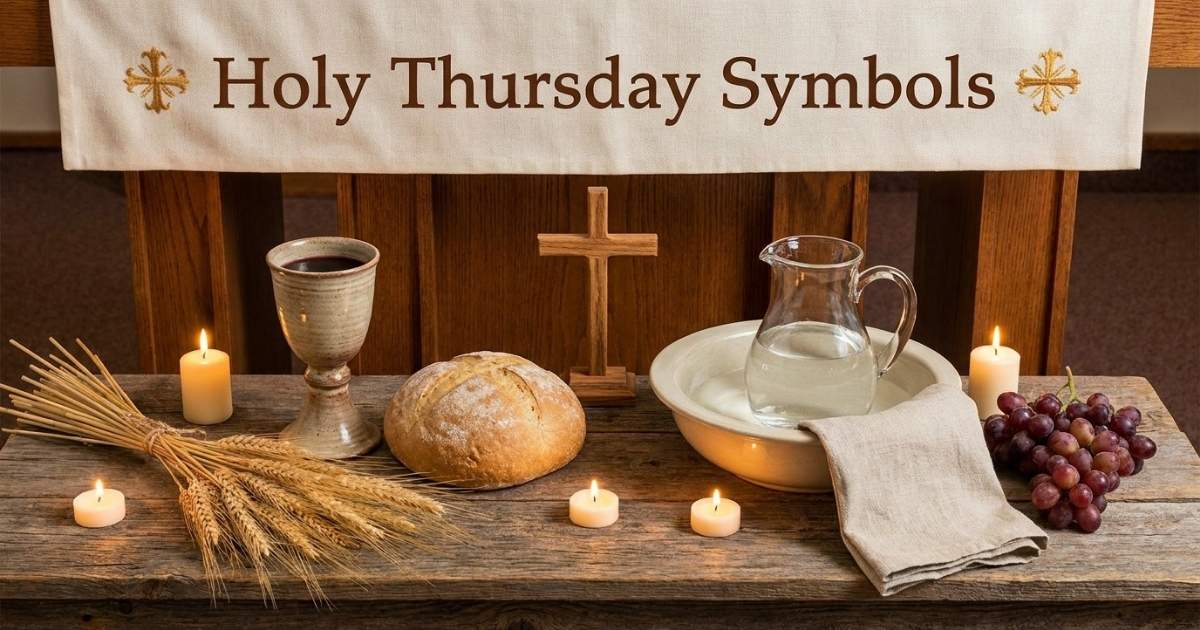

Holy Thursday marks one of the most meaningful days in the Christian calendar. It carries deep symbolism tied to the Last Supper, the washing of feet, and the institution of the Eucharist.
This guide breaks down every major Holy Thursday symbol in simple language. You will find their biblical roots, spiritual meaning, and how different Christian traditions observe them.
Whether you are preparing a homily, a classroom lesson, or your own personal reflection, this article gives you a complete and easy to follow reference.
What Are Holy Thursday Symbols?
Holy Thursday symbols are visual and ritual signs that represent events from the night before Jesus’ crucifixion. They include bread, wine, a basin, a towel, and the color white used in churches.
Each symbol connects worshippers to a specific moment in the Gospel accounts. They are not just decorations, they carry theological weight passed down for nearly 2,000 years.
Churches use these symbols to help people experience the story, not just hear it. This makes worship more personal and memorable.
- Represent servanthood, sacrifice, and covenant
- Rooted directly in Gospel narratives
- Used across Catholic, Orthodox, and Protestant traditions
- Appear in art, liturgy, hymns, and home devotions
Read More Symbol: Mental Health Symbols
Holy Thursday Symbols and Meanings
Below is a detailed table covering more than 105 symbols associated with Holy Thursday. Use it as a quick reference guide for study or teaching purposes.
| Symbol | Meaning |
| Bread | Body of Christ |
| Wine | Blood of Christ |
| Basin | Humility and service |
| Towel | Servant leadership |
| Upper Room | Place of institution of the Eucharist |
| Twelve Apostles | The Church’s foundation |
| Judas’ Betrayal | Sin entering the sacred circle |
| Thirty Pieces of Silver | Cost of betrayal |
| Passover Lamb | Christ as sacrificial offering |
| Unleavened Bread | Purity, absence of sin |
| Bitter Herbs | Suffering of Israel and Christ |
| Cup of Blessing | New Covenant |
| Foot Washing | Humble service |
| White Vestments | Joy and purity |
| Altar Stripping | Abandonment of Christ |
| Tabernacle | Christ’s continued presence |
| Candles | Christ as light |
| Chrism Oil | Anointing and healing |
| Oil of Catechumens | Preparation for baptism |
| Oil of the Sick | Healing grace |
| Holy Thursday Vigil | Watching with Christ |
| Garden of Gethsemane | Agony and prayer |
| Olive Trees | Peace and suffering |
| Kiss of Judas | False loyalty |
| Silver Coins | Greed overtaking loyalty |
| Rooster | Peter’s denial |
| Sword | Human resistance to God’s plan |
| Ear of Malchus | Violence rejected by Christ |
| Empty Tabernacle | Christ’s absence after Mass |
| Chalice | Vessel of the New Covenant |
| Paten | Plate holding the Body of Christ |
| Ciborium | Vessel for consecrated hosts |
| Purple Cloth | Mourning and penance |
| Seven Churches Visitation | Tradition of prayerful visits |
| Watch of the Hours | Solidarity with Christ’s suffering |
| Maundy | Latin root meaning commandment |
| New Commandment | Love one another |
| Sacred Triduum Start | Beginning of Easter’s holiest days |
| Bells Silenced | Mourning and solemn waiting |
| Wooden Cross | Coming sacrifice foretold |
| INRI Sign | Christ’s kingship |
| Crown of Thorns (foreshadowed) | Suffering to come |
| Loaves | Provision and multiplication |
| Fish | Early Christian identity |
| Wine Press | Christ’s suffering |
| Grapevine | Union with Christ |
| Wheat | Unity of believers |
| Millstone | Nourishment turned sacred |
| Water | Cleansing and baptism |
| Linen Towel | Service without pride |
| Sandals Removed | Humility before God |
| Reclining Table | Ancient Passover custom |
| Thirteen Seats | Christ and His apostles |
| Lamp of the Upper Room | Guidance in darkness |
| Broken Bread | Christ’s broken body |
| Poured Wine | Blood poured out |
| Covenant Words | Institution of the Eucharist |
| Hymn After Supper | Worship amid sorrow |
| Mount of Olives | Site of prayer and betrayal |
| Sleeping Disciples | Human weakness |
| Sweat Like Blood | Intensity of Christ’s agony |
| Angel of Comfort | Divine support in suffering |
| Cock Crow | Fulfilled prophecy |
| Courtyard Fire | Peter’s moment of denial |
| Silence of Christ | Submission to God’s will |
| High Priest’s House | Unjust trial |
| Torn Garments | Accusation of blasphemy |
| False Witnesses | Injustice against Christ |
| Guard’s Mockery | Humiliation before crucifixion |
| Empty Altar | Christ’s departure |
| Stripped Church | Desolation before Good Friday |
| Purple Vestments (Lent tie in) | Penitential season |
| White Lily (Easter tie in) | Coming resurrection |
| Green Palm (Holy Week tie in) | Triumphal entry |
| Sackcloth | Repentance |
| Ashes (Lenten tie in) | Mortality and repentance |
| Holy Water Font Covered | Solemnity of the Triduum |
| Processional Cross | Leading toward sacrifice |
| Thurible and Incense | Prayers rising to God |
| Sanctuary Lamp Extinguished | Christ’s physical absence |
| Watch Candles | Vigil with Christ |
| Twelve Loaves | Tribes of Israel represented |
| Broken Seal | End of the old covenant era |
| Golden Chalice | Royal priesthood |
| Simple Wooden Cup | Humility of the meal |
| Reclining Posture | Freedom, not slavery |
| Head Covering Removed | Equality before God |
| Foot Basin Bronze | Ancient hospitality custom |
| Servant’s Robe | Christ taking servant form |
| Girded Waist | Readiness to serve |
| Kneeling Posture | Submission and love |
| Peter’s Protest | Human resistance to grace |
| Full Washing Request | Desire for complete cleansing |
| Clean Feet, Unclean Heart | Inner versus outer purity |
| New Commandment Cloth | Symbol of charity |
| Love Command Banner | Central Christian ethic |
| Silver Trumpet (liturgical use) | Announcement of solemn rites |
| Church Bells Before Silence | Final joyful sound before mourning |
| Gloria Hymn | Last celebratory hymn before Good Friday |
| Tabernacle Veil | Separation and mystery |
| Repository Altar | Place for reserved Eucharist |
| Watching Faithful | Community solidarity |
| Night Vigil Prayers | Spiritual companionship |
| Thirty Silver Coins Returned | Guilt and remorse |
| Field of Blood | Consequence of betrayal |
| Broken Body Imagery | Total self giving |
| Poured Out Life | Total sacrifice |
| Shared Cup | Unity among believers |
| One Loaf | Oneness of the Church |
| Table Fellowship | Inclusion and grace |
The Biblical Meaning of Holy Thursday
Holy Thursday comes from four Gospel accounts: Matthew, Mark, Luke, and John. Each writer highlights a different detail of that final night.
Matthew, Mark, and Luke focus on the bread and wine as the new covenant. John instead centers on the foot washing and Jesus’ final teachings.
Together, these accounts show a night of both intimacy and betrayal. Jesus reveals His deepest love while facing His closest friend’s betrayal.
- Matthew 26 highlights the Passover meal
- Mark 14 records the institution of the Eucharist
- Luke 22 emphasizes the new covenant in His blood
- John 13 centers on humble service and love
This layered narrative gives Holy Thursday its emotional depth. It is a day of joy, sorrow, service, and sacrifice all at once.
Holy Week Symbols and Meanings
Holy Thursday sits within the larger framework of Holy Week. Each day carries its own symbols that build toward Easter Sunday.
Understanding the full week helps place Holy Thursday’s symbols in proper context. It also shows the progression from celebration to crucifixion to resurrection.
| Day | Key Symbol | Meaning |
| Palm Sunday | Palm branches | Triumphant entry |
| Holy Monday | Fig tree | Judgment and faith |
| Holy Tuesday | Oil | Anointing and preparation |
| Spy Wednesday | Silver coins | Betrayal |
| Holy Thursday | Bread and wine | Eucharist and covenant |
| Good Friday | Cross | Sacrifice and death |
| Holy Saturday | Empty tomb | Waiting and hope |
| Easter Sunday | Empty tomb, light | Resurrection |
Holy Thursday acts as the emotional turning point of this week. It moves the story from public ministry into private suffering.
Read More Symbol: Jeep Dashboard Symbols
The History and Origin of Holy Thursday Symbols
Early Christians began commemorating the Last Supper within decades of Christ’s death. Historical records show Eucharistic gatherings as early as the first century.
The foot washing ritual entered formal liturgy by the fourth century in Jerusalem. Pilgrims documented this practice during Holy Week processions.
- Fourth century: Jerusalem church records foot washing rites
- Middle Ages: Chrism Mass becomes standardized in Catholic dioceses
- Reformation era: Protestant traditions reinterpret symbols with less ritual emphasis
- Modern era: Global churches adapt symbols to local culture while keeping core meaning
These practices spread through Rome, Constantinople, and beyond. Regional adaptations emerged, but the core symbols of bread, wine, and service remained constant.
The Last Supper and Eucharist Symbols
The Last Supper introduced the Eucharist as the central Christian sacrament. This meal transformed an ordinary Passover celebration into a lasting act of worship.
Jesus took common elements and gave them new meaning. This act became the foundation for communion services celebrated worldwide today.
- Bread represents Christ’s body given for humanity
- Wine represents His blood poured out for forgiveness
- The shared table represents unity among believers
- The command “do this in remembrance” establishes ongoing practice
Artists have painted this scene more than any other biblical moment. Leonardo da Vinci’s version remains the most recognized depiction in Western culture.
Bread and Wine as Holy Thursday Symbols
Bread and wine form the heart of Holy Thursday’s meaning. They connect the ancient Passover meal to the Christian sacrament of communion.
Unleavened bread specifically ties to the Exodus story. It reminds believers of hurried freedom and purity without corruption.
- Bread: broken to represent Christ’s suffering body
- Wine: poured to represent His sacrificial blood
- Together they form the “new covenant” language from Luke 22
- Consumed in community, never alone in original practice
Many churches still use unleavened bread today to preserve this historical link. Wine, sometimes substituted with grape juice, maintains the symbol of shed blood.
Washing of Feet Symbols and Their Meaning
The washing of feet appears only in John’s Gospel. It stands as one of the most humbling acts recorded of Jesus.
In ancient culture, foot washing was a servant’s task, not a teacher’s. Jesus reversed social expectation to model true leadership.
- Demonstrates servant leadership over authority
- Shows love expressed through humble action
- Establishes a “new commandment” to love one another
- Prepares disciples for a life of service after His departure
Many churches now reenact this ritual on Holy Thursday. Priests, pastors, or leaders wash the feet of congregation members as a living lesson in humility.
The Cross, Basin, and Towel Symbolism
Three simple objects summarize Holy Thursday’s entire message. Together they represent sacrifice, service, and readiness.
The basin holds water for cleansing, echoing baptism themes. The towel, wrapped around the waist, shows willingness to serve without status.
| Object | Symbolic Meaning |
| Cross | Coming sacrifice and atonement |
| Basin | Cleansing and humility |
| Towel | Servanthood and readiness |
The cross is not physically present at the Last Supper but is foreshadowed throughout the meal. It looms over every word Jesus speaks that night.
Holy Thursday Symbols in the Catholic Church
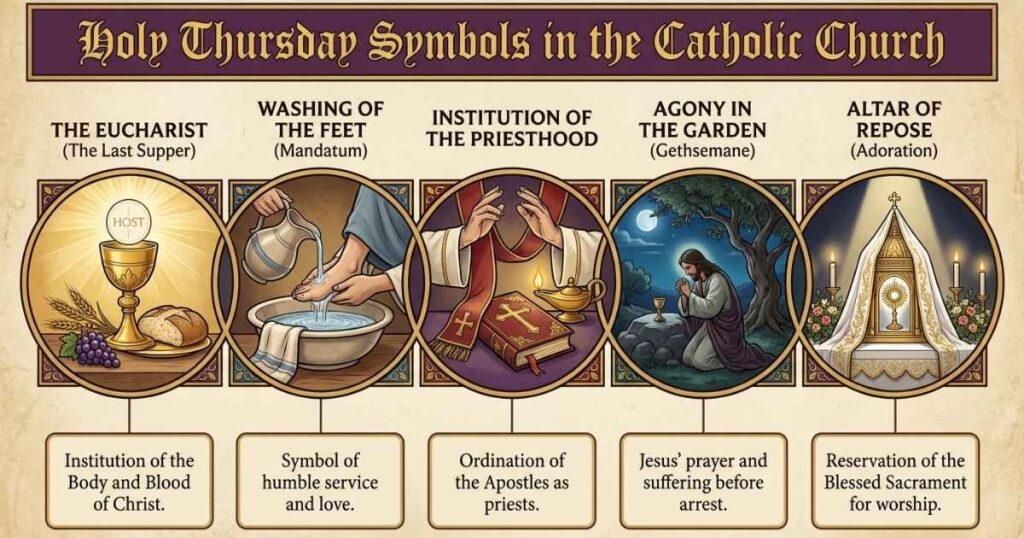
The Catholic Church observes Holy Thursday with the Chrism Mass and the Evening Mass of the Lord’s Supper. Both carry distinct symbolic elements.
The Chrism Mass blesses three types of oil used throughout the year. Priests renew their ordination vows during this service.
- Sacred Chrism used for baptism, confirmation, and ordination
- Oil of Catechumens used to prepare candidates for baptism
- Oil of the Sick used for anointing during illness
- Altar stripped bare after Mass to symbolize abandonment
The Blessed Sacrament is carried to a separate altar called the repository. This procession invites the faithful to keep watch, echoing Christ’s request in Gethsemane.
Maundy Thursday Symbols Explained
The word “Maundy” comes from the Latin “mandatum,” meaning commandment. It refers directly to Christ’s words in John 13:34.
This name emphasizes the ethical command over the ritual meal. It reminds believers that love in action defines true discipleship.
- Mandatum: root word meaning commandment
- New Commandment: love one another as I have loved you
- Foot washing: physical demonstration of that command
- Communion: spiritual nourishment to live out that love
Anglican and Catholic churches commonly use “Maundy Thursday” in official liturgical calendars. The term highlights service as much as sacrifice.
Holy Thursday Symbols Across Different Christian Traditions
Different denominations emphasize different symbols based on theology and history. Understanding these differences helps explain varied worship styles.
Orthodox churches often use unleavened bread and elaborate icons. Protestant churches typically simplify symbols while keeping core meaning intact.
| Tradition | Key Practice | Primary Symbol |
| Roman Catholic | Chrism Mass, foot washing | Bread, wine, oil |
| Eastern Orthodox | Twelve Gospels service | Icons, incense |
| Anglican | Maundy service | Foot washing, communion |
| Lutheran | Communion service | Bread and wine |
| Baptist | Communion, sometimes foot washing | Bread and grape juice |
| Methodist | Love feast tradition | Shared bread |
Despite these differences, nearly all traditions center on the Eucharist and Christ’s example of humble love. The variation lies in ritual style, not theological core.
Holy Thursday Symbols in Art and Christian Culture
Artists across centuries have depicted Holy Thursday scenes to teach and inspire. These works remain some of the most studied pieces in art history.
Leonardo da Vinci’s “The Last Supper” remains the most famous, painted in the 1490s in Milan. It captures the emotional reaction of disciples at the moment of betrayal’s announcement.
- Renaissance art often emphasizes dramatic facial expressions
- Byzantine icons focus on symbolic gold backgrounds and stillness
- Modern art reinterprets the scene with diverse cultural settings
- Stained glass windows commonly depict the foot washing scene
Music also carries these symbols forward through hymns and chants. Compositions like “Ubi Caritas” reflect the love command central to this day.
Holy Thursday Images
Visual imagery helps deepen understanding of Holy Thursday’s meaning. Common images include the Last Supper table, a basin with towel, and a chalice with bread.
Churches often display these images during services or in printed bulletins. They serve as visual reminders of the sacred story being retold.
- The Last Supper table setting
- Basin and towel side by side
- Chalice and paten with bread
- Christ kneeling before a disciple
- Candlelight vigil scenes
- Empty, stripped altar
These images work well for bulletins, presentations, and educational materials. They translate complex theology into simple, memorable pictures.
Holy Thursday Quotes
Scripture and tradition offer powerful words tied to this sacred day. These quotes are commonly used in sermons, reflections, and personal devotion.
- “Do this in remembrance of me.” Luke 22:19
- “A new commandment I give you: Love one another.” John 13:34
- “If I do not wash you, you have no part with me.” John 13:8
- “This is my body, given for you.” Luke 22:19
- “This cup is the new covenant in my blood.” Luke 22:20
These short phrases carry centuries of theological weight. They remain central to liturgy, hymns, and personal prayer during Holy Week.
The Spiritual Meaning of Holy Thursday Symbols
Beyond ritual, these symbols invite personal reflection. They ask believers to consider service, humility, and sacrificial love in daily life.
The foot washing challenges pride. The bread and wine challenge selfishness by pointing toward communal sharing and gratitude.
- Bread and wine call believers to gratitude and unity
- Foot washing calls believers to humble service
- The basin and towel call believers to lead through love
- The stripped altar calls believers to sit with sorrow before joy
Together, these symbols form a spiritual roadmap. They guide believers from celebration through suffering toward eventual resurrection hope.
Frequently Asked Questions
What is the main symbol of Holy Thursday?
Bread and wine are the main symbols, representing Christ’s body and blood shared at the Last Supper.
Why is foot washing important on Holy Thursday?
It demonstrates humble servant leadership and Christ’s new commandment to love one another.
What does the stripped altar represent?
It represents Christ’s abandonment and the solemn mourning before Good Friday.
What is the difference between Holy Thursday and Maundy Thursday?
They refer to the same day. “Maundy” comes from the Latin word for commandment.
Why is the color purple or white used on Holy Thursday?
White represents joy at the Eucharist’s institution, while purple reflects penitential Lenten roots.
What do the twelve apostles symbolize at the Last Supper?
They represent the foundation of the Church and the twelve tribes of Israel.
Is Holy Thursday a fasting day?
Some traditions fast lightly, but the focus is more on solemn reflection than strict fasting rules.
Conclusion
Holy Thursday brings together some of Christianity’s richest symbols in one sacred night. From bread and wine to the basin and towel, each element carries deep meaning rooted in scripture and history.
Understanding these symbols helps believers connect more fully with Holy Week’s story. It also equips teachers, pastors, and writers to explain this day with accuracy and depth.
Use this guide as a lasting reference for study, worship planning, or personal reflection during this sacred season.
Explore More Symbols:

Hi, I’m Ethan Brooks, the admin of SymbolHubz.com. Passionate about symbols, emojis, kaomojis, and text art, helping users discover creative ways to express themselves online.